| New Reply |
Wavelengths of sunlight, blackbody radiators, Planck's law, CCT |
Share Thread | Thread Tools |
| Jan22-13, 11:13 AM | #1 |
|
|
Wavelengths of sunlight, blackbody radiators, Planck's law, CCT
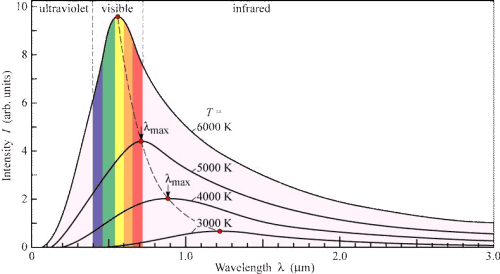
A blackbody radiator emits radiation across the entire radiation spectrum. The "temperature" of the blackbody radiator (measured in kelvin) can be directly calculated from the peak wavelength of its radiation using Wien's displacement law.
![]() At shorter wavelengths, the temperature is higher. Most objects, even stars, are not actually blackbody radiators as predicted in theory, for various reasons. A spectrum of radiation that is not a true blackbody radiator is not described by its actual temperture but by its correlated color temperature (CCT) essentially by the closest blackbody radiator's temperature. My question is in regards to natural daylight which apparently can reach 25,000 kelvin. This is in contrast to the actual temperature of the surface of the sun which is closer to 5,800 kelvin. A high CCT implies the peak wavelength is shorter. I have read unconfirmed assertions that a cloudy day or morning might be closer to 5,800 while a clear bright day might reach a much higher CCT like 25,000. I have read about Rayleigh scattering and other atmospheric effects, but I haven't been able to find resources specifically about the direct impact of these effects on the radiation spectrum of daylight. One person asserted to me that clouds filter out longer wavelengths, but this would imply the highest CCT of daylight is on cloudy days, not sunny days. I tried searching in the astrophysics and earth forums, and I found some tangential threads but nothing directly addressing this. I am not a physicist and my interest in this question arises from photography. Can anyone here explain, or point me to a resource that explains, the mechanics of how the radiation spectrum of daylight can sometimes be at very short wavelengths (and hence have a very high correlated color temperature)? |
| Jan22-13, 02:35 PM | #2 |
|
|
Are you referring to something like this?
http://www.ephotozine.com/article/gu...mperature-4804 The principle is the same although the numbers are somewhat different from yours. Note the author refers to the temperature of 'blue sky'. So this is equivalent to the question "why is the sky blue?" And the answer to that is already in your post. It is because the red light has been removed by the passage of the light through our atmosphere. |
| Jan22-13, 02:46 PM | #3 |
|
|
Thank you for your reply. That's a general photographer's website, I have basically described some of the underlying theory behind some of those ideas. However, the specific reason for why CCTs reach 25,000 in daylight is not really touched in that article. There are a lot of photography websites with articles making assertions like those in that article. None of them seem to really understand the underlying theory and mechanisms. Every photography article has a different assertion about what the peak CCT of daylight is and under what conditions such peak temperature occurs.
Note: I am NOT asking why the sky is blue. I am asking why the wavelengths which penetrate to ground level are primarily blue at certain times of the day (and what mechanism makes the distribution peak at the short wavelengths). |
| Jan22-13, 03:03 PM | #4 |
|
|
Wavelengths of sunlight, blackbody radiators, Planck's law, CCT
If they penetrate to the ground they are not in the sky, n'est ce pas?
The scattered blue light 'bounces around' (that is what scattering is), whilst the longer wavelengths are absorbed by the ground. Hopefully a geo-expert will come in here with asome facts and figures. My explanation was 'qualitative'. |
| Jan23-13, 09:14 AM | #5 |
|
|
In Color and spectral analysis of daylight in southern europe, there is a histogram (see attached) that suggests CCT is uncorrelated with the existence or absence of cloud cover.
Very curious if anyone knows of the atmospheric physics that explains this, or can point me in the right direction. What explains such wide variations in the peak wavelengths of the daylight spectrum? |
| Jan23-13, 08:55 PM | #6 |
|
|
On a cloudy day the clouds scatter ALL wavelengths of light equally, so the spectrum of the sky, which includes the clouds, is made up of all colors, lowering the temperature back towards 5,000-6,000 k. |
| Jan24-13, 12:50 AM | #7 |
|
|
I honestly don't think the conventional wisdom type explanations really explain things, but thanks for giving it a shot.
What doesn't make sense to me is that there is an absolute amount of irradiation received by the earth. Whether the wavelengths spend a little time bouncing around in the atmosphere before falling to the earth, there is still an absolute spectrum radiation coming in from the sun. What I would expect is for the net total radiation reaching the ground to roughly equal the spectrum originating from the sun. Unless wavelengths of light are actually transformed in the atmosphere somehow, and a red wavelength gains energy and becomes a blue wavelength, there is no reason why blue should massively exceed on the ground what is emanating from the sun. I am assuming for the moment that the sun's radiation roughly approximates a blackbody radiator (not 100% but close) and has a smooth warm spectrum around 5800 emanating from its surface. I don't know this for a fact. |
| Jan24-13, 05:18 AM | #8 |
|
|
Figure 5 shows the h0 dependence of CCT for clear and overcast skies. The mean CCT for overcast skies is greater than that for clear skies, as is its variability (for h0 . 10°, the overcasts’ mean CCT exceeds that for clear skies at the 5% significance level). The mean CCT is greater, meaning the wavelengths measured from the sky are longer on average. Keep in mind this is coming from multiple days, not just one, and cloud cover varies significantly. |
| Jan24-13, 08:10 AM | #9 |
|
|
As it indicates, clear skies occur ;3.5 times more frequently in Granada than do overcasts. Yet perhaps surprisingly, Fig. 4 shows only subtle differences in inverse-CCT frequency distributions for these two extreme sky states. So fair enough, the mean CCT for overcast skies is greater, suggesting the cloud scattering mechanism probably plays some role in the process (this is what we are speculating explains it). But the paper also says on the grand scale of things, this is only a "subtle difference". Just analyzing the histogram itself, you can see many high CCT (low inverse-CCT) readings for clear days. Likewise, there are also many low CCT (high inverse-CCT) readings for cloudy days. So this scattering mechanism we're speculating on is only a small part of the story here. Here our SPDs are of hemispheric daylight: global spectral irradiances E(l) on a horizontal surface from direct sunlight (when present) and the entire sky |
| Jan24-13, 05:09 PM | #10 |
|
|
Hold on, if they are getting both the direct sunlight AND the scattered light from the sky, then it makes much more sense to me. There is very little variation in the CCT because overall almost the same amount of light from each wavelength hits the sensor during both the overcast and clear days. Like you said, the wavelength doesn't change. However the variation shown is probably the result of different kinds of absorption from moisture, atmospheric dust, and other related items that change with the weather.
As for the 25k spectrum recorded, consider the following: |
| Jan26-13, 03:32 PM | #11 |
|
|
|
| Jan26-13, 04:06 PM | #12 |
|
|
|
| New Reply |
| Tags |
| atmosphere, blackbody radiation, cct, rayleigh scattering, sunlight |
| Thread Tools | |
Similar Threads for: Wavelengths of sunlight, blackbody radiators, Planck's law, CCT
|
||||
| Thread | Forum | Replies | ||
| planck's blackbody law | Quantum Physics | 2 | ||
| Planck's formula for Blackbody Radiation | Advanced Physics Homework | 14 | ||
| Derive Stefan-Boltzmann Law from Planck Distribution for blackbody radiation | Advanced Physics Homework | 2 | ||
| Planck's law for blackbody | Advanced Physics Homework | 0 | ||
| What main wavelengths are within sunlight (p.s. not a hw problem) | Classical Physics | 7 | ||