ensabah6
- 691
- 0
Given the earlier thread, why not combine diesel with electric motors?
The discussion revolves around the potential advantages and disadvantages of diesel-electric hybrid vehicles compared to gasoline-electric hybrids, focusing on fuel efficiency, emissions, and environmental impact. Participants explore various technical aspects, including engine efficiency and pollution levels, while considering the implications of using biodiesel.
Participants express differing views on the pollution levels of diesel versus gasoline engines, with no consensus reached on whether diesel engines can be considered cleaner or more efficient overall. The discussion remains unresolved regarding the comparative advantages of diesel-electric hybrids versus gasoline-electric hybrids.
Participants reference various studies and emissions data, but there are limitations in the assumptions made about the technologies and their real-world applications. The discussion also touches on the evolving nature of emissions standards and the potential future of biodiesel.
This discussion may be of interest to automotive engineers, environmental scientists, and individuals exploring alternative fuel technologies and their implications for vehicle emissions and efficiency.

http://www.msnbc.msn.com/id/10788292/Diesel hybrid concept car also taps the sun
Ford says all-wheel-drive Reflex can get 65 mpg
Frostfire said:I would almost assure that. Though from everything I've read, a detached diesel motor/generator would be more efficent than a parallel drive design, as a detached generator would let the diesel run at peak efficiency constantly rather than constantly changing rpm and efficiency
Topher925 said:This is called a series hybrid and is the type of hybrid that most hybrid auto manufacturers are now focusing on.
While a diesel based hybrid may get better fuel economy than a gasoline engine, it doesn't necessarily make it better. Diesel engines generate a lot of pollution, which is why they are not very common in the US for commercial vehicles.
Topher925 said:While a diesel based hybrid may get better fuel economy than a gasoline engine, it doesn't necessarily make it better. Diesel engines generate a lot of pollution, which is why they are not very common in the US for commercial vehicles. Gasoline is a much more cleaner burning fuel which is why its most commonly used. Future series hybrid electric/gas cars will probably use stratified ignition engines, or something close to it, to try and take advantage of the benefits the diesel cycle offers, but still using the clean burning fuel, gasoline.
brewnog said:Sorry, this is cobblers. Do you have anything to back up the claim that Diesel engines "generate a lot of pollution"? Have you actually even compared a modern gasoline engine with its Diesel counterpart, in terms of brake specific NOx/CO/HC/PM/CO2 emissions, or do you just think "old lorries make smoke, so all Diesel engines must be terrible"?
http://www.hybridcenter.org/hybrid-watchdog-hybrid-vs-diesel.htmlMost of today’s hybrids and even some conventional gasoline vehicles are considerably cleaner...
...it takes about 25% more oil to make a gallon of diesel fuel than a gallon of gasoline, so we should really look at how a vehicle does on fuel efficiency in terms of "oil equivalents."
...when it comes to smog-forming pollutants and toxic particulate matter, also known as soot, today's diesels are still a lot dirtier than the average gasoline car.
US tailpipe standards for diesel cars, which have historically been weaker than those for gasoline cars, are being updated to force diesel and gasoline vehicles to meet the same set of emissions standards. The tiered structure of the new "Tier 2" standards, however, allows automakers to produce some cars that release two times more soot and smog-forming pollution than the average new vehicle and still meet their targets. Also, until the standards are fully implemented in 2009, existing loopholes allow some cars to pollute even more.
http://www.grinningplanet.com/2005/04-12/diesel-vs-gasoline-article.htmMaking a gallon of diesel fuel requires 25% more oil and emits 17% more heat-trapping greenhouse gases than gasoline reformulated with MTBE. Similarly, diesel requires 17% more oil and emits 18% more heat-trapping gases than gasoline reformulated with ethanol. This means that diesel fuel's advantages from its higher per-gallon energy content and better performance on greenhouse gases are partially offset by the impact of diesel's fuel-production process.
http://www.cicero.uio.no/fulltext/index_e.aspx?id=6871We know from before that passenger cars with diesel engines emit, depending on their condition, about 20 percent less of the greenhouse gas carbon dioxide (CO2) per kilometer than the same car type with gasoline engines. However, besides CO2, the exhaust contains a number of other components such as nitrogen oxide (NOx), carbon monoxide (CO), and particles. With the exception of CO, emissions of these components are generally higher from diesel cars, and lead to lower air quality and negative health effects.
Ivan Seeking said:Assuming Exxon et al manage to produce biodiesel from algae [$600 million recently invested by Exxon alone], diesel CO2 emissions would be reduced to near zero. Also, biodiesel contains no sulfur.
http://www.ucsusa.org/clean_vehicles/technologies_and_fuels/biofuels/biodiesel-basics.html#Biodiesel_versus_gasoline_in_cars_and_libut diesel still has a long way to go to match the emissions performance of the many fuel-efficient conventional and hybrid electric gasoline-powered vehicles on the road today.
ensabah6 said:Given the earlier thread, why not combine diesel with electric motors?

Topher925 said:Biodiesel is still far from reality.
Even so, diesel engines whether biodiesel or not, still generate pollutants. Yes there is less CO2
.. but there's also plenty of CO, NOx, HC, etc. But if biodiesel creates less of the pollutants than gasoline, I don't know, I've heard mixed information. Do you have any info on this?
EDIT: Some good info about biodiesel,
http://www.ucsusa.org/clean_vehicles/technologies_and_fuels/biofuels/biodiesel-basics.html#Biodiesel_versus_gasoline_in_cars_and_li
Topher, after citing http://www.cicero.uio.no/fulltext/index_e.aspx?id=6871":Topher925 said:No it isn't. Yes I do. Yes, and no I don't. A simple google search reveals lots of info about how gasoline is cleaner than diesel...
[...]
If I'm missing something or don't know of some technological breakthrough that has made this possible please enlighten me.
one can see your first blanket answer to the OP's query about gasoline versus diesel pollutants in this engineering forum was incorrect on a per km distance for CO2 and CO. It is known that Bio-diesel burns cleaner than petrol diesel. Brownog also drew your intention to the new Tier 2 bin 5 EPA standards, which reduce particulates to nearly nothing.Cicero article said:[...]We know from before that passenger cars with diesel engines emit, depending on their condition, about 20 percent less of the greenhouse gas carbon dioxide (CO2) per kilometer than the same car type with gasoline engines. However, besides CO2, the exhaust contains a number of other components such as nitrogen oxide (NOx), carbon monoxide (CO), and particles. With the exception of CO, emissions of these components are generally higher from diesel cars, and lead to lower air quality and negative health effects.
Topher925, are you really standing by your link which holds...
Not true. Biodiesel is in common use now.
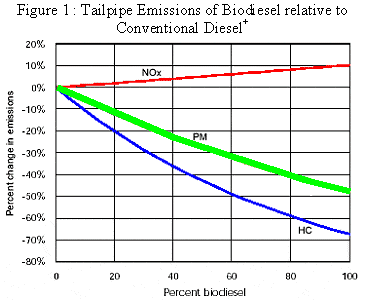
Biodiesel is notoriously low in emissions, less NOx emission, which are a bit higher than petrodiesel.
mheslep said:Topher, after citing http://www.cicero.uio.no/fulltext/index_e.aspx?id=6871":
one can see your first blanket answer to the OP's query about gasoline versus diesel pollutants in this engineering forum was incorrect on a per km distance for CO2 and CO. It is known that Bio-diesel burns cleaner than petrol diesel. Brownog also drew your intention to the new Tier 2 bin 5 EPA standards, which reduce particulates to nearly nothing.
Meaning what, that neither CO2 nor CO are pollution? In post 3 you made the blanket statementTopher925 said:I'm sorry, I don't understand your logic? I never stated that diesels produced more CO2 or CO,
[my highlights]Without attaching a qualification that assertion is incorrect. The truth is the pollution profile, diesel vs gasoline, is mixed for unit of energy delivered. Also, this considers only the gasses at the point where they are exhausted directly from the cylinder. Post processing in the most recent engines might change the mix decidedly in favor of diesel, I dunno.post 3 said:Diesel engines generate a lot of pollution, which is why they are not very common in the US for commercial vehicles. Gasoline is a much more cleaner burning fuel which is why its most commonly used.
Look, I could point to those same sources and naively make the reverse statement because I happened to focus only on CO2 and CO in favor of diesel.I merely stated that diesels produce more pollution than their gasoline counterparts, which according to my sources they do. I have seen no information that suggests otherwise.
Topher925 said:No. I'm not familiar with the politics, but only the science of how thermal engines work.
Well said, as are the CO2 emissions, the benzene emissions, etc (lower, not necessarily half)brewnog said:I could just as easily claim that Diesel is "cleaner" because the CO emission limits now are half for Diesel what they are for gasoline. ...
I had hoped that the preceding posts would have prompted more careful sourced based statements, and less sweeping claims with no sources. Anyway:mgb_phys said:Modern diesel engines are pretty much as clean as gasoline.
Clearly, the new environmental standards (EPA and EU) require greatly reduced PM emissions over a decade ago. That's still a long way from asserting diesel PM is "about the same as gasoline." Can you verify that?They produce less CO2 and you get more miles/gallon, PM are about the same as gasoline although there is a concern that the mix of particle sizes produced by diesels is more harmful.
Smaller but not lighter weight that I can see. That high compression comes with a weight cost, and thus a $ cost. Observe that we do not see diesel back pack leaf blowers, or diesel push lawn mowers.A plus of diesel for hybrids is that you can make very efficient small diesels - the original european version of the smart car had a 800cc diesel. Diesels are also simpler and you can turn them off and restart them with less loss of efficiency than a gasoline engine.
How? More letters in the name?xxChrisxx said:The below is a mix of fact and my not so humble opinion.
Modern TurboDiesel engines > Modern Petrol engines
http://www.euractiv.com/en/transport/euro-5-emissions-standards-cars/article-133325mheslep said:That's still a long way from asserting diesel PM is "about the same as gasoline." Can you verify that?
But negligible weight difference for a car, you don't see 4stroke leaf blowers with cats either.Smaller but not lighter weight that I can see. That high compression comes with a weight cost, and thus a $ cost. Observe that we do not see diesel back pack leaf blowers, or diesel push lawn mowers.
Yes I was aware that the regulations for each had come roughly into line from an earlier EPA reference; that doesn't necessarily mean diesel matches gasoline PM emissions; gasoline may much less than the regulation.mgb_phys said:http://www.euractiv.com/en/transport/euro-5-emissions-standards-cars/article-133325
The 2009 euro5 regs requires diesels to have the same PM emissions as gasoline
Merc and VW both have diesels in the US that already beat the Euro5 specs.
mheslep said:Smaller but not lighter weight that I can see. That high compression comes with a weight cost, and thus a $ cost. Observe that we do not see diesel back pack leaf blowers, or diesel push lawn mowers.
Existing example?dr dodge said:technically the glow plug RC engine is a 2 cycle diesel, and it is the lightest/hp IC engine available.
cheap to manufacture, robust. with some minor "improvements" it would probably run a leave blower cleaner than a conventional 2 cycle. not specifically cleaner, but still a tiny diesel in a lightwieght package
dr
Then I wonder why we don't they see inroads for lawn mowers and leaf blowers?Mech_Engineer said:He's correct that most R/C engines are compression ignition, which technically makes them a 2-stroke diesel cycle engine (although they use a nitro-methanol mix for fuel rather than diesel fuel). They also have excellent power-per-weight and power-per-displacement ratings due to their very high operating speeds (30,000+ rpms) (although they don't run very cleanly, and I wouldn't call them reliable).
One example would be this engine (considered a big block in the R/C world): http://www3.towerhobbies.com/cgi-bin/wti0001p?&I=LXLGH6&P=0". It's a nitro engine (meaning it runs on a mix of methanol and nitromethane, and is compresison ignition with a glow plug), 0.298in^3 displacement (5.0cc), 36,000rpm redline.
Displacement: 0.298 cu in (5.0cc)
Bore: 0.728" (18.5mm)
Stroke: 0.717" (18.2mm)
Practical RPM: 4,000-36,000
Power Output: 3.0 ps/28,000 RPM
Weight: 12.7oz (360g)
This results in 600hp/l, and 8.33 hp/kg. I would not be surprised if engines in this market are higher output pound for pound than any other naturally aspirated engine (other than possibly Formula 1 and turbine engines). It's basically all about engine speed.
Mech_Engineer said:He's correct that most R/C engines are compression ignition,