| New Reply |
Earth rotation rate |
Share Thread |
| Oct7-09, 08:21 AM | #1 |
|
|
Earth rotation rate
The (long term) EARTH ROTATION RATE can be in one of 3 states:
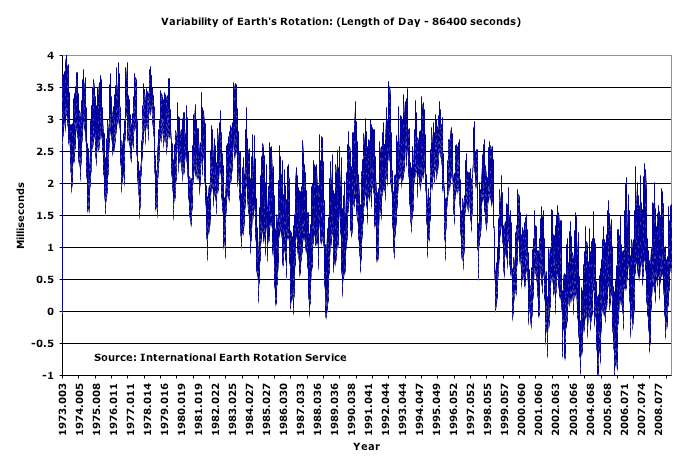
STABLE : as the Earth is a dynamical system it is unlikely SLOWING : as we can find this is the general information available and corresponds to the science mainstream public position example here : http://tycho.usno.navy.mil/leapsec.html @ "Time Service Dept., U.S. Naval Observatory, Washington, DC " "The aged Earth is slowing down in its daily rotation, at least in the current epoch. " the same is here and full of acceptable references and here at http://en.wikipedia.org/wiki/Leap_second and here at http://en.wikipedia.org/wiki/Earth_rotation ACCELERATING : example here : http://tycho.usno.navy.mil/leapsec.html see the graph that asserts that it is accelerating ![]() and we can further investigate at the source of the graph ("International Earth Rotation Service") to see if it is mirrored by mistake, but no, it is not a mistake. the graph clearly says that the Earth is accelerating the rotation rate: by year 1973 the LOD (Length of day was aprox as 86400.0030 sec by year 1994 the LOD (Length of day was aprox as 86400.0025 sec by year 2005 the LOD (Length of day was aprox as 86400.0005 sec i.e. in order to perform one rotation in less time (uniform time measure) the Earth must accelerate the rotation, or else the logic is a potato (portuguese expression) We have been kept misinformed, scientiffically. (this post is at the debunk forum, preciselly) |
| Oct7-09, 08:59 AM | #2 |
|
Recognitions:
|
In general over a long period of time the Earth's rotation is slowing due to tidal friction with the moon. there are also periodic effects caused by interactions with other planets.
On a short timescale the behaviour is more chaotic, events like earthquakes, volcanoes and even changes in patterns of snow fall can change the rotation rate very slightly. |
| Oct7-09, 10:29 AM | #3 |
|
|
But more than 30 years of precise mesures, as anyone can see, contradicts the expected and theorized and the myth: "The aged Earth is slowing down in its daily rotation, at least in the current epoch. " The graph image clearly states "is accelerating". At glance, the graph show three regimes: 1st, and more important, an aprox. constant rate acceleration, 2nd an aprox. 18 years period sine-wave motif 3rd a short period (perhaps a 6 months period) motif 4th some glitches, from time to time A statistical package and the original data can give a more correct decomposition that the one that I present but, for sure, the general trend is toward "ACCELERATING". Trying to maintain that the Earth is slowing the rotation rate is unsupported by the actual measures (more precise than ever). I'm prepared to read : "The Earth is accelerating and we dont know why ". |
| Oct7-09, 12:30 PM | #4 |
|
Mentor
|
Earth rotation rateHere is a slightly longer term plot of the variation in length of day: ![]() Source: http://www.iers.org/MainDisp.csl?pid=95-97Extending this chart back over hundreds of millions of years and the trend would be purely upward. Even the large variations caused by ice ages are just noise on a hundred million year time scale. On a long enough time scale, the only visible trend will be that due to the monotonic transfer of angular momentum from the Earth's rotation to the Moon's orbit. Note well: Angular velocity and angular momentum are different things. The transfer of angular momentum to the Moon's orbit is a slow process. Over short periods of time (thirty years is a very short period of time), periodic changes in the distribution of the Earth's mass and angular momentum will temporarily dominate over this secular trend. These short term effects include annual changes in the atmosphere and multi-year changes in the rotation of the Earth's core. Even longer term, ice ages have a large effect as mass is transferred toward/away from the equator. |
| Oct7-09, 01:18 PM | #5 |
|
|
Let's be clear that we don't "debunk" mainstream science. If that is your intent, then let me know so that I can delete the thread.
You are welcome to ask questions about science that you don't understand. Moving to Earth Sciences. |
| Oct7-09, 04:49 PM | #6 |
|
Mentor
|
Or: 30 years is far too short a time to measure a phenomena that only affects the rotation of the earth by 1 second every 45,000 years. |
| Oct7-09, 04:51 PM | #7 |
|
|
I don't think there isn't anything to debunk. In addition to the already mentioned factors affecting lenght of day, the internal dynamic mass distribution and changing shape of the earth constantly changes Earth's angular momentum.
See: http://www.sciencemag.org/cgi/conten...t/297/5582/831 some explanation: http://www.space.com/scienceastronom...ge_020801.html That will likely have a significant impact on length of day. |
| Nov12-09, 06:48 AM | #8 |
|
|
No, No, No to this
from http://en.wikipedia.org/wiki/Angular_momentum Angular momentum is conserved in a system where there is no net external torque, and its conservation helps explain many diverse phenomena. For example, the increase in rotational speed of a spinning figure skater as the skater's arms are contracted is a consequence of conservation of angular momentum Only external forces (tidal forces,..) can change the angular momentum. Of theese forces are in presence but can not account for an acceleration, only part of the deceleration. This fact puts more pressure in the validity of what I'm saying: the acceleration component dominates. In the graph it is marked the trend of the evolution of LOD. As I say the earth is accelerationg the rotation because it is in the measures as graphed. Is there a problem with the referential that was used ? Is it moving ? It is not the case. Even if I were the only one to say that. The gyroscope Earth after 11000 turns (30y) says : The day is shorter and shorter so ..I'm spinning faster! The Leap seconds have been introduced under the saying ' the Earth is slowing...then from time to time we have to introduce an extra second'. This is a mistake, and a lie because if we put the dates of the leap-seconds in this graph we can clearly see that is a contradiction between the sayings and the facts. NASA says "currently the secular change in the rotation rate increases the length of day by some 2.3 milliseconds per day per century." and UNSO/NAVY says 1.4 ms per day increase... 2.3 quite different of 1.4 Am I the only one that, reading the graph, can say that the Earth is accelerating? And no theory says why the Earth is spinning faster. And no theory can explain this "data indicate that the AU is increasing by about 15 centimeters per year" and this "Increase in the eccentricity of the Moon's orbit ... After accounting for tides on the Earth that produce an eccentricity change of 1.3 ...... and tides on the Moon that produce a change of -0.6 ...... there is an anomalous ... extra 3.5 mm/yr distance (Williams & Boggs 2009). (**)" refs inside arxiv.org/abs/0907.2469: Astrometric Solar-System Anomalies It may be the fact that those findings are correlated by theory (*) (*) I do know one theory that says so, even before it was actually measured. Yes it says 'Earth is spinning faster', Earth is moving away from Sun, Moon is moving away from Earth, and it is curious that we are actually measuring things like that. (**) I can we trust the LOD (Length of Day) calculated to the past centuries by eclipses (it is the main basis that sustain the calculations) if the extra 3.5 mm/yr increase in the Noon-Earth distance accounts for large errors that where not known by the time of the calculations? I wonder why, as a colective, we are unable to read a simple graph? Can we simply look into the picture and say: The day is shortening and Earth is accelerating the rotation, not slowing. |
| Nov12-09, 08:39 AM | #9 |
|
Mentor
|
For everyone else, heldervelez referred to a paper at arxiv that discusses four anomalies. The Pioneer anomaly remains an enigma. The flyby anomaly, maybe not. This paper was written well after multiple people pointed out that the flyby anomaly might be nothing more than a math error. Regarding the increase in the AU, the paper contains this *huge* error: However, rather than increasing, the AU should be decreasing, mainly as a result of loss of mass to solar radiation, and to a much lesser extent to the solar wind.This is bass-ackwards. If the sun's mass is decreasing (which it is), the astronomical unit must correspondingly be increasing (which it is) to conserve orbital angular momentum. The only anomaly here is a complete misunderstanding by the authors of the paper of the relevant dynamics. Finally, regarding the Moon, the paper, and the paper it references, do not contradict the notion that the Moon is receding. The anomaly (anomaly in the sense of "currently unexplainable behavior") is in the Moon's eccentricity, not its semi-major axis length. |
| Nov12-09, 09:52 AM | #10 |
|
Mentor
|
The explanation of the difference between NASA's (actually, IERS's) number, 2.3 milliseconds per day, and USNO's value of 1.4 milliseconds per day, and the very decrease in length of day is simple: Timescale. The IERS number is based on 200 or years worth of accurate time keeping. One solar day is currently more than 86,400 seconds long. Our second is based on the length of day in the early 1800s, when one solar day was 86,400 seconds long. The USNO number is using historical records of eclipses to go even further back into time. Different time scales yields different values. *Nobody* worth their salt claims that length of day changes at a constant. So, what does cause a change in length of day? Broadly speaking, this can be split into two categories
Losses in the Earth's total angular momentum If the Earth was an isolated system its angular momentum would be constant. The Earth is not an isolated system. It loses rotational angular momentum due to tidal interactions with the Moon. We know this is the case because, among other things
Those long-term records are very telling. The other influences on the length of day are periodic rather than secular. Only a secular trend can explain why a day was, for example, 21.9 hours long 620 million years ago. Transfer of angular momentum to the Moon is by far the source of this secular trend. Short-term variations in length of day Note well: Tens of thousands of years is a short time geologically. Length of day changes slowly due to transfer of angular momentum to the Moon. Length of day also varies in the short term due to other causes. These other causes, however, cannot explain a secular drift. Amongst these other causes are
|
| Nov12-09, 09:55 AM | #11 |
|
|
Mr D.H the papper I've pointed is not the main question here.
I'd a problem like you and said to myself: 'I do not understand why .. this apparent lack of logic, and I will study this latter. Certainly I will look better and try to understand. I will start with Gauss constant, revisit Keppler laws, the AU definition, etc ... Look the credentials of the fellows of the papper- John D. Anderson and Michael Martin Nieto (*) , eccentricity is a ratio but the mention is DISTANCE, quoting "also equivalent to an extra 3.5 mm/yr in perigee and apogee distances (Williams & Boggs 2009)" But this value of extra 3.5 mm/year in Moon-Earth distance was already known. What I dindnt know, until now, is the increase in the Sun-Earth distance. There are a lot of points in my previous post that you can disagree, ... instead of just saying 'nonsense'. Much easyer than spot 'obvious' errors on those fellows from NASA is,... lets try..., say with me, looking to that official graph, that the Earth is accelerating the rate of rotation. The chart is so easy,... try to look to the graph. I can post here the numbers that say the same. But if we, educated people, can not read a simple graph how can we expect ...to comunicate ? It would be nonsence. (*) Jet Propulsion Laboratory (Retired) and Theoretical Division (MS-B285), Los Alamos National Laboratory |
| Nov12-09, 10:53 AM | #12 |
|
Mentor
|
|
| Nov12-09, 01:57 PM | #13 |
|
|
is well explained Mr D_H, we can see it here:
and quoting "In 2004, an analysis of radiometric measurements in the inner Solar System suggested that the secular increase in the unit distance was much larger than can be accounted for by solar radiation, +15±4 metres per century.[21] Later estimates based on both radiometric and angular observations lowered this estimate to +7±2 metres per century,[22] but this is still far larger than can be accounted for by solar radiation and current theories of gravitation.[23] The possible variation in the gravitational constant based on radiometric measurements is of the order of parts in 10^12 per century, or lower.[24] It has been suggested that the observed increase could be explained by the Dvali–Gabadadze–Porrati multi-dimensional braneworld scenario (possibly DGP model).[25]" And I agree that "multi-dimensional braneworld scenario" can be anything, for instance: "we dont know" or "its magical thinking". The papper that I've pointed I believe it is a confirmation of values in this one G.A. KRASINSKY and V.A. BRUMBERG (2004) About counting the time flow (seconds), we dont have a uniform tic-tac before the 60s or 50s of XX century. The Chronometer is recent +- y1760 and the precision was +-6s a day. The time keeping was done using the planets (Jupiter moons, Moon, Sun, pendulum) but with a poor precision. When a solar eclipse happened before the expected time, we can thing on three scenarios: The Earth is rotating slower; The Moon is accelerating the translation motion, or both. The 1st scenario was choosen. When we try to maintain that the tabulated values of the LOD are effectively as we have been told, for such that long and anciant period, I suspect. googling for 'metrologia leapsecond' we will find this papperThe leap second: its history and possible future reading that and trying to account the efforts to resync solar day by a uniform clock along XX century, I think that it is close to a second, each year. And the fact that the calcs about eclipses (as far as 2000 years ago) were done disregarding the change on the Moon Earth distance, is a no-go. The error is much greater then the needed precision. Only recently we are using a stable tic-tac (VLBI measures of distant pulsars) and it is only with a stable time referential that we can account. In the past we measured time differences and can only say: something changed, this, or that. I am aware of the several 'why' the Earth must be slowing, but no mechanism is provided to explain the observed acceleration on the Earth rotation. Also it is absolutelly unlogical the saying 'the leap seconds have beeing introduced because of the slowing ..." just because in the timeframe were applyed the Earth was not slowing. Too much 'unexplained and unexpected' variations, all of the same sign, can say something. And yes, the Earth is NOT slowing the rate of the rotation, as the graph says. A wall of silence surrounds the inconvenient truth that is inscript into the data. |
| Nov18-09, 05:58 PM | #14 |
|
|
Hello Heldervelez. A quote from the US Navy Military site as per your initial post:
Note that every year, the rate of rotation slows for (the greater) part of the year and speeds up for a lesser part of the year. Why do you think this is? It is due to differential behaviour of the north and south poles during the year, as they alternatively enter winter and summer and the (more rigid) mass of sea ice replaces the surface of Arctic or Antarctic oceans. There is a differential torque between the poles, and differently behaving ocean tides. Winds and polar jet streams move north and south and encounter different mountain ranges at different velocities during different seasons, and the angular momentum of the atmosphere is transferred to the solid earth. Weather and climate patterns shift, creating fears of global warming or cooling, and the earth responds by minutely changing it's rate of rotation. Even the thickness of the denser parts of the polar atmosphere draws in to lower altitudes, bringing the stratosphere closer to the surface at some times. Sometimes the equatorial Pacific Ocean experiences warming (El Niño) or cooling (La Niña) which allows relatively dense or less dense masses of water to slow or speed up the rotation rate (at the equator where the effect is greatest) as a ballerina does by withdrawing or extending her arms to control her rate of spin. However, the tidal bulge does not stop from day to day and the slow transfer of angular momentum in the earth-moon system, from the earth to the moon will continue as long as there remains fluid matter on the earth, until the moon and earth become tidally locked. When this happens, the moon's orbit will stop increasing, the earth and moon will always present the same face to each other, and the length of day will be equal to the length of the month. When will this happen? - it is calculable but there are many uncertainties - the rate of accretion of matter from the solar system, comets, meteorites etc., for example. If you attempt to calculate in the other direction there are also problems - when did the moon start orbiting the earth - by using the known rates of day length change over historical, prehistoric and palaeontological periods, it seems that somewhere about 2 billion years is the answer, which conflicts with the dating of moon rock samples at about 4.5 billion years. A very interesting professor, Walter Munk, from The Scripps Institute of Oceanography did the calculation in part 8 of: this paper Try to avoid the maths and read some of Munks rather humorous commentary. |
| Mar29-11, 10:04 AM | #15 |
|
|
I'm not a physicist, nor mathematician...
How fast was the earth spinning 100,000,000 years ago? |
| New Reply |
| Tags |
| earth rotation rate, lod, science myth |
Similar discussions for: Earth rotation rate
|
||||
| Thread | Forum | Replies | ||
| Rotation of earth and weight of an object on the earth | Classical Physics | 8 | ||
| Rate of Rotation of a Pendulum | Introductory Physics Homework | 2 | ||
| What is the RATE of Rotation! help!!!!! | Introductory Physics Homework | 14 | ||
| Earth Rotation | Introductory Physics Homework | 4 | ||
| rotation of earth | General Astronomy | 5 | ||