| Thread Closed |
Do Low Interest Rates Really Help The Economy? |
Share Thread | Thread Tools |
| Aug2-10, 10:46 PM | #1 |
|
Blog Entries: 3
|
Do Low Interest Rates Really Help The Economy?
The theory goes that lowering interest rates allows people to borrow more and this stimulates consumption. However, as I mentioned in another thread low interest rates allow people to hold onto non perishable goods longer. The consequences is a surplus of vacant houses and excess inventory. Consumption is primary driven by both the quantity and quality of employment. Any changes in consumption which result from changes in debt burden are purely transitory.
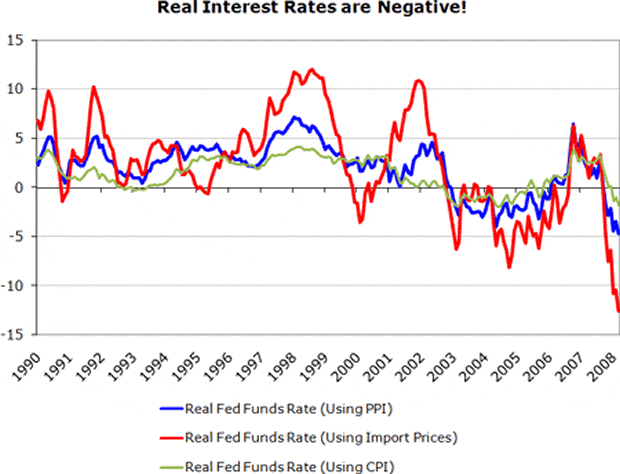
In David Cass & Menahem Paper A Re-Examination of The Pure Consumption Loans Model they show that if the interest rate is less then then growth rate then this is a suboptimal situation because it is possible for all parties to consume more. How might we interpret this model in the case of capital formation. Perhaps we could conclude that the real interest rate should be equal to the rate of real GDP growth. The real GDP growth can be scene in the flowing graph: http://scottgrannis.blogspot.com/201...utput-gap.html As for the real interest rate I'm having trouble in getting a good standard number. A graph for the funds rate is shown bellow and is zero or bellow from the period of 2000 to 2006. I suspect if I looked at the real prime interest rate and the real mortgage rates it would be closer to 6% but if you subtract the risk premium perhaps it would be closer to the 3%. ![]() http://www.marketoracle.co.uk/Article4386.html It is clear that at least in terms of short term borrowing some institutions can borrow much cheaper in real terms then the growth in GDP but I'm not yet sure of the implications of this on the wider economy. |
| Aug2-10, 11:26 PM | #2 |
|
|
Consider your home mortgage. As rates go down, the cost of a larger mortgage goes down as well. This means you can effectively afford to pay more for the same property (a $120,000 mortage will cost the same as a $100,000 mortgage over the term if the fixed rate goes down by 20%). The reverse is true when rates go up. If rates go up, demand goes down, which means a seller will have to accept a lower clearing price for the same property. It may be the case that an investor will believe real property to be a superior investment than cash in a low-rate environment, encouraging him to hold it (presumably until rates go up?), as you imply in your linked thread. This is a reasonable expectation of investor behavior, but a dubious economic proposition. Market forecasting is an imprecise game; there is no guarantee that the price appreciation in his property will be large enough that he will still earn a greater return than an equivalent investment in cash, after debiting for the price decline that will follow a rising interest rate. For a real life example of this, consider the price collapse that followed the interest rate hikes between 2006 and 2008; clearly a property purchased in the low-rate environment of 2000-20005 turned out to be a poor investment relative to cash. Is this Cass & Menahem's concern? |
| Aug3-10, 12:22 PM | #3 |
|
|
If you ask me, low interest rates are as "beneficial" for the economy as drugs are for a person's health: you might at first feel more energetic, but in the end it will detoriate your health. This kind of monetary policy which has been invoked now to "cure" the crisis, is to me a sign that this (capitalistic) system is on a dead-end.
|
| Aug11-10, 12:07 AM | #4 |
|
|
Do Low Interest Rates Really Help The Economy?
If they raise the interest rate now, then people with mortgages at floating rates will be hurt, and there will be more foreclosures and many banks would be troubled again, which would cause a shock to ripple through all the U.S. economy.
|
| Aug14-10, 01:33 PM | #5 |
|
|
I think all these ideas about fiscal stimulus and GDP are overgeneralizing. Just because lower interest rates, fiscal stimulus, and/or increased GDP increases the flow of money, it says nothing about who is getting more and who is getting less and what is being done in exchange for the money. The person who mentioned drugs as an analogy could just as well have mentioned drugs, prostitution, or gambling as real examples of activities that stimulate the economy fiscally and probably increases GDP while actually decreasing economic (and physiological) health.
Lower interest rates stimulate investment, which stimulates productive labor. The question is when labor is beneficial and when it is detrimental economically. Labor requires material resources, such as equipment, vehicles, fuel, etc. When the product of labor is something relatively unnecessary, like superfluous service sector activity - why does it make sense to stimulate GDP to achieve this? An economy that drives blindly in the direction of profit without well-reasoned goals is a waste-machine. Arguably, all life is a form of waste (see George Bataille's "The Accursed Share"). But even if life is waste, there are still ways to manage resource utilization in ways that make it possible for more life to occur with relatively less waste. It makes no sense to stimulate the global economy to the point where, say, 10 billion human lives can be sustained when the same resources could be used to sustain, say, 20 billion. You may say that this is an ethical concern, not an economic one, but consider it in economic terms: why would you produce 10 million widgets per year with a factory using a certain amount of power when you could produce 20 million with the same factory and the same amount of power? Whether interest rates go up or down, the more relevant issue, imo, would be how money is spent and how the spending affects economic patterns and resource-utilization. If anything, I think lower interest rates have caused property prices to rise while discouraging saving. I think lower property prices and higher interest rates would make it easier to own property and save money, which would provide more financial security, thus making the economy less desperate for revenues and income. The problem that people always note with this is that existing debts become more difficult to pay off if interest rates go up. That may be true but it is a self-fulfilling prophecy that the economy must boom to generate money to pay off debts and that debt-payments are relieved by lower interest rates, which also encourage more spending and less saving. So by taking existing debts as a reason to keep interest rates low and stimulate economic growth, a perpetual high-money-flow economy is advocated, which itself will continue to promote debt and superfluous business activity with little if any purpose other than generating revenues for the sake of profit and income. |
| Aug15-10, 01:40 PM | #6 |
|
|
Well, the service sector accounts for what? 70% of the U.S. economy? So that definitively is not superfluous since many jobs come from that sector. If the employment rate falls below 30%, prepare yourself for Armageddon. People will burn cars and the overall economy will turn into something as chaotic as a civil war.
|
| Aug15-10, 02:23 PM | #7 |
|
|
Culturally, there is currently the problem that cheap, plentiful fossil fuels have allowed numerous economic practices to develop that aren't sustainable in the long term. Yet people are simply accustomed to these little lifestyle perks to the degree that they suffer significantly when they have to do without them. Ask any single-car family how inconvenient it is to deal with having only one car. Try turning off your air-conditioning or just raising your thermostat and see how grumpy you get. Try reducing your discretionary shopping and sticking to buying only basic necessities and the occasional perk. Try only going out to eat (including fast food) only once a month. Just living at this level of reduced-consumption would be enough for many people to ignite armageddon. Nevertheless, there are many people in the world who would find it heavenly to live at this level of consumption if they could just have peace and access to good health, clean water, healthy food, and time with family. Since these basic services and necessities aren't that costly in and of themselves, the question is why the economy is so saturated with superfluous needs that get paid for by juicing up the economy so much more than necessary with profit-making and job-creation. People are working their butts off and depleting resources like mad to maintain lifestyles that don't really give them peace of mind. And what's worse is that it seems to be contagious and very difficult to voluntarily reduce economic participation to a level that achieves such peace-of-mind without losing social and professional status and ending up in poverty. So what is the problem with this economy that causes this? |
| Aug15-10, 02:42 PM | #8 |
|
|
Although, I'm not sure how they estimate that. I guess arming oneself and taking the necessities of life isn't considered employment. |
| Aug15-10, 03:01 PM | #9 |
|
|
A friend of mine recently visited Ghana and told me that there is a local agricultural economy where people dig up cassava roots and cook them into dough and sold in local markets. She said there is an animal the size of a small pig that is caught wild and slaughtered for meat, along with chickens. I didn't ask her what the vegetable selection was or who farmed produce. Needless to say, people can feed themselves locally if necessary, but US agriculture is so far from people going hungry, even if they were all unemployed. The issue is what to do with all those labor hours ready to be utilized once people have learned to feed themselves instead of relying on food service constantly. I would expect a vibrant (informal) self-service social economy to evolve if the economic means to gain access to raw materials were available without pushing people into debt. What it comes down to is that if people were satisfied with a lower level of service-dependency, the pressure to generate profit and jobs would decrease and people would be more free to combine more meaningful forms of employment with more free time to do their own cooking, cleaning, leisure, etc. Wouldn't this be a more pleasant economy than the constant hustle-bustle of zipping around for big ticket service-consumption constantly? I think so. |
| Aug15-10, 04:27 PM | #10 |
|
|
|
| Aug15-10, 05:08 PM | #11 |
|
|
|
| Aug17-10, 12:45 PM | #12 |
|
|
There is no purpose of an economy. There is a purpose in trade, which is exchanging goods and services for other goods and services, and a purpose in increasing GDP, which is ultimately to raise the living standards and political power of a country, but there is no purpose of an economy.
|
| Aug17-10, 06:42 PM | #13 |
|
|
|
| Aug17-10, 10:32 PM | #14 |
|
Blog Entries: 3
|
I would also like to point out that while real GDP growth is claimed to be be 3% per year in the good times that is based on the CPI and even the fed does not use the cpi as their measure of inflation. Anyway, we are getting quite far off topic not that I mind this digression. |
| Aug17-10, 10:46 PM | #15 |
|
|
Another example of how GDP growth can have a negative effect is through not just price inflation (including real-estate, insurance policies/premiums, and other goods and services not measured by the CPI or any other inflation measure). It could also generate or at least reflect a proliferation of goods and services that ultimately decrease rather than increase quality of life. For example, I can remember 10 or 20 years ago when people would acquire loads of kitchen utensils or knick knacks because they were in fashion. Ultimately these items didn't get used and ended up getting thrown away or stored in attics. Their purchase certainly contributed to GDP growth, job-creation, stock dividends, etc. but that's ultimately all they were - that and a waste of energy to produce and distribute them. Why isn't it possible that instead of GDP growth being better when its higher, that lower levels of GDP are better because they promote more fiscal discipline and caution in consumption? It could be that living economically simpler lives is ultimately better for people and better for the functionality of the economy as a system - but how would economists ever recognize this if it was true? |
| Aug17-10, 11:32 PM | #16 |
|
|
Economics is a science, not an art. Certain assumptions can be made about any living organism - specifically, it wants to maximize its utility (quality of life, etc). This is as true for a peasant in Africa as it is for a laborer in China or an investment banker in London. The only difference is circumstance. By better understanding the laws of economics, we can build society's (markets) which more efficiently allocate available resources, increasing net utility without any corresponding change in technology or capital. |
| Aug18-10, 10:11 AM | #17 |
|
|
|
| Thread Closed |
| Thread Tools | |
Similar Threads for: Do Low Interest Rates Really Help The Economy?
|
||||
| Thread | Forum | Replies | ||
| How to fix the economy | Current Events | 779 | ||
| interest rates | Set Theory, Logic, Probability, Statistics | 2 | ||
| Economics: Forcing Interest Rates Low | Social Sciences | 2 | ||
| Formulas for interest Interest | Precalculus Mathematics Homework | 3 | ||
| Interest rates | Current Events | 2 | ||