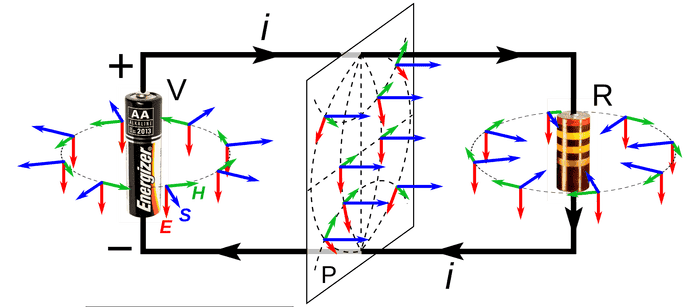
Discussion Overview
The discussion revolves around the role of the Poynting vector in energy transmission within electrical circuits, particularly focusing on whether energy travels through the wires or through the electromagnetic fields surrounding them. Participants explore the implications of circuit theory, the behavior of electric and magnetic fields, and the relationship between these fields and energy transfer in both DC circuits and resistive elements.
Discussion Character
- Exploratory
- Technical explanation
- Conceptual clarification
- Debate/contested
- Mathematical reasoning
Main Points Raised
- Some participants propose that energy transmission in circuits occurs through electromagnetic fields rather than directly through the wires, as indicated by the Poynting vector.
- Others argue that circuit analysis is based on simplifying assumptions that are accurate under certain conditions, but do not address the spatial distribution of energy within circuit elements.
- A participant questions the role of wires, suggesting they may primarily create the electromagnetic field that facilitates energy transmission from the battery.
- Concerns are raised about how energy transfer occurs in a DC circuit, particularly regarding the interaction between electrons and atoms in resistive elements.
- Some participants reference a paper discussing the flow of energy in circuits, noting that while the Poynting vector is present, much of the energy travels parallel to the wire just outside of it.
- There is a discussion about the relationship between surface charges on conductors and the electric field, with some suggesting that the electric field enters the resistor and influences electron movement.
- One participant expresses skepticism about the intuition behind the Poynting vector, questioning its validity in explaining energy transfer in DC circuits.
- Another participant counters this skepticism by asserting that the presence of conductors alters the behavior of the electric fields, preventing them from following the inverse square law.
Areas of Agreement / Disagreement
Participants express a mix of agreement and disagreement. While some acknowledge the validity of circuit analysis under certain assumptions, others contest the sufficiency of this perspective in explaining energy transmission at a deeper level. The discussion remains unresolved regarding the precise mechanisms of energy transfer and the roles of electric and magnetic fields.
Contextual Notes
Limitations include the dependence on classical versus quantum perspectives, as well as the unresolved nature of how energy transmission relates to atomic interactions within resistive elements.