Can i use a neon lamp as radiation detctor?

Click For Summary

Discussion Overview

The discussion revolves around the feasibility of using a neon lamp as a radiation detector, specifically exploring its potential as an ionization chamber or a crude Geiger-Müller tube. Participants examine the circuit design and its components, including voltage requirements and the behavior of the neon tube in response to radiation.

Discussion Character

  • Exploratory, Technical explanation, Debate/contested

Main Points Raised

  • One participant proposes using a neon indicator lamp as a radiation detector, outlining a circuit that involves ionization of the neon gas and pulse generation.
  • Another participant notes that the neon tube has a breakdown voltage of about 100V, suggesting that a higher voltage source, such as a string of PP3 batteries, is necessary for operation.
  • Concerns are raised about the series resistor value, with suggestions that it should be higher (e.g., 100k or 1M) to prevent overheating the tube.
  • There is a discussion about the capacitor's role in the circuit, with one participant questioning how to determine the best value for it and whether a voltage divider should be used after the capacitor.
  • Another participant explains that the neon tube will continue to glow after it strikes, requiring careful consideration of the circuit design to manage this behavior.
  • One participant suggests that the flash rate of the neon tube may increase in the presence of radiation, although this is not definitively established.
  • A later reply questions how to correct for the counting mechanism in the Arduino, indicating uncertainty about the relationship between flash rate and radiation ionization.

Areas of Agreement / Disagreement

Participants express various viewpoints regarding the circuit design and the operational characteristics of the neon tube, with no consensus reached on the effectiveness of the proposed method or the optimal circuit parameters.

Contextual Notes

Participants discuss the dependencies of the circuit on specific voltage levels and component values, as well as the implications of the neon tube's behavior when ionized. There are unresolved questions about the impact of radiation on the flash rate and how to implement corrections in the counting mechanism.

patric44
Messages
308
Reaction score
40
hi guys
i was just wondering if i can use one of those neon indicator as some sort of ionization champer
or as a crude geiger-mullar tube.
and use the basic circuit of the radiation detector to make a simple radiation detector/counter
this is the circuit i came up with :
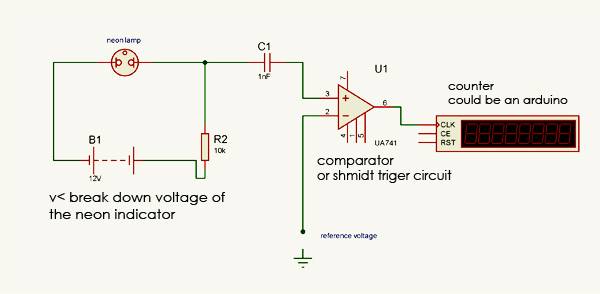
radiation.jpg

so the circuit works as folowing :

1- the radiation ionize the neon which is already close to its breaking Point from the applied voltage
2-then the electron accelerated tho the anode passing to the capacitor forming a pulse
3-then this small pulse trasformed to a square wave using a shmidt triger circuit or a comparator
4-then counting it using the arduino .

i need your opinions if this could work to start building it ?
thanks.
 
Science news on Phys.org
The Neon tube has a break-down voltage of about 100V, so 12V is not enough. A string of PP3 batteries would work. Once the tube strikes, it will keep burning. I believe they are sensitive to ionising radiation and also electric fields and microwaves. The series resistor must be higher, maybe 100k or 1M to avoid over heating the tube. If you shunt the tube with a capacitor, it will strike at intervals, and maybe the time interval will be radiation sensitive. I think the subsequent circuitry is less important than getting the tube to detect radiation in the first place.
 
Also in your circuit, I notice that the 1nF capacitor will pass pulses of about 20 volts directly to the logic gate, which it might not like.
 
tech99 said:
The Neon tube has a break-down voltage of about 100V, so 12V is not enough. A string of PP3 batteries would work. Once the tube strikes, it will keep burning. I believe they are sensitive to ionising radiation and also electric fields and microwaves. The series resistor must be higher, maybe 100k or 1M to avoid over heating the tube. If you shunt the tube with a capacitor, it will strike at intervals, and maybe the time interval will be radiation sensitive. I think the subsequent circuitry is less important than getting the tube to detect radiation in the first place.
thank you tech99 for resbonding
i didnt mean to but 12v( those numpers from the proteus8 i didnt bother to change its value )

i didnt understand what you mean by (once the tube strikes ,it will keep burning) !
- the resistor that value was just random value i will use 1M or 10m as you sugested
with the capacitor problem how can i determine the best value to use ? i mean on what basis
- should i use a voltage divider after the cap?
 
The tube requires, say, about 100v to strike, but will then continue alight with about 80V. So once it strikes it will not go out.
The capacitor will give a time constant with the resistor equal to CxR, so for instance 1M x 10uF = 10 seconds. Actually it will flash faster than this.
The logic circuit must not load the neon, so must have an impedance much higher than the series resistor. I suggest a small capacitor - maybe 1nF will be OK - and maybe you could protect the logic input with a 5 volt Zener. It is possible that a very slow flash rate would be best.
 
thank you so much tech99.

but i have another question :) :
- the counting on the circuit depends on C*R (the flash rate) not the radiation ionization it self (or that wouldn't matter since i can add some correction on the arduino )
and what that correction would be ?
 
I think the flash rate will increase if radiation is present. I cannot see another method of avoiding the continuous glow of the tube after it fires.
 

Similar threads

  • · Replies 18 ·
Replies
18
Views
2K
  • · Replies 26 ·
Replies
26
Views
3K
Replies
12
Views
2K
  • · Replies 18 ·
Replies
18
Views
5K
  • · Replies 24 ·
Replies
24
Views
3K
  • · Replies 17 ·
Replies
17
Views
6K
Replies
1
Views
3K
Replies
1
Views
2K
Replies
1
Views
3K
  • Poll Poll
  • · Replies 1 ·
Replies
1
Views
5K