Direction (bearing) of sunrise/sunset

  • Thread starter Thread starter DaveC426913
  • Start date Start date
Click For Summary
SUMMARY

The discussion centers on calculating the sunrise and sunset bearings at a latitude of 45°N, emphasizing the complexities introduced by Earth's axial tilt and seasonal variations. Participants suggest using tools like Stellarium and Heavens-Above to obtain accurate azimuth data for specific dates. The calculations involve solar hour angles, declination, and adjustments for factors such as the observer's height. Ultimately, the sun's azimuth can vary significantly throughout the year, with specific examples provided for different months.

PREREQUISITES
  • Understanding of solar hour angles and declination
  • Familiarity with astronomy software such as Stellarium
  • Basic knowledge of Earth's axial tilt and its effects on sunlight
  • Ability to interpret azimuth and compass bearings
NEXT STEPS
  • Research the "Sunrise Equation" for precise calculations
  • Explore "Astronomical Algorithms" by Jean Meeus for advanced methodologies
  • Learn how to use Heavens-Above for tracking solar events
  • Investigate the impact of latitude on solar position and azimuth calculations
USEFUL FOR

Astronomy enthusiasts, navigators, and anyone interested in solar position calculations will benefit from this discussion, particularly those working at mid-latitudes and seeking to understand seasonal variations in sunlight direction.

DaveC426913
Gold Member
2025 Award
Messages
24,231
Reaction score
8,350
TL;DR
How can I calculate - or better yet visualize - where on the compass the sun will rise and set?
One piece of Earth/astro geometry that always confused me is why the sun is able to set north of West. (I suppose it must also rise north of East, but I'll have to take the word of Early Birds on that.)

I try to build a mental model of the Earth's tilt over the seasons and visualize where the Sun should appear but I can never quite construct the 3D geometry.

For a latitude of, say, 45°N, how can I calculate (or better yet, diagram) sunset and sunrise bearings (0-360°) or compass points over the course of the year? If I know its October, I should be able to look toward the sun on the horizon and say with confidence "that's bearing X".

(I know of several confounding factors, which I can account for under field conditions, once I know the data:
  • the sun rises and sets at an oblique-r angle in the winter-er months, meaning the margin of error can become embiggened.
  • the rate of change in position changes over the season, being quite slow near the equinoxen and quite fast near the solsteese.)

Basically, it'll be an annalemma, flattened onto the horizon (but including compass marks and/or bearings).
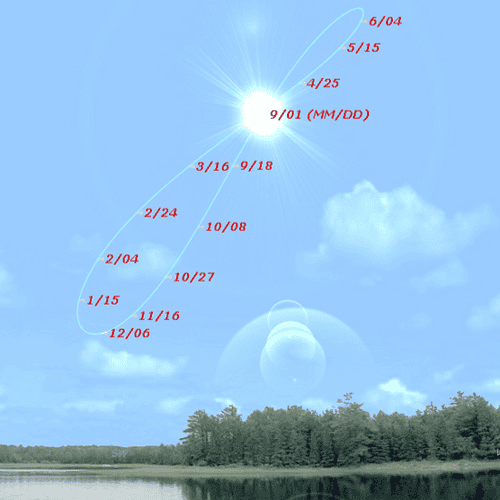
1697428632750.png


So, instead of the time of sampling being the constant (usually noon, as on a standard annalemma), this would have altitude (0°) constant, letting the time vary.
 
Last edited:
Earth sciences news on Phys.org
You are not the first to ask that question.
The direction gets more complicated near the poles.
https://en.wikipedia.org/wiki/Sunrise_equation

While it does not refer to sunrise and sunset directly, it might be time for you to get a copy of:
"Astronomical Algorithms" by Meeus. 1998. 2nd edn.
 
  • Like
Likes   Reactions: Nik_2213, scottdave and jim mcnamara
Baluncore said:
You are not the first to ask that question.
The direction gets more complicated near the poles.
https://en.wikipedia.org/wiki/Sunrise_equation
That seems to be all about the time, not about the direction.

I guess it goes both ways:

\cos \omega _{\circ }=-\tan \phi \times \tan \delta

where:

If I set
\delta
to zero? No that doesn't give me a compass angle.
 
What do you mean by "calculate"? From what starting information? And to what accuracy.

In the Navy, the azimuth of sunrise is used to calibrate compasses. The calculation uses position, tables, interpolation and corrections for height of eye (there may be other factors I don't remember.

You could also use free astronomy software such as Stellarium.
 
russ_watters said:
What do you mean by "calculate"? From what starting information?
All one should need to know is the latitude and time of year.

russ_watters said:
And to what accuracy.
Eyeballing it.

My pinky, held at twice arm's length, is about 1.5 Sols wide - or about .75 degrees. :wink:

russ_watters said:
In the Navy, the azimuth of sunrise is used to calibrate compasses. The calculation uses position, tables, interpolation and corrections for height of eye (there may be other factors I don't remember.
Azimuth. Thanks. I know the term from astronomy charts and telescopes, though I hadn't thought of it as a more general term for "compass point" and "bearing".

russ_watters said:
You could also use free astronomy software such as Stellarium.
I had not thought of that. I did kind of assume I'm not the first person to wonder, and not the first one to want to plot the direction of the sunrise and sunset. But I guess I'll be the first one after all.

There's a little 30-minute micro-project for me. Thanks.
 
A quick solution for a fixed location is, for the 22 of the month to use;
https://www.heavens-above.com
That will give you sunrise and sunset, times and azimuths.
Then fit a curve to the azimuths for your location.

A numerical solution must search for the time of negative solar elevation, that is equal to your definition of sunrise or sunset.
Use Julian day and time to correct for leap year time slip. Solar-centric position of Earth corrects for elliptical Earth orbit.
Given a Lat & Long on tangent plane to the Earth ellipsoid, find that Sun elevation point in time, and compute the Sun's azimuth at that instant.
In polar regions, there may be no daily solution to the elevation search.
 
  • Like
Likes   Reactions: russ_watters
The Amplitude of the Sun is its angle relative to East or West.
According to Reeds Astro Navigation Tables, Sin Amplitude = Sin Dec / Cos Lat.
If the Sun is rising it is East and if it is setting it is West. The Dec decides whether the amplitude is N or S.
For instance, if Amplitude was calculated as 13 deg for a setting Sun in Winter, the Amplitude will be W 13deg S. This gives a real bearing of 270-13 E of N = 257 E of N.
 
As an example calculation, on 13 Oct the Declination of the Sun is listed as 8 deg South. For someone in latitude 45 deg north,
Sin Amplitude = Sin (8 deg) / Cos 45 = 0.14/0.71 = 0.20
Amplitude = 11.5 deg
Bearing at dawn = E 11.5 deg S
True bearing = 090 + 11.5 = 101.5 deg E of N
 
Wow, this ended up a lot messier than I thought. I cannot help but think I've made some mistakes.

Month (15th of)TimeΔTBearingΔ°
Jan1700240
Feb1742+42252.5+12.5
(Mar 12)(-60)+15.5
Mar1918+96267
Apr1956+38284+17
May2030+34296.5+12.5
Jun2055+25303+5.5
Jul2051-4300-3
Aug2016-35289-11
Sep1923-53274-15
Oct1829-54258-16
(Nov 5)(+60)
Nov1647-102244-14
Dec1630-17236.5-7.5
 
Last edited:
  • #10
DaveC426913 said:
Wow, this ended up a lot messier than I thought. I cannot help but think I've made some mistakes.
Do you have daylight saving time?
 
  • #11
Baluncore said:
Do you have daylight saving time?
It was in there, yes. I was in the middle of editing the data and have put it in a table now.

The site does not really mention daylight savings; I had to assume it is incoporated into their data, otherwise the curve looks much worse.
 
  • #12
You may find this book a worthwhile read. It is written at the undergraduate level. Historical approaches to solving your exact problem are developed throughout the chapters.
 
  • Informative
Likes   Reactions: DaveC426913
  • #13
This the data, graphed.
1697499211433.png

Kind the antithesis of smooth...

I've compensated for daylight savings (two vertical segments - Mar 12 to Nov 5) that I assume to be in the data.

If I do not compensate for daylgiht savings, this is what it looks like:
1697499606180.png

Neither one looks to me like a smooth annalema (even if I gave it smooth curves).

I've checked the data a half dozen times. Don't know what I'm doing wrong. Maybe it's not me; Maybe HA is playng fast and loose with sunsets.
 
  • #14
I checked the Heavens Above data against Stellarium.
Month (15th of)TimeΔTBearingΔ°
Jan1703240.5
Feb1745+42253+12.5
(Mar 12)(-60)
Mar1921+96267.5+14.5
Apr1958+35284+16.5
May2033+34297+13
Jun2058+25303.5+6.5
Jul2054-4301-2.5
Aug2019-26290-11
Sep1926-53274.5-15.5
Oct1832-54258.5-16
(Nov 5)(+60)
Nov1650-102244-14.5
Dec1638-12237-7

Stellarium has explicit sunset times listed, rather than me just setting alt to <±1°. (As I said, the sun sets obliquely, so a small diff in time can produce a large difference in azimuth).

This data produces a much cleaner graph.

1697503112015.png


A=April, a=august, J= Jun, j=July


(The discprenacy in the left edge of the curve is because the sun doesn't start in the exact same place on Jan 1, 2023 as it ends on Dec 31, 2023).
 
Last edited:
  • #15
So, in conclusion:

  • At 45° North, the sun sets in the range of ±35° of due West.
  • Sunset is due West near (but not necessarily on) the March and September equinosees (because: eccentricity).
  • Its azimuth will change by as much as a half degree per day (~16° over 30 days) at those times.
  • Over Christmas, its northerly limit, the sun sets as far north as 303.5°, just 5° shy of due NorthWest.

Huh.

Thanks guys! Esp. @russ_watters for suggesting Stellarium.

I can stop guessing now. I have it down to a couple of bullets. That feels good.

[Commencing garbage collection to free up memory.]
 
Last edited:
  • Like
Likes   Reactions: Nik_2213 and russ_watters
  • #16
DaveC426913 said:
(The discprenacy in the left edge of the curve is because the sun doesn't start in the exact same place on Jan 1, 2023 as it ends on Dec 31, 2023).
I guess you do not allocate 28.25 days to February.
I used HA Sun data and got smooth curves.
 
  • #17
Baluncore said:
I guess you do not allocate 28.25 days to February.
The rez of my graph is on the order of a pixel or two per day. So the variance in month lengths is just a couple of pixels. My data points are about 20 pixels in size, which should have masked even very large inaccuracies.

Despite that, there is just no way to fudge them into behaving - for example the vertical position of March or August in my initial graphs in post 13 cannot be coaxed onto any simple curve let alone a straight line.

Baluncore said:
I used HA Sun data and got smooth curves.
I would be interested in your data and rendering - even if only partial.
I'm curious to see if our raw data even matches, and how our methods might have differed such that I got bad data.

(I set the date/time to 15th of each month and then advanced the time a minute at a time until the sun first disappeared below the horizon, which put its altitude at < ±0.5 degrees.)
 
Last edited:
  • #18
DaveC426913 said:
I would be interested in your data and rendering - even if only partial.
I'm curious to see if our raw data even matches, and how our methods might have differed such that I got bad data.

(I set the date/time to 15th of each month and then advanced the time a minute at a time until the sun first disappeared below the horizon, which put its altitude at < ±0.5 degrees.)
I used https://www.heavens-above.com/main.aspx
Set for my location.
I selected: "Astronomy"; "Sun"; Then read the "daily events" panel.
https://www.heavens-above.com/sun.aspx
I selected the 22nd day, then each month in turn, and pressing the "Update" button.
Then recorded the daily events: sunrise, sunset, times and their azimuths.

Why 22nd of the month? My solstice is on 21 or 22. My equinox is on 22 or 23. The data is therefor symmetrical.
 
  • Like
Likes   Reactions: russ_watters
  • #19
Baluncore said:
the "daily events" panel.
Ah. I didn't know about that panel. I was reading times, alts and azimuths off the skymap, by eye.
 
  • #20
DaveC426913 said:
  • Over Christmas, its northerly limit, the sun sets as far north as 303.5°, just 5° shy of due NorthWest.
The Sun's bearing for Christmas time does not look quite correct to me, as it will be South of West, not North. Astro Navigation tables give the maximum declination South on 22 Dec and I calculate the Sun's bearing at sunset that day as 235.8 deg E of N.
 
  • #21
tech99 said:
The Sun's bearing for Christmas time does not look quite correct to me, as it will be South of West, not North. Astro Navigation tables give the maximum declination South on 22 Dec and I calculate the Sun's bearing at sunset that day as 235.8 deg E of N.
Oops! Duh. Of course the sun sets at its northerlymost point in summer, not winter!

The diagram is correct, just not the bullet. Amended:

  • Over the sumer solstice, at its northerly limit, the sun sets as far north as 303.5°, just 5° shy of due NorthWest.

Thanks for catching that.
 
  • #22
Think yourself lucky.
Sunset in Murmansk, Russia, this year, will be on 1 December, 2023, at 12:56 PM.
It will next rise on the 11 January, 2024, at 12:50 PM, then set again 11 minutes later.
 
  • #23
Baluncore said:
Think yourself lucky.
Luck has nothing to do with it!

They crossed the Arctic Circle - they knew what they were in for!
 
  • #24
Decades ago, I was asked for a program or formula to determine the Sun position in the sky given date and hour at arbitrary Lat. & Long. At the time that information was not easily available, just look-up tables for select locations.

So I did a work-around.

I found the equations for the position of Earth-orbiting satellites given there orbital period and inclination. There was a very small residual error approximating a sine wave over a year. I assume it was due to our elliptical orbit around the Sun, but it was not enough to bother with. Turned out to be "Good Enough for Government Work!"

Cheers,
Tom

p.s. The program was written in the BASIC language and was used in a production environment. Sorry, no further details available, I did not keep any documentation and the client company no longer exists.

EDIT: (5 months later) For a few more details see https://www.physicsforums.com/posts/7061222/bookmark
 
Last edited:
  • Like
Likes   Reactions: DaveC426913
  • #25
Fun problem. I can get R² to 1.000 (≈ ± 1 minute) with 13 variables for x = day of year and y = time of sunrise. (only good for 2023 and my location)

Guessing I could reduce the number of variables, but the above took me two days!

Interestingly, knowing the sunrise time and date, you can determine where the sun rises with only 4 variables with an R² of 0.9996 (≈ ± 1°). It's nearly a perfect sine wave.
 

Similar threads

  • · Replies 4 ·
Replies
4
Views
5K
  • · Replies 16 ·
Replies
16
Views
7K
  • · Replies 11 ·
Replies
11
Views
4K
  • · Replies 1 ·
Replies
1
Views
4K
  • · Replies 1 ·
Replies
1
Views
3K
  • · Replies 8 ·
Replies
8
Views
8K
  • · Replies 6 ·
Replies
6
Views
2K
  • · Replies 15 ·
Replies
15
Views
3K
  • · Replies 10 ·
Replies
10
Views
2K
  • · Replies 56 ·
2
Replies
56
Views
6K