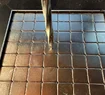
Practical demo - Ferromagnetic attraction at interpole boundary

  • Context: Graduate 
  • Thread starter Thread starter magnetics
  • Start date Start date
Click For Summary
SUMMARY

The discussion focuses on the behavior of ferromagnetic objects in the presence of multipolar permanent magnets, specifically concentric alternating-polarity configurations. Using a handheld gauss meter, it was observed that a steel nail snaps to interpole boundaries where the magnetic field (Bz) is approximately zero, while the pointed tip of the nail aligns with the center where Bz is maximal. This indicates that the attractive force is influenced more by field gradients than by local field strength, highlighting the importance of object geometry in magnetic interactions. The inquiry seeks to clarify the relationship between measured field strength and force in these magnet geometries.

PREREQUISITES
  • Understanding of multipolar permanent magnets and their configurations
  • Familiarity with magnetic field measurement using gauss meters
  • Knowledge of magnetic field gradients and their effects on ferromagnetic materials
  • Basic principles of magnetism, including field strength and flux concentration
NEXT STEPS
  • Research the mathematical principles of magnetic field gradients in multipolar configurations
  • Explore the effects of object geometry on magnetic attraction in ferromagnetic materials
  • Study the relationship between magnetic field strength and force in practical applications
  • Investigate advanced gauss meter techniques for measuring magnetic fields in complex geometries
USEFUL FOR

Physicists, engineers, and hobbyists interested in magnetism, particularly those exploring the interactions of ferromagnetic materials with multipolar permanent magnets.

magnetics
Gold Member
Messages
51
Reaction score
4
TL;DR
Experiment with flat side or pointed side of a nail and its attractive forces to an alternating pole static magnet
I was experimenting with multipolar permanent magnets (concentric alternating-polarity) and a nail and noticed something that initially seems counterintuitive.

Using a handheld gauss meter, when scanning normal to the magnet face (z-axis), the measured Bz is maximal near the centre of the magnet (furthest from the alternating pole) and approaches zero at the boundaries between adjacent poles, as expected due to axial cancellation.

However, when placing a small ferromagnetic object (e.g. a steel nail) over the magnet:

• With the flat end facing the magnet, the object consistently snaps to the interpole boundaries, precisely where Bz ≈ 0
• When the nail is flipped and the sharp tip faces the magnet, it preferentially aligns over the centre, where Bz is maximal

Concentric2.webp
Concentric1.webp
Concentric3.webp


This suggests that the attractive force is dominated by field gradients rather than local field magnitude, and that object geometry (flat or point) strongly influences which part of the field is sampled.

Am I correct in interpreting this behaviour as a consequence of ∇(B²) being maximal at the interpole boundaries despite Bz ≈ 0 there? And is the preference of the pointed tip for the centre best explained by flux concentration and field symmetry?

I’m interested in whether there’s a clean way to describe this distinction between measured field strength and force in multipolar permanent magnet geometries.
Thank you.
 
  • Like
Likes   Reactions: Charles Link
Physics news on Phys.org
Can you draw a diagram of where the poles are on this magnet? I had trouble following your explanations.
 
magnetics said:
• With the flat end facing the magnet, the object consistently snaps to the interpole boundaries, precisely where Bz ≈ 0
• When the nail is flipped and the sharp tip faces the magnet, it preferentially aligns over the centre, where Bz is maximal
How do you know that the nail is not magnetised in some weird way?
 
magnetics said:
This suggests that the attractive force is dominated by field gradients rather than local field magnitude
Correct. If the B field is constant in a region enclosing a ferrous object, there is no net magnetic force on the object. There is a mild gradient heading axially away from a cylindrical magnet, which will attract an object like a nail. But there is a stronger gradient side-to-side between the coaxial alternating poles for that magnet that you show, which is why the flat head is strongly attracted to that region.

BTW, how can an alternating pole coaxial magnet have 3 exposed poles? Shouldn't it have an even number of poles? How is it actually constructed?
 
  • Like
Likes   Reactions: hutchphd
berkeman said:
Correct. If the B field is constant in a region enclosing a ferrous object, there is no net magnetic force on the object. There is a mild gradient heading axially away from a cylindrical magnet, which will attract an object like a nail. But there is a stronger gradient side-to-side between the coaxial alternating poles for that magnet that you show, which is why the flat head is strongly attracted to that region.

BTW, how can an alternating pole coaxial magnet have 3 exposed poles? Shouldn't it have an even number of poles? How is it actually constructed?
The pictures were unclear and the OP's explanations were lacking. I think that larger surface with 3 rings is the sensor, but I don't know.
 
Charles Link said:
The pictures were unclear and the OP's explanations were lacking. I think that larger surface with 3 rings is the sensor, but I don't know.
It could have been explained better, I agree. The magnets in the photo are static magnets and the interpole boundary is the neutral line between two neighboring opposite-polarity rings. Just like the images below, where the interpole boundary is the neutral line between two neighboring opposite-polarity squares. You see the same effect. The point of the nail is attracted to the centre of the magnet, where Bz in max, while the flat part of the head of the nail is attracted to the point where B(dx/dy) gradient is maximum. I was expecting both ends of the nail to be attracted to same spot.
 

Attachments

  • Nail-Head-Point1.webp
    Nail-Head-Point1.webp
    85.8 KB · Views: 2
  • Nail-Head-Point2.webp
    Nail-Head-Point2.webp
    80.5 KB · Views: 1
  • Like
Likes   Reactions: Charles Link
You've got a very odd looking nail. I thought the head of the nail was the magnet. That is the head of the nail as I know it. You called it the flat end. Your nail has spiral grooves in it. I don't know if you can expect it to behave like an ordinary nail.
 
Charles Link said:
You've got a very odd looking nail. I thought the head of the nail was the magnet. That is the head of the nail as I know it. You called it the flat end. Your nail has spiral grooves in it. I don't know if you can expect it to behave like an ordinary nail.
It looks like they are called "Spiral Shank Nails", and the grooves afford superior holding power for the nails:

1776468268538.webp


I don't think the spiral grooves are affecting this experiment. It's just that the B-field gradient experienced by the flat head of the nail is stronger side-to-side given the dimensions of the nail head versus the forces experienced by the nail when the pointed end is down. I don't find it all that strange overall.
 
  • Like
  • Agree
Likes   Reactions: hutchphd, Bystander and Charles Link
It is starting to make a little more sense, now that I have a clearer picture of it. I think the flat head is extensive enough that it is able to get magnetized in the x-y plane with a north pole and a south pole that will line up with the south and north poles respectively of the underlying magnet.

For the case of the point, the nail can get magnetized in the z direction, and if the point is above a north pole of the underlying magnet, a south pole will appear at its tip, etc., with the north pole at its head.
 
  • Like
Likes   Reactions: berkeman
  • #10
That makes sense. Thanks for that. The image from OP there are three alternating poles, with the two ring magnets and one central disc.

A nice one-sentence explanation would be:
The point behaves like a flux concentrator that seeks the centre of a single pole cell, while the head behaves like a keeper that seeks to bridge adjacent opposite poles, so it settles over the four-pole junction.
 
Last edited by a moderator:
  • Like
Likes   Reactions: Charles Link
  • #11
How do you know that the steel nail is not magnetised?
 
  • #12
Baluncore said:
How do you know that the steel nail is not magnetised?
From the response of the nail it is likely it is not permanently magnetized, if that is what you are referring to. It is responding how one might expect to induced magnetization.

If the nail permanently had one pole on the top and the opposite pole on the tail, the response would be for each pole of the nail to be attracted to one type of pole on the underlying magnet, and be repelled by the other.
 
  • #13
Charles Link said:
It is responding how one might expect to induced magnetization.
Just because you have a reasonable sounding explanation does not make it correct. Confounding factors should be tested for and eliminated.

The nail is made from a hard steel that has been twisted and worked to form a head and a point. I would be surprised if it was not a permanent magnet.

Maybe a nail could be annealed, degaussed and tested with or as a compass. Does the experimental behaviour then change?
 
  • Like
Likes   Reactions: Charles Link
  • #14
Thread closed temporarily for Moderation.
 
  • #15
After deleting a reference to a LLM conversation, the thread is reopened. Please remember that AI references are not allowed in the technical forums. Thanks.
 
  • Like
Likes   Reactions: Charles Link
  • #16
The nail is just a typical steel (ferrous) nail from a shop. Being a soft magnetic material, there would be induced magnetism while touching the neodymium magnet (temporary alignment of the magnetic domains). But the magnetism would not be retained when removed from the magnet, aside from a small residual effect. Any induced magnetism, therefore I suspect would have negligible influence on how the nail has behaved with the differences between the point and head.
This is one of those examples where you play with magnets and something completely counterintuitive occurs and it's nice to have the Physics Forums to elucidate.
 
  • Like
Likes   Reactions: Charles Link
  • #17
magnetics said:
Any induced magnetism, therefore I suspect would have negligible influence on how the nail has behaved with the differences between the point and head.
I presume you are referring to any permanent magnetism, if there is any, appears to be minimal, but why not check for it, like @Baluncore suggested, with a compass.
 
  • #18
magnetics said:
The nail is just a typical steel (ferrous) nail from a shop. Being a soft magnetic material, ...
Iron with a low carbon content, is a "soft" magnetic material. The steel used to make nails has high carbon content, which makes it a "hard" magnetic material.

Nails are made from high carbon steel, so they will not bend or deform when being driven. The nail was cold worked, forming the work hardened head and point. The shank was twisted cold. That made a straight rigid nail with hard ends.

The cold working will have given the nail a permanent magnetic field. The nail would need to be annealed by heating, or be degaussed, to remove that "built in" field.
 
  • Agree
  • Like
Likes   Reactions: Charles Link and berkeman
  • #19
I do think if the nail is a permanent magnet, that the tip will be of one polarity and the head of the other polarity. That would make it so that the tip gets centered on one region of the underlying magnet and the head on the other. The alternative is that the magnetism on the head is more complex. Certainly a possibility, but perhaps unlikely. That's where I don't think we yet to have complete agreement on what gave us the experimental results that were observed.

See https://fractory.com/magnetic-metals-non-magnetic-metals-with-examples/
 
Last edited:
  • #20
berkeman said:
How is it actually constructed?

Charles Link said:
I presume you are referring to any permanent magnetism, if there is any, appears to be minimal,
t too thnk the inclusion of remanance in the discusson is likely not fruitfuil.

I do think it important, however, to remember that the presence of the nail can greatly change "magnetic circuit" and therefore its shape analysis may need to be more nuanced. The flat end will strongly intensify the total magnetic flux and thereby also amplify the consequential field gradents. In addition it will di
stort the total field geometry in unknown ways. I think rigorous sketches of field lines for each interaction geometry would be dispositive. Such sketching practices a very useful skill (IMHEO....)
 
  • Like
Likes   Reactions: Charles Link

Similar threads

  • · Replies 9 ·
Replies
9
Views
5K
  • · Replies 1 ·
Replies
1
Views
3K
  • · Replies 7 ·
Replies
7
Views
2K
Replies
4
Views
5K
  • · Replies 44 ·
2
Replies
44
Views
21K
  • · Replies 7 ·
Replies
7
Views
4K