Special Relativity - clocks on two trains

  • Level: Undergrad 
  • Thread starter Thread starter Mike_bb
  • Start date Start date
Join the discussion
Registration is free. Ask a follow-up in this thread, or start your own.
9 replies · 822 views
Mike_bb
Messages
354
Reaction score
41
Hello, PF!

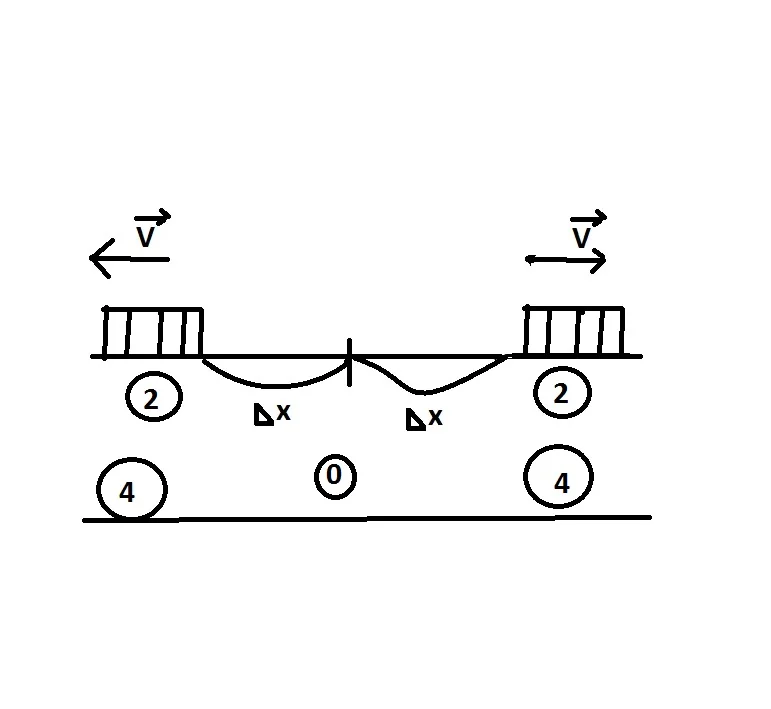
Example: Two trains are moving in opposite directions with constant velocity ##V##. Clocks in the trains are synchronized at start point. Clocks on the platform are synchronized too. Left clock and right clock on the platform read 4sec. Due to time dilation clocks in the trains read 2sec.
1.webp


Observer in the left train see the clock (1) in the left train and read the clock (2) in the right train and conclude that clock (2) is slowed.
Observer in the right train see the clock (2) in the right train and read the clock (1) in the left train and conclud that clock (1) is slowed.

My question: Is it possible that differences in time are the same (due to given conditions and relativity of simultaneity)?
For example, for observer in the left train: clock (1) = 2sec; clock(2)=1.5sec and for observer in the right train: clock (2) = 2sec; clock(1) = 1.5sec.
The difference in time for observer in the left train = 2sec-1.5sec=0.5sec.
The difference in time for observer in the right train = 2sec-1.5sec=0.5sec.

Thanks!
 
Physics news on Phys.org
I'm not completely clear on the scenario (probably my fault), but you are correct that the time dilation is the same regardless of the direction of the relative velocity.
 
Mike_bb said:
Is it possible that differences in time are the same (due to given conditions and relativity of simultaneity)?
If I correctly understood your setup then, yes. Not only is it possible, it is required. Otherwise one inertial frame would be distinguished from the other. That would violate the principle of relativity.
 
  • Like
  • Informative
Likes   Reactions: FactChecker and Mike_bb
Dale said:
If I correctly understood your setup then, yes. Not only is it possible, it is required. Otherwise one inertial frame would be distinguished from the other. That would violate the principle of relativity.
I meant following: for the left train: clock(1)=2sec; clock(2)=1.5sec and for the right train: clock(2)=2sec; clock(1)=1.5sec. The difference in time is 0.5sec (relativity of simulteneity).
Right?
 
Mike_bb said:
(relativity of simulteneity).
You refer to this, but I'm not sure you realize how it works in this scenario. It refers to the synchronization of the clocks within the two trains' Inertial Reference Frames (IRFs) being different. Each train thinks that the clocks along the path of other train's IRF are synchronized incorrectly.
 
Mike_bb said:
I meant following: for the left train: clock(1)=2sec; clock(2)=1.5sec and for the right train: clock(2)=2sec; clock(1)=1.5sec. The difference in time is 0.5sec (relativity of simulteneity).
This isn't relativity of simultaneity, just basic symmetry.

Relativity of simultaneity here would be for example how the clocks on the platform are desynchronized in each train frame. But you don't use the clocks on the platform at all as far I can see, so what did draw them for?
 
A.T. said:
This isn't relativity of simultaneity, just basic symmetry.
Yes, symmetry for ##\Delta t## and ##\Delta t'## . But time difference exists (not always, only when clocks are synchronized in one system) due to relativity of simultaneity. I wrote that time difference is 0.5sec. I think, in my example ##\Delta T = vx/c^2 = 0.5sec##
 
Mike_bb said:
Yes, symmetry for ##\Delta t## and ##\Delta t'## . But time difference exists (not always, only when clocks are synchronized in one system) due to relativity of simultaneity. I wrote that time difference is 0.5sec. I think, in my example ##\Delta T = vx/c^2 = 0.5sec##
It really helps if you actually give all the details of your experiment, instead of us having to back them out of your description.

You seem to be considering two trains moving at ##\pm c/\sqrt{2}## relative to the platform, so with ##\gamma=2## for both of them in the platform frame. The event where they pass each other is the origin of coordinates. Each train has a clock, and there are also two clocks at rest on the platform ##\pm 2\sqrt{2}\mathrm{ls}## from the origin as measured in the platform frame. All clocks are synchronised to their rest frame time - in particular this means that in the platform frame all read zero at the instant the trains pass one another.

Now we can write down a list of interesting events. Using T+ and T- to refer to the clocks on the trains moving in the positive and negative x directions respectively, and P+ and P- to refer to the platform clocks with positive and negative x coordinates respectively the events and their coordinates ##x_p, t_p## in the platform's rest frame are:
##x_p/\mathrm{ls}####t_p/\mathrm{s}##
P+ zeroed##2\sqrt{2}####0##
P- zeroed##-2\sqrt{2}####0##
T+ zeroed##0####0##
T- zeroed##0####0##
T+ and P+ meet##2\sqrt{2}####4##
T- and P- meet##-2\sqrt{2}####4##
Now you have coordinates for each event you can apply the Lorentz transforms:$$
\begin{eqnarray*}
x'&=&\gamma(x-vt)\\
t'&=&\gamma\left(t-\frac{v}{c^2}x\right)
\end{eqnarray*}
$$where ##\gamma=(1-v^2/c^2)^{-1/2}##, to get the coordinates used by other frames (##x_\pm,t_\pm## for the rest frames of the trains travellibg in the ##\pm x## direction):
##x_p/\mathrm{ls}####t_p/\mathrm{s}####x_+/\mathrm{ls}####t_+/\mathrm{s}####x_-/\mathrm{ls}####t_-/\mathrm{s}##
P+ zeroed##2\sqrt{2}####0####4####-2\sqrt{2}####4####2\sqrt{2}##
P- zeroed##-2\sqrt{2}####0####-4####2\sqrt{2}####-4####2\sqrt{2}##
T+ zeroed##0####0####0####0####0####0##
T- zeroed##0####0####0####0####0####0##
T+ and P+ meet##2\sqrt{2}####4####0####2\sqrt{2}####8####6\sqrt{2}##
T- and P- meet##-2\sqrt{2}####4####-8####6\sqrt{2}####0####2\sqrt{2}##
Now, you asked about the time difference at the meetings as determined in the rest frame of one of the trains. You can simply consult the table - the ##t_+## coordinate is the time measured using the rest frame of the train moving in the +x direction, and in this frame the T+ and P+ clocks meet at ##t_+=2\sqrt{2}\mathrm{s}## and the T- and P- clocks pass at ##t+=6\sqrt{2}\mathrm{s}##. So the difference in this frame is ##4\sqrt{2}\mathrm{s}##.

This is not the 0.5s you are citing, but you have not shown your work, so we have no idea if you are wrong or just doing something different.
 
Last edited:
  • Informative
Likes   Reactions: berkeman and Mike_bb
Ibix said:
You seem to be considering two trains moving at ##\pm c/\sqrt{2}## relative to the platform, so with ##\gamma=2##
Not quite; for ##\gamma = 2## you need ##v / c = \pm \sqrt{3} / 2##. For ##v / c = \pm \sqrt{2}## you get ##\gamma = \sqrt{2}##. Remember the square root in the formula for ##\gamma##.