Reciprocal Lattice: Visible Points in an X-Ray Experiment

  • Context: Graduate 
  • Thread starter Thread starter Dr_Pill
  • Start date Start date
  • Tags Tags
    Lattice Reciprocal
Click For Summary

Discussion Overview

The discussion revolves around the concept of reciprocal lattice points in the context of x-ray diffraction experiments. Participants explore how the orientation of the incident beam affects which reciprocal lattice points are visible in the diffraction pattern, as well as the implications of aligning crystal planes to fulfill the Bragg condition.

Discussion Character

  • Exploratory
  • Technical explanation
  • Debate/contested

Main Points Raised

  • One participant suggests that only certain reciprocal lattice points become visible depending on the orientation of the incident beam, specifically noting that only parallel planes involved in diffraction will be represented in the diffraction pattern.
  • Another participant points out that it is possible to align a single crystal to fulfill the Bragg condition for multiple sets of lattice planes simultaneously, which challenges the initial claim about visibility being limited to one set of planes.
  • The concept of the "Umweganregung" or "Renninger effect" is introduced, indicating that multiple reflections can be excited by adjusting the azimuthal angle and photon energy.
  • Links to historical and theoretical resources on x-ray diffraction are provided for further reading.

Areas of Agreement / Disagreement

Participants express differing views on the visibility of reciprocal lattice points in x-ray diffraction, with some agreeing on the initial claim while others contest it by introducing the possibility of multiple reflections under specific conditions. The discussion remains unresolved regarding the extent of visibility based on beam orientation.

Contextual Notes

There are limitations regarding the assumptions made about the relationship between incident beam orientation and visible reciprocal lattice points, as well as the conditions required for multiple reflections to occur.

Dr_Pill
Messages
41
Reaction score
0
I got a bunch of questions about reciprocal lattice, I start with this one:

In an x-ray experiment:

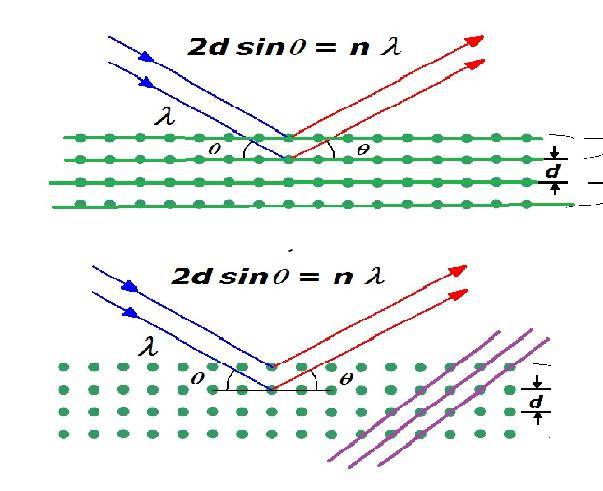
For one specific orientation of your incident beam on your real lattice, only a portion of the points of your reciprocal lattice will become visible as your diffraction pattern right?

See my picture
nm4bBeB.jpg


For one incident beam, only the parallel planes are involved in your diffraction and so only the reciprocal lattice points that represent these set of parallel planes will becoem visible on your diffraction pattern

If you want to make other reciprocal points points visible on your diffraction pattern, u have to change the orientation of your incident beam so that another set of parallel planes is involved in diffraction
So in first picture, your blue beam will get the reciprocal points that representing the green parallel planes visible on your diffraction pattern.

Second picture, the same blue beam does nothing on the purple planes, so the reciprocal points that represents the purple planes will not be visible on the diffraction pattern.

Is this correct?
 
Last edited:
Physics news on Phys.org
It might help with the Forum formatting if you reduce the size of your image to no more than 800 pixels by 600 pixels. There's no reason for it to be THIS big.

Zz.
 
ZapperZ said:
It might help with the Forum formatting if you reduce the size of your image to no more than 800 pixels by 600 pixels. There's no reason for it to be THIS big.

Zz.

Ok, like this? But now my picture is unsharp.
 
Last edited:
Dr_Pill said:
how can i resize it?

Remove the image, and upload a new, resized version.

Zz.
 
Dr. Pill,

your images are in real space, not reciprocal space.

It is perfectly possible to align a single crystal such that two or even three sets of lattice planes fulfull the Bragg condition simultaneously.

For the two-beam case this can be done by aligning one Bragg peak (corresponding to the reciprocal space vector Q), and by then rotating the crystal about the vector Q until you excite a second reflection (=changing the azimuthal angle). To get 3 simultaneous reflections you also need to tune the photon energy just right.

The effect is known by several names including "Umweganregung", "Renninger effect" and "Multiple beam diffracton". It was first described in 1935.

The following links give a bit more informaiton:

P. P. Ewald, Rev. Mod. Phys. v37, pp46 (1965)
http://rmp.aps.org/abstract/RMP/v37/i1/p46_1
This is an excellent review article about the early theory of x-ray diffraction, written by one of the founding fathers. Highly recommended if you are interested in x-rays.

Renninger, Z. Phys v. 106 pp 141 (1937) in German
http://link.springer.com/article/10.1007/BF01340315

Description of a computer code for calculating Umwegs.
http://www1.uni-hamburg.de/mpi/rossmanith/Reprints/Z_Krist_85.pdf
 

Similar threads

  • · Replies 3 ·
Replies
3
Views
6K
  • · Replies 1 ·
Replies
1
Views
2K
  • · Replies 16 ·
Replies
16
Views
2K
  • · Replies 4 ·
Replies
4
Views
3K
  • · Replies 3 ·
Replies
3
Views
2K
Replies
2
Views
3K
  • · Replies 5 ·
Replies
5
Views
5K
  • · Replies 2 ·
Replies
2
Views
3K
  • · Replies 2 ·
Replies
2
Views
10K
  • · Replies 1 ·
Replies
1
Views
4K