Can an electric field change faster than light?

Click For Summary

Discussion Overview

The discussion centers around whether an electric field can change faster than the speed of light, particularly in the context of capacitors and electromagnetic fields. Participants explore theoretical implications, the nature of electric and magnetic fields, and the relationship between changes in these fields and the propagation of electromagnetic waves.

Discussion Character

  • Debate/contested
  • Conceptual clarification
  • Technical explanation

Main Points Raised

  • Some participants propose that the speed of light is a fundamental limit for the propagation of changes in electric and magnetic fields, as they are components of electromagnetic fields.
  • Others argue that in a capacitor, nothing physically travels between the plates, and question why the speed of light should be a limit in this scenario.
  • A participant expresses confusion about the presence of electromagnetic waves in a capacitor, suggesting that electric fields do not propagate through the dielectric material.
  • Another participant explains that a changing electric field produces a magnetic field, which implies the existence of electromagnetic waves, thus linking the concepts of electric fields and wave propagation.
  • Some contributions highlight that the voltage on capacitor plates may lag behind, indicating that changes in electric fields can have complex dynamics.
  • One participant mentions that while fields cannot change faster than light, there are parameters in Maxwell's equations that could suggest phenomena that might appear to exceed this limit.
  • There is a discussion about the speed of gravity and its relationship to electromagnetic interactions, with some participants asserting that gravity is not an electromagnetic interaction despite both propagating at the speed of light.

Areas of Agreement / Disagreement

Participants generally do not reach consensus, as multiple competing views remain regarding the nature of electric fields, their propagation, and the implications of electromagnetic theory. Some express agreement on the speed of light as a limit, while others challenge this notion.

Contextual Notes

Participants express varying levels of understanding regarding electromagnetic theory, and there are references to Maxwell's equations without full exploration of their implications. The discussion includes assumptions about the behavior of fields in different materials and the nature of wave propagation.

Who May Find This Useful

This discussion may be of interest to those studying electromagnetism, electrical engineering, or physics, particularly in understanding the complexities of electric and magnetic field interactions and their theoretical limits.

Meizirkki
Messages
55
Reaction score
0
I found the thread "Can magnetic field expand faster than light?" but no thread on electric fields.

For example:
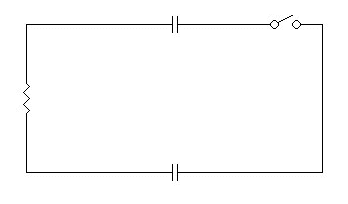
iBiOU.png


If, in the above setup, the dielectrics used in capacitors were physically very long (the distance between plates very high) and the capacitors were charged up to high potential in a way that closing the switch would create a HV peak measurable at the resistor, is it possible that this peak could appear faster than light travels the distance between capacitor plates?
 
Physics news on Phys.org
Light consists of electric and magnetic fields so the speed of light is hardly likely to be different. April 1st was several days ago.
 
sophiecentaur said:
Light consists of electric and magnetic fields so the speed of light is hardly likely to be different. April 1st was several days ago.

This thread is not an april fools joke.

In a capacitor, nothing has to travel the distance between the plates (and nothing does, assuming a perfect dielectric). Is there a reason why the speed of light would be a limit?
 
Electric fields and magnetic fields are both electromagnetic fields.
Both expand at most as fast as the speed of light in vacuum.
 
An EM wave consists of changing E and H fields. The rate of propagation of a change in field IS the speed of the EM wave. How could it be different?
Why are people obsessed with the dielectric in a capacitor? Capacitors can have a vacuum between the plates. Any material between will SLOW DOWN the wave speed - that's what the refractive index is about.
 
Excuse my ignorance. I just don't quite understand this. And all this EM wave talk is making it much more confusing. There's no EM wave in a capacitor, right?

I can understand this very well for magnetic field that starts from one point and expands, but electric field lies on the sides of the dielectric and does not propagate through it. If the charge is changing on one side.. it has to change on the other side too? Otherwise the field can be canceled out and that wouldn't make any sense either.

Do I just lack knowledge of time to understand this?
 
Meizirkki said:
Excuse my ignorance. I just don't quite understand this. And all this EM wave talk is making it much more confusing. There's no EM wave in a capacitor, right?

I can understand this very well for magnetic field that starts from one point and expands, but electric field lies on the sides of the dielectric and does not propagate through it. If the charge is changing on one side.. it has to change on the other side too?
Do I just lack knowledge of time to understand this?

Ever hear of Maxwell's equations?
A changing electric field produces a magnetic field, and vice versa. Ergo, an EM "wave".

"Equation Four" here ought to suffice...
http://www.google.com/imgres?imgurl...a=X&ei=1vmAT6XhAdGhtwec192TBg&ved=0CCwQ9QEwBA
Read through from "Equation Four" to the bottom (last two eqns. are for the resultant EM wave.)
Simplistic, but you will get the idea.

Creator
 
Last edited:
A charged particle does not know it has to move differently unless the force on it changes, i.e. the electric field changes. Light in itself is the information that the electric and magnetic field has changed. When you wiggle an atom back and forth, the force felt by a stationary particle some distance away changes, because of the inverse square law. When the electric field changes, it creates a wavefront traveling at the speed of light with the information of a changed electric (and magnetic) field and that is what light is. Electrons do not know what the charge is on the other plate or anything else, they just act once the information about the changed field reaches them and that's what light is.

So an electric field cannot change faster than light, because light is how a particle knows the field has changed.
 
It may help to think of the scale involved. The separation between capacitor plates is very small, compared with the wavelength of typical RF signals so you can't think of 'whole wavelengths' between them. The voltage on one plate will lag behind that on the other plate but this lag represents only a small portion of an actual wave.
 
  • #10
Thank you for the replies.
 
  • #11
While the fields can't change faster than light, Maxwell's equations does show a parameter that can be FTL and can be used to generate EM waves of a curious nature.

http://oxbridgepulsars.moonfruit.com/
 
  • #12
the reason that light (at whatever frequency) propagates at this apparently constant speed (we call "c") is because the electromagnetic interaction propagates at that speed.

it is a fundamental property of nature that these ostensibly "instantaneous" fundamental forces all propagate at this speed which is sometimes called the "speed limit" of the universe.
 
  • #13
rbj said:
the reason that light (at whatever frequency) propagates at this apparently constant speed (we call "c") is because the electromagnetic interaction propagates at that speed.

it is a fundamental property of nature that these ostensibly "instantaneous" fundamental forces all propagate at this speed which is sometimes called the "speed limit" of the universe.

I'm supposing this includes gravity, too?

Does the observation that it acts at the speed of "c" (but does it?) constitute good evidence that gravity is also, at root, an electromagnetic interaction?

Respectfully submitted,
Steve
 
  • #14
Dotini said:
I'm supposing this includes gravity, too?

Does the observation that it acts at the speed of "c" (but does it?) constitute good evidence that gravity is also, at root, an electromagnetic interaction?

Respectfully submitted,
Steve

Yes, changes in gravity also expand at the speed of light.
But disappointingly gravity really is not an electromagnetic interaction.
(We're still waiting for the grand unification theory.)
 
  • #15
I like Serena said:
Yes, changes in gravity also expand at the speed of light.
But disappointingly gravity really is not an electromagnetic interaction.
(We're still waiting for the grand unification theory.)
Why are you "disappointed" about this? It's something we are 'stuck with' just the same as the length of a day and taxes. I guess that, somewhere along the line, when a Unified Theory arrives, it will take us somewhere beyond this and possibly suggest applications where the commonality can be made use of - possibly for FTL, antigrav etc.
 

Similar threads

  • · Replies 16 ·
Replies
16
Views
4K
  • · Replies 7 ·
Replies
7
Views
20K
  • · Replies 2 ·
Replies
2
Views
4K
  • · Replies 12 ·
Replies
12
Views
2K
  • · Replies 7 ·
Replies
7
Views
2K
  • · Replies 6 ·
Replies
6
Views
1K
  • · Replies 2 ·
Replies
2
Views
1K
  • · Replies 8 ·
Replies
8
Views
2K
  • · Replies 7 ·
Replies
7
Views
27K
  • · Replies 8 ·
Replies
8
Views
2K