1 wire power transmission using coils.

Click For Summary

Discussion Overview

The discussion revolves around the concept of power transmission using a single wire and coils, focusing on the principles of magnetism and electromagnetic induction. Participants explore the feasibility of inducing current in a wire through changing magnetic fields, comparing it to antenna behavior and transformer configurations.

Discussion Character

  • Exploratory
  • Technical explanation
  • Debate/contested
  • Conceptual clarification

Main Points Raised

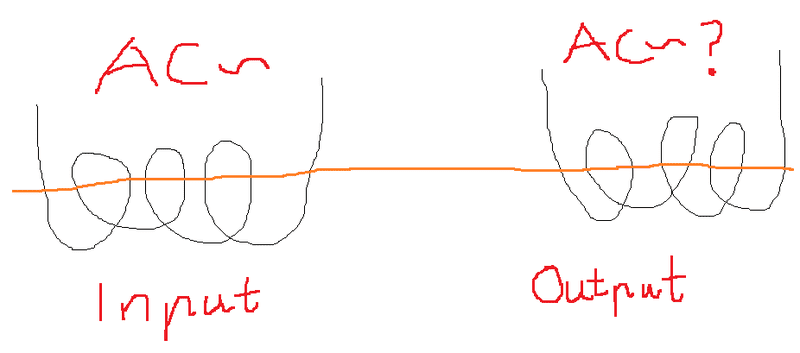
  • One participant suggests that the orange wire must be a loop to induce current, questioning its comparison to an antenna.
  • Another participant argues that a loop is not necessary, as a changing magnetic field can push electrons in the wire, likening it to Hall voltage in a moving conductor.
  • A participant expresses confusion over the Hall voltage concept and requests further clarification.
  • It is noted that no current would be induced in a wire aligned with the axis of a coil due to the direction of the magnetic fields.
  • A participant questions whether the induced electric field is in the phi direction, indicating a need for understanding the underlying physics.
  • One participant revises their earlier statement, suggesting that coiling the orange wire inside the black wire could facilitate electron movement.
  • Another participant proposes a configuration involving connecting the ends of green coils to create two transformers, suggesting laminated iron cores to enhance magnetic fields.
  • One participant asserts that using a single wire for the connection complicates the situation, stating that a high enough frequency could allow for two loop antennas instead of needing the green coils.
  • There is a general acknowledgment that electromagnetic interactions depend on the angles between currents, electric fields, and magnetic fields.

Areas of Agreement / Disagreement

Participants express differing views on the necessity of a loop for current induction and the effectiveness of using a single wire for power transmission. The discussion remains unresolved, with multiple competing ideas presented.

Contextual Notes

Participants reference complex concepts such as Hall voltage and transformer configurations, indicating a reliance on specific definitions and assumptions that may not be universally understood. The discussion also highlights the importance of frequency in electromagnetic applications.

pete20r2
Messages
22
Reaction score
0
Hello Physicists,
I am doing my final year of High School in Australia and our current topic is magnetism and related fields.

Physics is my favorite subject after maths and I tend to query a lot of things.

Here is my basic Idea:
attachment.php?attachmentid=35270&stc=1&d=1304772248.png


My basic instinct tells me that the orange wire must be a loop, so a current can be induced in it. If not, what are the comparisons between this wire and an Antenna?
 

Attachments

  • power.png
    power.png
    13.1 KB · Views: 605
Physics news on Phys.org
I don't think you would need it to be a loop. The changing B field will push the electrons in the orange wire . It will be similar to producing a hall voltage in a conductor moving in a B field.
 
"hall voltage in a conductor moving in a B field."
I did not understand any of that, can you please elaborate?
 
There would be no current induced in a wire that runs along the axis of one coil because the fields aren't in the right direction, I'm afraid.
 
My bad. Is this because the induced E field is in the phi direction.
 
Are you messing with me, I say I do not understand, and you say something more complex.
 
No I am not messing with you. the Ac current in the first loop will create a B field in the direction of the orange wire . And a changing B field will induce an E field . This induced E field will be in the direction of the current in a circular direction around the orange wire and won't cause electrons to flow in the orange wire. My first post was wrong. Maybe coil
the orange wire inside the black wire like a transformation then it will push the electrons.
 
So will something like this work:
attachment.php?attachmentid=35294&stc=1&d=1304840959.jpg
 

Attachments

  • coils.jpg
    coils.jpg
    27.9 KB · Views: 507
Yes i think that would work .
 
  • #10
pete20r2 said:
Are you messing with me, I say I do not understand, and you say something more complex.

The word "no" isn't complex. The reason why not, however, may be. Some of these questions don't have easy answers and there may be no point in looking for one.
 
  • #11
pete20r2 said:
So will something like this work:
attachment.php?attachmentid=35294&stc=1&d=1304840959.jpg

If you connected each end of the green coils together then you'd effectively have two transformers. Sling in some laminatediron cores to increase the magneticic fields and you would be describing the usual arrangement - which works,
 
  • #12
I only want 1 wire to connect the two systems, that is the only condition.
 
  • #13
So the least complex answer has to be NO.
E X C E P T if you use a high enough frequency, in which case you will have two loop antennae (the two red coils) so you may as well throw away the green ones and your single wire.
All this electromagnetic stuff works because of the angles between currents, electric fields and magnetic fields. Coils in the same plane or with their planes parallel will couple because the magnetic fields of each will 'coincide'. etc. etc.
 
  • #14
ok, thankyou.
 

Similar threads

  • · Replies 6 ·
Replies
6
Views
2K
  • · Replies 9 ·
Replies
9
Views
3K
Replies
8
Views
3K
  • · Replies 3 ·
Replies
3
Views
18K
  • · Replies 42 ·
2
Replies
42
Views
4K
  • · Replies 9 ·
Replies
9
Views
3K
  • · Replies 6 ·
Replies
6
Views
2K
  • · Replies 5 ·
Replies
5
Views
3K
  • · Replies 1 ·
Replies
1
Views
4K
Replies
3
Views
6K