101 in air flow dynamics please?

Click For Summary
SUMMARY

This discussion focuses on selecting the appropriate fan type for a DIY exhaust filter system designed to manage fumes from a device. The user, Nabil, compares an axial fan with a flow rate of 18 CFM and a maximum pressure of 0.12 inH2O against a centrifugal fan with a flow rate of 4.5 CFM and a maximum pressure of 0.39 inH2O. Key considerations include the restrictive 4 cm² inlet area and the need to achieve a minimum flow rate of 0.18 m³/min to effectively ventilate the closed environment of approximately 60,000 cm³. Recommendations include calculating pressure drops and examining fan curves to ensure compatibility with the system's requirements.

PREREQUISITES
  • Understanding of fluid dynamics principles, specifically Bernoulli's equation.
  • Familiarity with fan specifications, including flow rate and pressure ratings.
  • Basic knowledge of orifice flow calculations and pressure drop estimations.
  • Experience with simulation software, such as SolidWorks, for airflow analysis.
NEXT STEPS
  • Calculate pressure drops across the 4 cm² inlet using orifice flow equations.
  • Research fan curves for both axial and centrifugal fans to determine operational efficiency under specific conditions.
  • Estimate air changes per minute (ACM) based on fume generation rates and required ventilation.
  • Explore computational fluid dynamics (CFD) tools for more accurate airflow simulations.
USEFUL FOR

This discussion is beneficial for DIY enthusiasts, engineers, and hobbyists involved in HVAC design, particularly those working on exhaust systems and airflow management in confined spaces.

Nabil
Messages
2
Reaction score
0
Hi everyone,

I've got a newbie question which is probably more complex than I imagine so please bare with me. As a small DIY project I've trying to build a small exhaust filter system (A) for another device that produces undesirable fumes (B). I'm trying to work out if an axial fan (generates greater air flow) or a centrifugal fan (more air pressure) would be better.

The setup
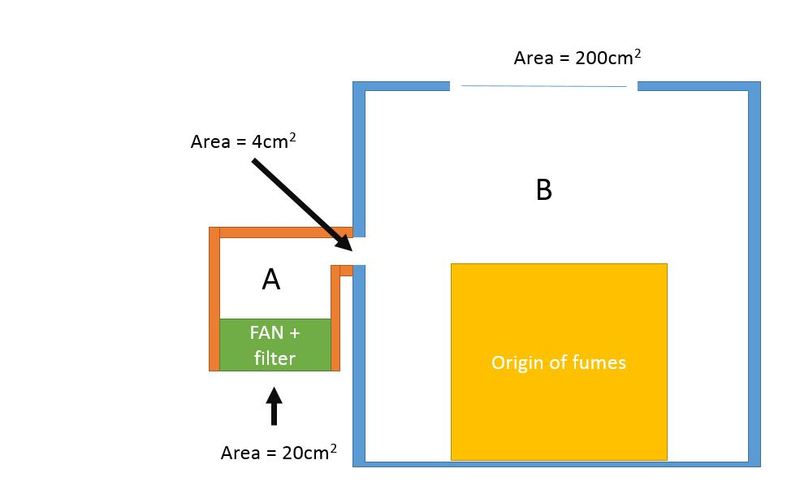
vauge_diagram.jpg

  • The exhaust (A) is connected to an inlet on the device (B) with an opening of an area of 4cm2. the outlet for A has an area of 20cm2
  • Device B besides the small 4cm2 outlet has an opening on the top with an area of appox 200 cm2. It is otherwise a closed environment. It has a volume of approx 60,000 cm3 or 0.06 m3
  • Environment has normal room temp of 21c and normal atmos. pressure.
The fans

Ideally I would like to be able simulate the effect of different extraction rates will have on the air flow in Device B. And considering picking up a solid works 30 day trail package to run some simulations. But for now to I've been trying to figure out what kind of fan would work best for my setup. My two considerations are:
  • An axial fan rated flow rate of 18 CFM (0.514 m3/min) and max + air pressure of 0.12 inH2O (3.04 mmH20).
  • A centrifugal fan rated flow rate of 4.5 CFM (0.12 m3/min) and max + air pressure of 0.39 inH2O (7.85 mmH20).
I'm guessing what I need to figure out is the resistance that will be caused by the 4cm2 inlet. I understand enough that the volume of space decreases, the air flow increases and pressure drops. But not sure what fluid dynamics equation I need to use to do my calculation. Bernoulli's equation seem like what I might need but not sure how to use it.

Any suggestions / advice would be most appreciated!

- Nabil
 
Engineering news on Phys.org
Any particular reason the connection between spaces A and B has an area of only 4 cm2? There's going to be quite a bit of restriction thru this connection.
Can this connection be enlarged?
 
SteamKing said:
Any particular reason the connection between spaces A and B has an area of only 4 cm2? There's going to be quite a bit of restriction thru this connection.
Can this connection be enlarged?

Hi SteamKing,

It's to do with the design of the device. I might be able to double it to perhaps 8 cm2, but I'm interested doing the calculations. If even 8 cm2 is too restrictive than I might need to start again with the problem. I know the centifugal fan should be fine with it as the outlet hole on the fan is it self about 4 cm SUP]2[/SUP]. But the airflow is quiet low. Based on other things I have researched, I think I want to be emptying out the volume of space in Device B at least about 3 time every minute for which I need a flow rate of 0.18 m3/min ideally. So I guess what I'm really trying to figure out is, hypothetically will the axial fan cut it...
 
Try this calculator for pressure drops across an orifice:

http://www.efunda.com/formulae/fluids/calc_orifice_flowmeter.cfm#calc

This is specifically for an orifice plate, but is probably ok for an initial estimate as long as the chamber after the 4 cm^2 outlet is significantly larger than 4 cm^2.

Treating the inlet and outlet as circular, back calculate the radii (A=Pi r^2, r =SQRT[A/Pi])
Inlet = 200m cm^2 --> 7.98 cm
Outlet = 4 cm^2 --> 1.13 cm

Note that you can mix units on this calculator.

Case 1: 0.12 inH2O (axial fan)
Case2: 0.39 inH2O (centrifugal fan)

Q[CFM], case 1 = 1.01 CFM
Q[CFM] case 2 = 1.82 CFM

You would need to look at fan curves to see if either of those fans will operate under these conditions. The centrifugal might work. I suspect you need a larger orifice. I would scope out this before trying CFD to see if you can find a design space that works.

Next step after determining your pressure drops and fan compatibility is to calculate air changes per minute and compare this with the expected fume generation rate.

Good luck!
 
First, you need to define the volumetric flow you need. Once this is done, you can start estimating the pressure drops across every components. This will give you different pressures reading like this:
vauge_diagram.jpg

Where:
P3 > Patm > P1 > P2;
P3 - Patm => pressure drop across filter;
Patm - P1 => pressure drop across entrance;
P1 - P2 => pressure drop across duct;
P3 - P2 => pressure drop across fan (what you need to know).

To help you understand better, I suggest this thread asking a question similar to yours, especially my post.
 

Similar threads

  • · Replies 9 ·
Replies
9
Views
2K
Replies
0
Views
2K
  • · Replies 45 ·
2
Replies
45
Views
6K
  • · Replies 31 ·
2
Replies
31
Views
5K
  • · Replies 11 ·
Replies
11
Views
3K
  • · Replies 2 ·
Replies
2
Views
4K
  • · Replies 3 ·
Replies
3
Views
3K
  • · Replies 1 ·
Replies
1
Views
2K
  • · Replies 17 ·
Replies
17
Views
3K
Replies
5
Views
3K