Discussion Overview
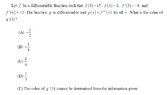
The discussion revolves around a calculus problem involving the derivative of a function defined as \( f(x) = 7x - 3 + \ln(x) \) and the evaluation of \( f'(1) \). Participants explore different approaches to solving the problem, including the use of inverse functions and derivatives.
Discussion Character
- Homework-related
- Mathematical reasoning
- Debate/contested
Main Points Raised
- One participant presents the function \( f(x) = 7x - 3 + \ln(x) \) and asks for the value of \( f'(1) \) while providing multiple choice answers.
- Another participant suggests starting with a different question related to derivatives, indicating a preference for a different level of difficulty.
- One participant proposes using the relationship between the derivatives of inverse functions, stating that \( g'(3) \) can be found using the derivative of \( f \) and its inverse.
- A later reply mentions that \( f(6) = 3 \) and provides a calculation for \( g'(3) \) based on the derivative \( f'(6) = -2 \), leading to \( g'(3) = -1/2 \).
- Participants express uncertainty and humor about their mathematical abilities, with some misreading options and correcting themselves.
Areas of Agreement / Disagreement
Participants do not reach a consensus on the solution to the original problem, and multiple approaches and interpretations are presented without resolution.
Contextual Notes
Some participants express confusion over the options provided and the calculations involved, indicating potential misunderstandings or misreadings of the problem.