[2 problems] Transverse Waves, Superpostion & Reflection

Click For Summary

Homework Help Overview

The discussion revolves around two problems related to transverse waves, specifically focusing on wave equations, superposition, and reflection. The first problem involves determining specific times for a transverse wave described by a mathematical equation, while the second problem concerns the behavior of a reflected pulse on a string with fixed endpoints.

Discussion Character

  • Exploratory, Conceptual clarification, Problem interpretation, Assumption checking

Approaches and Questions Raised

  • Participants discuss the calculations for the first problem, questioning the correctness of specific time values and the role of parameters like k in the wave equation. There is also confusion about the origin of certain values in the equation. For the second problem, participants express uncertainty about the behavior of the reflected pulse and how it affects the overall wave pattern, with some suggesting that the amplitude should remain unchanged upon reflection.

Discussion Status

The discussion is ongoing, with participants providing insights and clarifications on the first problem's calculations and the implications of wave reflection. Some participants have shared their interpretations and attempted to clarify the conditions under which the waves interact, but there is no explicit consensus on the correct answers for either problem.

Contextual Notes

Participants note that the first problem's answer is not provided by the homework platform, leading to uncertainty. Additionally, there is mention of the assumption that the wave does not lose energy upon reflection, which is a point of contention in the second problem.

mfu
Messages
5
Reaction score
0
Question 1
1. Homework Statement

The drawing shows a snapshot of a transverse wave traveling along a string at 9.6 m/s. The equation for the wave is y(x, t) = A cos(ωt + kx).
At what times could this snapshot have been taken? (Give the three smallest nonnegative possibilities.)

The Attempt at a Solution


Found the following:
A= 2mm
ω= 1507.96447 rad/s
k= 157.07963 rad/m

time1= 1.04ms
time2= 5.21ms
time3= 9.38ms

The problem I have is that time 1 is incorrect while the other 2 are. To find the times, I used the setup found in this post but with my values:
https://www.physicsforums.com/showpost.php?p=2690152&postcount=6

Not sure what I could be doing wrong. Also, could someone explain where the person got the 2pi, 4pi, and 6pi in the above link? Don't quite understand it.Question 2
1. Homework Statement

The pulse of the figure travels to the right on a string whose ends at x = 0 and x = 12.0 m are both fixed in place. Imagine a reflected pulse that begins to move onto the string at an endpoint at the same time the incident pulse reaches that endpoint. The superposition of the incident and reflected pulses gives the shape of the string. When is the next time t that the string referred to in the figure looks exactly as it does at t = 0? (Answer in seconds.)

Image:
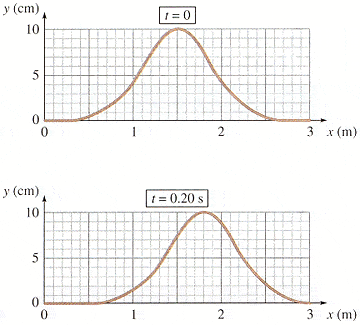
p11-38.gif


I have no idea what to do for this one. Just plain stumped. Any tips such as what equation(s) to use would be very helpful.

Thanks in advance to anyone that can help me with these 2 problems!
 
Last edited by a moderator:
Physics news on Phys.org
What is the correct answer for time 1? I think your calculations are correct.

The pi's come in because they satisfy the equation:

y(x, t) = A cos (wt + kx)
0.002m = 0.002m cos ((1508 rad/s)(t) + (157 rad/m)(0.03m))
1 = cos ((1508 rad/s)(t) + (157 rad/m)(0.03m))
arccos(1) = (1508 rad/s)(t) + (157 rad/m)(0.03m)

arccos(1) = 0, 2pi, 4pi etc..


The second problem is confusing, I don't understand this part: "Imagine a reflected pulse that begins to move onto the string at an endpoint at the same time the incident pulse reaches that endpoint."

The pulse in the picture starts with a positive amplitude, once it hits the right end it will be reflected and have a negative amplitude. If a "reflected pulse" begins at the same time the incident pulse reaches the endpoint, I would think you'd end up with a wave that has an amplitude twice that of each individual wave because they would be in perfect constructive interference both pointing down at the same time and place. This is assuming the reflected wave has the same wavelength and amplitude of the incident wave, but they don't specify what the second reflected pulse even looks like, or what its state was before it got reflected.

If the question was:
"The pulse of the figure travels to the right on a string whose ends at x = 0 and x = 12.0 m are both fixed in place. When is the next time t that the string referred to in the figure looks exactly as it does at t = 0? (Answer in seconds.)"

Then the trick is knowing that the wave won't look the same the very next time the crest is at x=1.5m, because it has been reflected and is now pointing down. Is there any more information for question 2? If not, then :confused:
 
For Q1, in which direction does the wave travel, to the left or to the right? This affects the value of k, since k can be either positive or negative.

For Q2, PiTHON almost got it. The assumption which must be made here is the wave won't lose its energy due to the collision, so that the amplitude of the wave stays unchanged after being reflected (note: Amplitude is a positive quantity. It always is. The reflected wave undergoes 180 degrees phase change relatively to the incident wave). After the 1st collision, the wave gets reflected the 1st time. Why isn't there the 2nd time, the 3rd time, etc? :smile:
 
Q1. U don't even need to bother about k. Just take the displacement of the particle at x=0.

Q2. Is the answer 7s??
 
@PiTHON:
I don't know the correct answer for time1. Using this webassign thing, and there's no answer key. If an answer's incorrect, it'll tell you, but won't tell you the correct answer.
& thank you for the explanation about the pi's. I understand now.

@hikaru:
Q1: The wave travels to the left.
Q2: This seems like it'll take a lot of counting...

@Swap:
Q1: Would that be 0? If so, I've already tried that, and it was incorrect.
Q2: Unfortunately, it isn't. Thanks anyways.
Edit: Got the answer for Q2. It was 16 seconds. Took a piece of graph paper, drew everything out, and started counting. Is there an easier way to do this?
 
Last edited:
Swap said:
Q1. U don't even need to bother about k. Just take the displacement of the particle at x=0.

You're wrong. Substitute your answers of t in y at any value of x but not 0, you will find some don't fit the graph.

mfu said:
Edit: Got the answer for Q2. It was 16 seconds. Took a piece of graph paper, drew everything out, and started counting. Is there an easier way to do this?

Is there really a lot of counting in this problem particularly? :smile:
I believe there isn't an easier way.
 
So am I to assume that there is nothing wrong with Q1 and that WebAssign is being a PoS?

And thanks to everyone that helped. I really appreciate it.
 

Similar threads

Replies
13
Views
2K
  • · Replies 9 ·
Replies
9
Views
2K
  • · Replies 6 ·
Replies
6
Views
2K
  • · Replies 8 ·
Replies
8
Views
2K
  • · Replies 3 ·
Replies
3
Views
2K
  • · Replies 2 ·
Replies
2
Views
3K
  • · Replies 9 ·
Replies
9
Views
3K
Replies
8
Views
2K
  • · Replies 5 ·
Replies
5
Views
2K
  • · Replies 1 ·
Replies
1
Views
2K