2 significant spot groups currently visible

  • Context: Stargazing 
  • Thread starter Thread starter davenn
  • Start date Start date
  • Tags Tags
    Groups
Click For Summary
SUMMARY

Two significant solar active regions, AR2671 and AR2672, are currently visible on the solar disk. AR2671 is located on the center-left, while AR2672 is near the eastern limb and will continue to rotate across the disk over the next two weeks. Both regions have a substantial likelihood of producing C-class flares. The discussion also highlights the complexities of image orientation when capturing solar images, particularly regarding the inversion of east-west and north-south poles.

PREREQUISITES
  • Understanding of solar active regions and their classifications
  • Familiarity with solar imaging techniques and equipment, such as refractors
  • Knowledge of image orientation and inversion in astronomical photography
  • Basic principles of solar observation and solar filters
NEXT STEPS
  • Research solar active regions and their impact on space weather
  • Learn about solar imaging techniques using refractor telescopes
  • Explore the effects of image inversion in astronomical photography
  • Investigate the characteristics of C-class solar flares and their implications
USEFUL FOR

Astronomy enthusiasts, solar observers, astrophotographers, and anyone interested in understanding solar activity and its effects on space weather.

davenn
Science Advisor
Gold Member
Messages
9,715
Reaction score
11,696
hi gang

there are currently 2 significant spot groups visible traversing the face of the solar disk

The centre-left string is active region 2671 and the region near the right edge ( eastern limb) is
active region 2672. AR2672 will continue to rotate across the disk across the next 2 weeks.

800mm, f9, 200th sec, ISO200 and solar filter
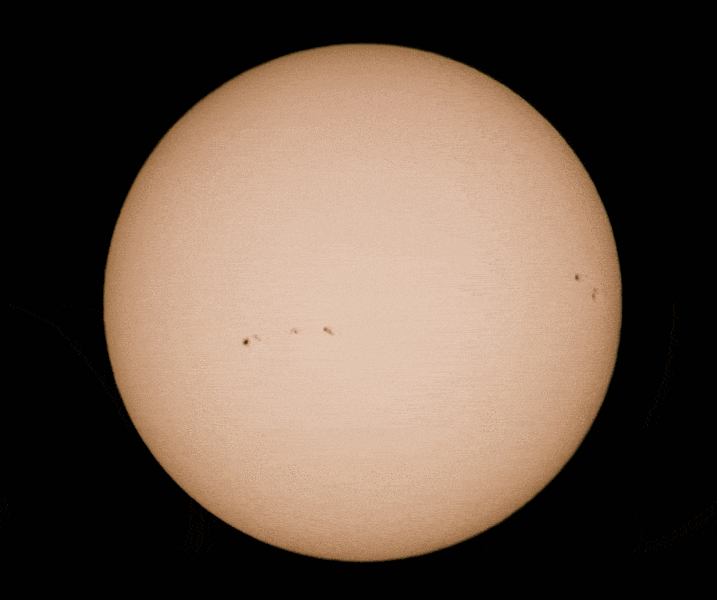
IMG_0933sm.gif
 
  • Like
Likes   Reactions: Stavros Kiri and FactChecker
Astronomy news on Phys.org
Cool picture.
Both groups have a good chance for C-class flares.
 
Last edited:
  • Like
Likes   Reactions: davenn
Was this picture taken morning hours? (to make sure I understand the orientation properly) Or pm hours and reverse image?
 
Stavros Kiri said:
Was this picture taken morning hours? (to make sure I understand the orientation properly) Or pm hours and reverse image?

West limb left side, east limb right side, not 100% certain if north pole is up or down ... I suspect it's up

this is visual view, non-telescope view as seen on spaceweather.com, sdac etc sites where E and W (and maybe N and S - not sure) are inverted
Tho I'm lead to believe that N and S poles are correct ( I haven't figured out how they invert E and W without doing the same to N and S poles ??)D
 
Last edited:
  • Like
Likes   Reactions: Stavros Kiri
Ok thanks Dave, that helps.
If it's visual view it must have been taken am hours, because that's how I see the sun in the morning. (In the afternoon and forth, if we do the "rotation" over our head, it turns upside down. [BTW, your being in the South Hemisphere I don't think it matters other than having the Sun to your left (instead of right) when you look East, this time of the year ... (simple Geometry).] )
 
I have a photo taken near the end of the eclipse Monday 8-21-2017 from Oregon. The photo above looks to be near midday. It is rotated 180 degrees. Both the E/W and N/S are swapped. This is the view as would be seen in an astronomical telescope. If you add a diagonal you get the N/S corrected but the E/W is still reversed. I will add a photo if I can figure out how.
 
  • Like
Likes   Reactions: Stavros Kiri
Len44 said:
This is the view as would be seen in an astronomical telescope.
It depends on the time.
Len44 said:
I will add a photo if I can figure out how.
Please do! You have to create media first, I think.
 
Screen Shot 2017-08-24 at 9.44.29 PM.png
The camera was tilted down on left a little to show more of the width of the sun. 11:33:01 PDT Aug 21, 2017. 2286mm (90 inches), f15, 100th sec, ISO 200 solar filter. Even though this is a 6" refractor it works just like a standard camera lens.
 
Len44 said:
View attachment 209698 The camera was tilted down on left a little to show more of the width of the sun. 11:33:01 PDT Aug 21, 2017. 2286mm (90 inches), f15, 100th sec, ISO 200 solar filter. Even though this is a 6" refractor it works just like a standard camera lens.
That's what I see pm hours. Is your image inverted for some reason?
Len44 said:
Even though this is a 6" refractor it works just like a standard camera lens.
?
 
  • #10
I am in the northern hemisphere at about 44.5 degrees north latitude. On checking an image that I took with the camera level I would say that the photo that I posted is rotated clockwise approximately 46 degrees. Otherwise it is exactly as was seen with the naked eye.
 
  • #11
Len44 said:
I am in the northern hemisphere at about 44.5 degrees north latitude. On checking an image that I took with the camera level I would say that the photo that I posted is rotated clockwise approximately 46 degrees. Otherwise it is exactly as was seen with the naked eye.
Is the small spot to the left, next to the moon, group region 2672? If yes (which I assume) then the orientation for am hours is that of a telescope view (unless your instruments are not upright; 46 degrees would still project similar view). In other words your image is almost inverted; I don't know why it is or how you managed it.
See also
https://www.physicsforums.com/threads/solar-activity-and-space-weather-update-thread.923468/
(posts #1, #2)

davenn's looks like am hours, visual view. That's what I also saw am hours back then (upright visual view image) ... etc.
[That's why I originally asked the 'hours' question.]
 

Similar threads

  • · Replies 444 ·
15
Replies
444
Views
57K
  • · Replies 38 ·
2
Replies
38
Views
6K
  • · Replies 16 ·
Replies
16
Views
8K
  • · Replies 2 ·
Replies
2
Views
3K
  • · Replies 21 ·
Replies
21
Views
5K
Replies
1
Views
3K
  • · Replies 17 ·
Replies
17
Views
5K
  • · Replies 1 ·
Replies
1
Views
4K
  • · Replies 94 ·
4
Replies
94
Views
12K