2nd Order Perturbation Theory Energy Correction

Join the discussion
Registration is free. Start your own thread to ask a follow-up.
5 replies · 4K views · last reply
electrogeek
Messages
14
Reaction score
1
Hi everyone,

I'm struggling with the proof for the second order energy correction for perturbation theory when substituting in the first order wavefunction. I have attached an image of my current proof for it below, but I'm not sure whether this is the correct approach for it (the H's in the calculations below are hamiltonian operators)! I'm still quite new to using Dirac notation for these calculations so thought I should double-check it.

Cheers!
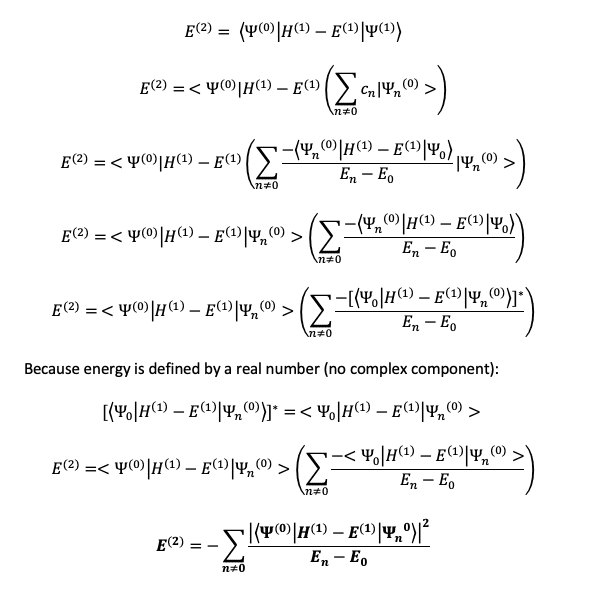
Handwritten-style derivation of the second-order perturbation energy correction E(2) in Dirac notation, progressing from a bra-ket expression to a sum over n not equal 0 of the squared matrix element divided by En minus E0, with a minus sign.
 
Physics news on Phys.org
You seem to have the right idea. Be careful you don't take objects outside of sums when they have the sum index (you have done this in your derivation). Second, check your use of the complex conjugate.
##\langle\psi|\hat{A}|\chi\rangle^*=\langle\chi|\hat{A}^{\dagger}|\psi\rangle##
 
  • Like
Likes   Reactions: electrogeek and vanhees71
Thank you for the help! I've now got to this stage which I've attached below instead of taking the ket out of the summation like I did previously:

Equation for second-order perturbation energy: E(2) = minus the sum over n not equal to 0 of [<Psi(0)|H(1) - E(1)|Psi_n> <Psi_n(0)|H(1) - E(1)|Psi(0)>] divided by (E_n - E_0).


But I'm confused why taking the complex conjugate of the first term in the numerator isn't just swapping around the terms in the bra and the ket?
 
Last edited:
Alright, good. I think you've ironed out the calculational problems.

electrogeek said:
But I'm confused why taking the complex conjugate of the first term in the numerator isn't just swapping around the terms in the bra and the ket?

When the operator sandwiched between the bra and ket is self-adjoint ##A^{\dagger}=A##, which is true for the Hamiltonians you are concerned with, then complex conjugating is "just swapping" the terms around. However, just because an operator is self-adjoint and has real eigenvalues that does not mean that a generic term ##\langle\psi|\hat{H}|\chi\rangle## is real.
 
Haborix said:
Alright, good. I think you've ironed out the calculational problems.
When the operator sandwiched between the bra and ket is self-adjoint $A^{\dagger}=A$, which is true for the Hamiltonians you are concerned with, then complex conjugating is "just swapping" the terms around. However, just because an operator is self-adjoint and has real eigenvalues that does not mean that a generic term ##\langle\psi|\hat{H}|\chi\rangle## is real.

Ah brilliant! Thank you very much for all the help. :)
 
  • Like
Likes   Reactions: Haborix