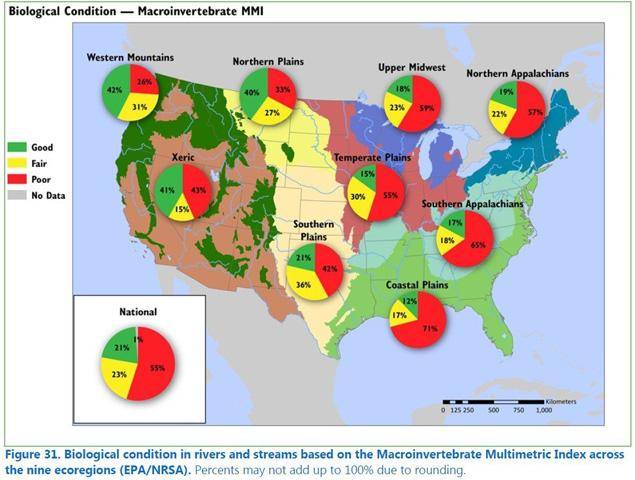
55% of the US rivers in poor condition

  • Thread starter Thread starter Greg Bernhardt
  • Start date Start date
  • Tags Tags
    Condition
Click For Summary

Discussion Overview

The discussion centers on the recent findings from the U.S. Environmental Protection Agency regarding the health of rivers and streams in the United States, specifically noting that 55% are classified as being in "poor" condition for aquatic life. Participants explore the implications of this data, the sources of pollution, and the effectiveness of current environmental policies.

Discussion Character

  • Debate/contested
  • Technical explanation
  • Exploratory

Main Points Raised

  • Some participants express concern over the high percentage of rivers in poor condition, questioning how much longer this situation can be tolerated.
  • Others highlight the impact of heavy metals from out-of-state sources, particularly from coal-fired power plants, on the health of Maine's waterways.
  • A participant notes that recommendations against consuming fish from contaminated waters indicate a broader issue of pollution that is not easily addressed at the state level.
  • Some argue that while there are signs of progress, such as reduced instances of rivers catching fire, the overall situation remains troubling.
  • Concerns are raised about the influence of powerful interests that resist environmental regulations and the challenges faced in addressing pollution that crosses state lines.
  • One participant questions the interpretation of the EPA report, suggesting that it does not clearly indicate a worsening trend over time and calls for more context regarding historical data.
  • Another participant points out that while some indicators of river health have improved since the 1970s, others have worsened, creating a mixed picture of progress.
  • There is discussion about the persistent problem of toxic sediments in rivers, with some suggesting that dredging may be necessary for cleanup.
  • Some participants argue that the current pollution issues are largely due to agricultural runoff and urban development, rather than point sources of pollution.
  • Concerns are raised about the lack of federal leadership in addressing airborne pollutants affecting local water quality, particularly in downwind states.
  • One participant critiques the media's portrayal of the EPA report, suggesting it may be misleading and lacks a comprehensive overview of the data presented.

Areas of Agreement / Disagreement

Participants express a range of views, with some agreeing on the seriousness of the pollution issue while others debate the interpretation of the EPA findings and the effectiveness of current environmental policies. There is no clear consensus on whether the situation is improving or worsening overall.

Contextual Notes

Participants note limitations in the EPA report, including the lack of a combined overall score for river health and the need for more historical context to assess trends accurately. The discussion also highlights the complexity of pollution sources and the challenges in addressing them.
Messages
19,879
Reaction score
10,886
55% of the US rivers in "poor" condition

A couple months old, but very troubling. How far do we let it slide?

Today, the U.S. Environmental Protection Agency released the results of the first comprehensive survey looking at the health of thousands of stream and river miles across the country, finding that more than half – 55 percent – are in poor condition for aquatic life.

http://yosemite.epa.gov/opa/admpress.nsf/0/26A31559BB37A7D285257B3A00589DDF

rivers-1-0326.jpg
 
Earth sciences news on Phys.org
It's a tough call. Maine's streams and rivers are poisoned with heavy metals from mid-west coal-fired power plants. If those pollutants can be choked off at the source, we would be much better off, but there are very powerful (wealthy) interests who fight and beat back any effort to clean them up.
 
BTW, when the Maine department of fish and wildlife strongly recommends that women of child-bearing age or pregnant women eat no live-caught fish from Maine waters due to mercury contamination, that's not something that we can fix within the state. It comes from elsewhere and drops on us.

Something similar happens every summer when we get rolling Ozone alerts. If you have a nice vacation home on the coast of Maine or an island, why should you put up with entire summer of elevated ozone. Not good.
 
Hey, at least the rivers aren't catching fire much any more. That's progress. Not impressive progress, but progress.
 
Pollution doesn't have any respect for borders.

I recall Mitt Romney's campaign promise to end the EPA.

Plenty of people foaming at the mouth in this country to pollute, trample, or otherwise despoil natural resources. Why? Because they are going to die someday and our dominant religions all preach that this here Earth is nothing but a Kleenex to wipe our butt with on the way to Heaven.

In my state, we stock the rivers, streams, and lakes with non-native hatchery fish so we can sell permits to truly brain-dead idiots living out a fantasy of a life living off the land.
 
Greg Bernhardt said:
How far do we let it slide?...

"Slide" implies a worsening trend over time. Curiously, I can't find a clear indication in that EPA summary that actually states the state of rivers are growing worse over time, rather only that the state of health is "poor", currently. For instance, "13,000 miles of rivers have fish with mercury levels that may be unsafe ...". Ok, "poor" compared to what? How much was there ten years ago? Fifty years ago? Have some pollutants improved while others worsened?
 
Last edited:
  • Like
Likes   Reactions: 1 person
You can click-through to the full report. It compares to a previous survey in 2004 and results on the change are mixed, with some indicators improving and others getting worse. 2004 is pretty recent though (the current report is for surveys from 2008-2009) and I'd be awfully surprised if there wasn't marked improvement since the 1970s, similar to how our air has improved.
 
russ_watters said:
You can click-through to the full report. It compares to a previous survey in 2004 and results on the change are mixed, with some indicators improving and others getting worse. 2004 is pretty recent though (the current report is for surveys from 2008-2009) and I'd be awfully surprised if there wasn't marked improvement since the 1970s, similar to how our air has improved.


One aspect that makes river cleanup a bit different is the toxic sediment at the bottom, much of it being persistent organics like PCB. I think the only way to get rid of it is to dredge, which isn't cheap.
 
aquitaine said:
One aspect that makes river cleanup a bit different is the toxic sediment at the bottom, much of it being persistent organics like PCB. I think the only way to get rid of it is to dredge, which isn't cheap.

Yes, though on the other hand my understanding is that those types of sources have largely stopped. They were mostly point sources - this factory, that rubbage pile. Then whatever is there at least should be growing no larger.

The problem now, apparently, is with nitrogen and phosphorus run off which to a degree is a linear product of more farms and residential development. Commercial development is leading the way there, with rules widely in place enforcing things like on-site retainage of storm water. Decades ago the commercial development paradigm used to be: find some undeveloped acres with storm water runoff X, develop the acres, pave them over which increases the storm water runoff to perhaps fifty X. Those days are over.
 
  • #10
In Maine, the mercury and cadmium (et al) heavy metal poisons polluting our lakes, streams, and rivers are air-borne from mid-west power-stacks. Without some federal leadership, this pollution will continue. There are no local point-sources that we can control at a state level, and it appears that there is no will in DC to rein in these polluters. Our congress is bought and controlled by big-money interests, and there seems to be little that citizens in down-wind states can do.
 
  • #11
russ_watters said:
You can click-through to the full report. It compares to a previous survey in 2004 and results on the change are mixed, with some indicators improving and others getting worse. 2004 is pretty recent though (the current report is for surveys from 2008-2009) and I'd be awfully surprised if there wasn't marked improvement since the 1970s, similar to how our air has improved.


There is a “trend” towards increasing pollution that is clearly stated here:
“A new report by the Environmental Protection Agency found that the majority of rivers and streams in this country can't support healthy aquatic life and the trend is going in the wrong direction. The report labels 55 percent of the nation's water ways as being in "poor" conidtion and another 23 precent as just "fair." Only 21 percent of rivers are considered "good" and "healthy biological communities." Even worse, the number of rivers and streams that qualify as "good" went down seven precent between 2004 and 2009.”
http://www.theatlanticwire.com/nati...-us-rivers-are-too-polluted-our-health/63579/
 
  • #12
turbo said:
In Maine, the mercury and cadmium (et al) heavy metal poisons polluting our lakes, streams, and rivers are air-borne from mid-west power-stacks. Without some federal leadership, this pollution will continue. There are no local point-sources that we can control at a state level, and it appears that there is no will in DC to rein in these polluters. Our congress is bought and controlled by big-money interests, and there seems to be little that citizens in down-wind states can do.
The only alternatives in most places to coal are natural gas and nuclear, with the latter having been chosen as the loser by government. Coal is starting to get phased out, mostly by natural gas, in the US. In Europe the opposite is happening, there is a coal renaissance underway. So look at the bright side, it could easily get a whole lot worse.
 
  • #13
Bob,
"Can't support healthy aquatic life" is referencing one of the criteria. In fact, what Greg posted in the OP is just one of several criteria and I don't see a combined, overall score anywhere (though it is listed as the "most comprehensive" of them). For example, page 65 says Phosphorous is 34% good, 40% poor. The others are total nitrogen, salinity, acidity, streambed sediment, in-stream fish habitat, riparian vegetative cover and riparian disturbance.

It also explicitly states in the report that two data points can't be considered a trend.

Disappointingly misleading synopsis from the Atlantic.
 
  • #14
Bobbywhy said:
There is a “trend” towards increasing pollution that is clearly stated here:

“...Even worse, the number of rivers and streams that qualify as "good" went down seven precent between 2004 and 2009.”

I think that synopsis from the AW is problematic. First, "rivers" needs to be dropped in a comparison. The 2008-9 report makes it clear that the comparison applies to streams only, as expected since the 2004 report was titled "Wadeable Streams Assessment". Specifically, the 2008-9 report states:

2008-9 National Rivers and Streams Assessment said:
It is important to note that these are differences for streams only, between two points in time.

and goes on to say

2008-9 National Rivers and Streams Assessment said:
Future surveys and more data are needed to discern trends and the reasons for those trends...
To detect trends in the condition of rivers and streams, more years of data will be necessary. ...
A change is not the same as a trend: it simply identifies the difference between two points in time.

The metrics that are compared include the "Macroinvertebrate MMI, total phosphorus, total nitrogen, in-stream fish habitat, riparian vegetative cover, and riparian disturbance" (pg 56). Comparisons ('04 vs '08-09) of, say, toxins like mercury PBCs, or the hydrocarbons the ignited in the Cuyahoga are not presented.

The seven percent change from '04 to '08-09 in the Macroinvertebrates is apparently driven entirely by the plains and lowland areas of the US. The Western US had no difference and the Eastern Highlands had no statistically significant difference (figure 28).

Finally:
The fact that the differences noted above are statistically significant does not automatically mean they are the result of human activities. Already, analysts have examined the relationships between the change in nutrients and in natural phenomena such as precipitation, stream flow, and drought, but they have found no reasons to explain the differences.
 
  • #15
mheslep, thanks for your definitive post, full of useful information. Russ W. also pointed out the misleading statement I quoted in that "Atlantic Wire" article. Yes, true that the definitions of just what is polluted were not very clear until your post. Slightly unclear to see the title "National Rivers and Streams Assessment" and then be advised that "rivers need to be dropped in a comparison".
 

Similar threads

  • · Replies 30 ·
2
Replies
30
Views
5K
  • · Replies 29 ·
Replies
29
Views
10K
  • · Replies 46 ·
2
Replies
46
Views
6K
Replies
3
Views
4K
  • · Replies 9 ·
Replies
9
Views
3K
Replies
28
Views
11K
  • · Replies 3 ·
Replies
3
Views
4K
  • · Replies 11 ·
Replies
11
Views
4K
  • · Replies 4 ·
Replies
4
Views
9K
  • · Replies 65 ·
3
Replies
65
Views
11K