A bit of help with a capacitor problem

  • Thread starter Thread starter bob92
  • Start date Start date
  • Tags Tags
    Bit Capacitor
Click For Summary

Homework Help Overview

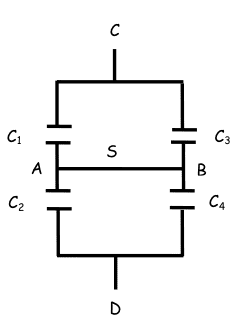
The problem involves a capacitor circuit with four capacitors (C1, C2, C3, and C4) and a switch that affects the charge distribution when opened. The original poster seeks to calculate the change in charge on C2 after the switch is opened, given the energy stored in C3.

Discussion Character

  • Mixed

Approaches and Questions Raised

  • Participants discuss the initial conditions of the circuit and the energy stored in C3, questioning the interpretation of the problem and the specific capacitors involved. There is confusion regarding whether the charge change pertains to C2 or C3, leading to clarifications about the question's wording.

Discussion Status

The discussion is ongoing, with participants attempting to clarify the problem statement and the calculations related to the energy and charge of the capacitors. Some guidance has been provided regarding the relationships between the capacitors when the switch is closed versus when it is opened.

Contextual Notes

There is ambiguity in the problem regarding the values of capacitance, particularly whether 12 F refers to microfarads (μF) or another unit. This uncertainty may affect the calculations and interpretations of the potential difference and charge stored in the capacitors.

bob92
Messages
4
Reaction score
0
1. The problem:
In the capacitor circuit shown below C1 = 4␣F, C2 = 12␣F, C3 = 12␣F, and C4 = 3␣F. The switch (S) between A and B is closed and the energy stored in C3 is 1.35x10⁻³ J. If the switch is now opened calculate the change in the charge on C2. Assume the potential difference between C and D is constant.
3UqNT.png
Here is the work that I have: (sorry the picture is too big to directly link)

http://i.imgur.com/qnTvK.jpg

The question asks what is the change in charge in C2 (the one on the lower left). The correct answer is -99uC but I can't even get my answer close.
 
Last edited:
Physics news on Phys.org
bob92 said:
1. The problem:
In the capacitor circuit shown below C1 = 4␣F, C2 = 12␣F, C3 = 12␣F, and C4 = 3␣F. The switch (S) between A and B is closed and the energy stored in C3 is 1.35x10⁻³ J. If the switch is now opened calculate the change in the charge on C2. Assume the potential difference between C and D is constant.

3UqNT.png


Here is the work that I have: (sorry the picture is too big to directly link)

http://i.imgur.com/qnTvK.jpg

The question asks what is the change in charge in C3 (the one on the top right). The correct answer is -99uC but I can't even get my answer close.

You either read the question incorrectly, or typed the question incorrectly - see red above.
 
Sorry, I apologize, I mean't C2. C3 is what is given at the start.
 
bob92 said:
Sorry, I apologize, I mean't C2. C3 is what is given at the start.

When did you mean C2 - in the question or in the answer?

You have still not removed the ambiguity.
 
C2 in the answer. The questions asks for the change in the charge of C2.
 
bob92 said:
1. The problem:
In the capacitor circuit shown below C1 = 4␣F, C2 = 12␣F, C3 = 12␣F, and C4 = 3␣F. The switch (S) between A and B is closed and the energy stored in C3 is 1.35x10⁻³ J. If the switch is now opened calculate the change in the charge on C2. Assume the potential difference between C and D is constant.

3UqNT.png


Here is the work that I have: (sorry the picture is too big to directly link)

http://i.imgur.com/qnTvK.jpg

The question asks what is the change in charge in C2 (the one on the lower left). The correct answer is -99uC but I can't even get my answer close.

Back to square 1 then.

If 1.35 x 10⁻³ J of energy is stored on C3, which has capacitance 12μF, what is the PD across it, and what charge is stored on it.
 
1.35 x 10⁻³ J would imply a PD of .015 using formula E=(CV^2)/2, so V = .015. Using the formula C = Q/V, gives the charge on c3 to be .18C
 
bob92 said:
1.35 x 10⁻³ J would imply a PD of .015 using formula E=(CV^2)/2, so V = .015. Using the formula C = Q/V, gives the charge on c3 to be .18C

Very small Voltage there. When you stated in the original 12␣F did you mean 12 μF or what?

With 12μF I get 15V [and a charge of 180 μC]

EDIT: DOn't just accept my figures, I could easily be out by a factor of 10
 
bob92 said:
1.35 x 10⁻³ J would imply a PD of .015 using formula E=(CV^2)/2, so V = .015. Using the formula C = Q/V, gives the charge on c3 to be .18C

Just checking that you realize that with the switch closed, we have C1 and C3 connected in parallel, and C2 and C4 connected in parallel, and those two pairs connected in series,

But when the switch is open, we have C1 and C2 in series, and C3 and C4 in series, and each of those pairs connected in parallel.
 

Similar threads

Replies
5
Views
1K
  • · Replies 15 ·
Replies
15
Views
1K
  • · Replies 1 ·
Replies
1
Views
4K
  • · Replies 2 ·
Replies
2
Views
14K
  • · Replies 8 ·
Replies
8
Views
2K
  • · Replies 9 ·
Replies
9
Views
2K
  • · Replies 4 ·
Replies
4
Views
4K
  • · Replies 19 ·
Replies
19
Views
3K
  • · Replies 9 ·
Replies
9
Views
2K
  • · Replies 9 ·
Replies
9
Views
3K