A Conceptual Difficulty regarding Potentials

Click For Summary
SUMMARY

The discussion centers on the conceptual difficulty regarding electric potential differences in two conducting spheres, one charged with +Q and the other neutral. The user incorrectly concludes that the potential at point A (left surface) equals that at point B, and similarly, that the potential at point B equals that at point C (right surface). However, the user fails to recognize that while the electric field (E) is zero inside a conductor, the potentials can differ due to the induced charges on the neutral sphere, leading to the conclusion that VA is not equal to VC.

PREREQUISITES
  • Understanding of electric potential and electric fields
  • Familiarity with the concept of induced charges
  • Knowledge of conductors in electrostatics
  • Proficiency in applying the equation dV = -E.dr
NEXT STEPS
  • Study the principles of electrostatics in conductors
  • Learn about electric potential differences in charged systems
  • Explore the concept of induced charges and their effects on potential
  • Review the mathematical implications of dV = -E.dr in various scenarios
USEFUL FOR

Students and educators in physics, particularly those focusing on electrostatics, as well as anyone seeking to clarify concepts related to electric potential and charge induction in conductors.

Avi1995
Messages
21
Reaction score
0
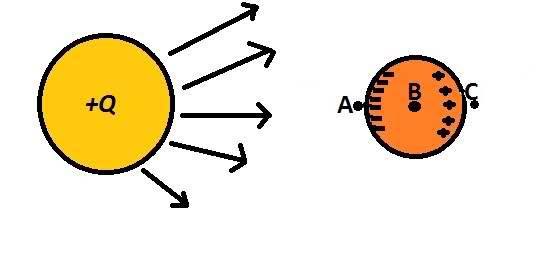
Plz help me out with this difficulty. Here is a figure showing two conducting spheres(haven't drawn all EF lines):-
24b1yyg.jpg


Here is the problem, Suppose one of the spheres is charged with a charge +Q, other is neutral
, so charges will get induced as shown in figure. The left portion of orange sphere(neutral one)
is at lower potential than the right portion because it has -ve charge and other is +ve.
Since E=0 inside a conductor, we have:-
dV=-E.dr
so if we move from the point A(on left surface) to B, since E=0 we have,
dV=0
so VA =VB
Now if we move from the point C(on right surface) to B, since E=0 we have,
dV=0
so VB =VC
but Va<Vc??
What is wrong in this reasoning?


Homework Equations


dV=-E.dr
 
Physics news on Phys.org
Avi1995 said:
Plz help me out with this difficulty. Here is a figure showing two conducting spheres(haven't drawn all EF lines):-
24b1yyg.jpg


Here is the problem, Suppose one of the spheres is charged with a charge +Q, other is neutral
, so charges will get induced as shown in figure. The left portion of orange sphere(neutral one)
is at lower potential than the right portion because it has -ve charge and other is +ve.
Since E=0 inside a conductor, we have:-
dV=-E.dr
so if we move from the point A(on left surface) to B, since E=0 we have,
dV=0
so VA =VB
Now if we move from the point C(on right surface) to B, since E=0 we have,
dV=0
so VB =VC
but Va<Vc??
What is wrong in this reasoning?


Homework Equations


dV=-E.dr
The conclusion in sentence I put in RED above is wrong.
 

Similar threads

Replies
9
Views
1K
Replies
1
Views
2K
  • · Replies 31 ·
2
Replies
31
Views
4K
  • · Replies 11 ·
Replies
11
Views
2K
  • · Replies 21 ·
Replies
21
Views
5K
  • · Replies 3 ·
Replies
3
Views
2K
  • · Replies 22 ·
Replies
22
Views
4K
Replies
2
Views
1K
  • · Replies 31 ·
2
Replies
31
Views
4K
  • · Replies 1 ·
Replies
1
Views
5K