A-level Mechanics Q3: Need Help w/Calculations

Click For Summary

Discussion Overview

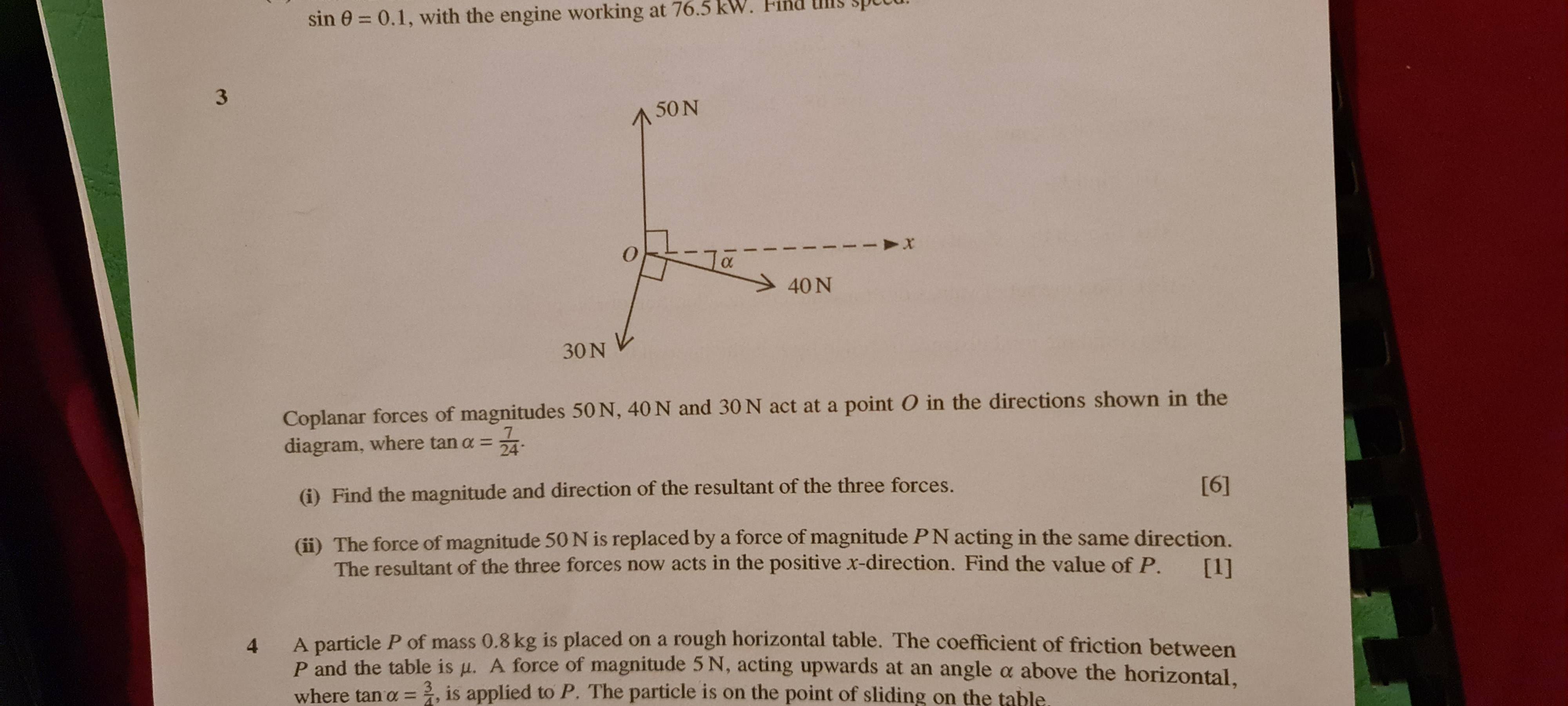
The discussion revolves around a specific mechanics problem from an A-level examination, focusing on the calculations involving vector components of forces. Participants seek clarification on how to correctly add these vectors, particularly in the context of coplanar forces.

Discussion Character

  • Homework-related
  • Mathematical reasoning
  • Technical explanation

Main Points Raised

  • One participant expresses confusion regarding the calculations involving a 30 N force and its components.
  • Another participant suggests adding the vectors by components, specifically mentioning the x and y components of the forces.
  • It is noted that the three forces are coplanar, which implies that only x and y components need to be considered.
  • Mathematical expressions for the sum of forces in the x and y directions are provided, along with the formula for the net force and the angle of the resultant force.
  • A later reply acknowledges a previous mistake regarding the interpretation of coplanar forces.

Areas of Agreement / Disagreement

Participants generally agree on the approach of adding vector components, but there is no consensus on the specific calculations or interpretations of the forces involved, as some confusion remains.

Contextual Notes

The discussion highlights the importance of correctly identifying the components of forces and the implications of the forces being coplanar. There are unresolved aspects regarding the calculations and the specific values used in the expressions.
Shah 72
MHB
Messages
274
Reaction score
0
It's question 3. Iam getting a bit confused with the calculations. Pls help
16416601983832410753386798256662.jpg
 
Mathematics news on Phys.org
On which part are you stuck? In each case you add the vectors by components.

-Dan
 
topsquark said:
On which part are you stuck? In each case you add the vectors by components.

-Dan
Iam getting confused with 30 N.
So f(x) = 40cos alpha - 30 cos alpha
F(y) = 40 sin alpha - 30 sin alpha
 
You have three forces, each having x, y, and z components. So:
[math]40 ~ cos( \alpha ) \hat{i} ~ + 40 ~ sin( \alpha ) \hat{j} ~ \text{N}[/math]

[math]30 \hat{j} ~ \text{N}[/math]

[math]50 \hat{k} ~ \text{N}[/math]

Add them and you get F.

-Dan
 
the problem statement says the three given forces are coplanar, so you are dealing with x and y components …

$\sum F_x = 0 + 40\cos{\alpha} - 30\sin{\alpha}$

$\sum F_y = 50 - 40\sin{\alpha} - 30\cos{\alpha}$

$|F_{net}| = \sqrt{(\sum F_x)^2+(\sum F_y)^2}$

$\theta = \arctan\left(\dfrac{\sum F_y}{\sum F_x}\right)$
 
"Co-planar forces" Hee hee. Sorry for the mistake!

-Dan
 
skeeter said:
the problem statement says the three given forces are coplanar, so you are dealing with x and y components …

$\sum F_x = 0 + 40\cos{\alpha} - 30\sin{\alpha}$

$\sum F_y = 50 - 40\sin{\alpha} - 30\cos{\alpha}$

$|F_{net}| = \sqrt{(\sum F_x)^2+(\sum F_y)^2}$

$\theta = \arctan\left(\dfrac{\sum F_y}{\sum F_x}\right)$
Thank you so so much!
 

Similar threads

  • · Replies 4 ·
Replies
4
Views
1K
  • · Replies 2 ·
Replies
2
Views
2K
  • · Replies 9 ·
Replies
9
Views
2K
  • · Replies 3 ·
Replies
3
Views
2K
  • · Replies 12 ·
Replies
12
Views
1K
  • · Replies 20 ·
Replies
20
Views
1K
  • · Replies 1 ·
Replies
1
Views
1K
  • · Replies 9 ·
Replies
9
Views
2K
  • · Replies 5 ·
Replies
5
Views
1K
Replies
2
Views
1K