A multivariate function of Toruses - tangent vectors

Click For Summary
The discussion revolves around solving a problem related to toruses and tangent vectors, specifically focusing on part c of the assignment. The user initially believes that tangent vectors are multiplied by a factor of sqrt(2) due to the orthogonality of the planes involved. They calculated the metric and found it useful for determining the length of tangent vectors, ultimately arriving at a solution of 2. However, they later expressed confusion about visualizing tangent vectors in polar coordinates and acknowledged that their earlier solutions were incorrect. The conversation emphasizes the importance of understanding the mapping of tangent vectors and the application of the metric in this context.
docnet
Messages
796
Reaction score
486
Homework Statement
this map multiplies all lengths of tangent vectors by the same factor. what is the factor?
Relevant Equations
p^2+q^2=1
r^2+s^2=1

w^2+x^2=1
y^2+z^2=1

w=pr+qs
x=qr-ps
y=pr-qs
z=qr+ps
Thank you to all those who helped me solve my last question. This week, I've been assigned an interesting problem about toruses. I think I've solved most of this problem on my own, but I'd like to hear a few suggestions for part c.
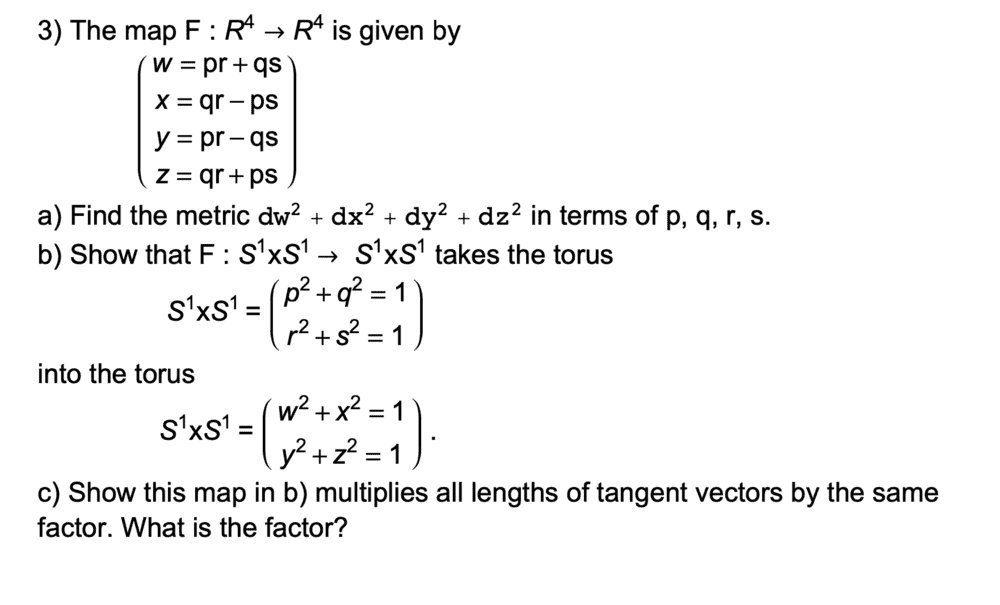
Screen Shot 2020-10-09 at 10.01.51 PM.png


I think this map multiplies tangent vectors by a factor of sqrt(2). We can think of tangent vectors as velocity while traveling along a curve on the surface. From simply plotting points, we know if travel around the pq plane or the rs plane once, we travel around both the wx and yz planes. We also know the two planes are orthogonal to each other because it's the definition of the torus under this equation. Under this map, the velocity gains an additional orthogonal component of equal magnitude, and from Pythagorean theorem the net magnitude is sqrt(1+1) = sqrt(2).

Is my intuition correct?

I've calculated the metric in part a and solved part b. but, I don't think these parts will help with c. thanks
 
Physics news on Phys.org
The metric tells you how to compute the length of tangent vectors. Maybe it can help?
 
  • Like
Likes docnet
If you set (p,q,r,s) = (\cos \theta, \sin \theta, \cos \phi, \sin \phi) you will find that in appropriate charts the map sends (\theta, \phi) to (\zeta, \eta) = (\theta - \phi, \theta + \phi). Thus a tangent vector X = \alpha \frac{\partial}{\partial \theta} + \beta\frac{\partial}{\partial \phi} is mapped to Y = (\alpha + \beta)\frac{\partial}{\partial \zeta} + (\alpha - \beta)\frac{\partial}{\partial \eta}. You can assume that all of the basis vectors are orthogonal with unit norm.
 
  • Informative
Likes docnet
Office_Shredder said:
The metric tells you how to compute the length of tangent vectors. Maybe it can help?

Thank you. I ended up using the metric and found the answer to be 2.
pasmith said:
If you set (p,q,r,s)=(cos⁡θ,sin⁡θ,cos⁡ϕ,sin⁡ϕ) you will find that in appropriate charts the map sends (θ,ϕ) to (ζ,η)=(θ−ϕ,θ+ϕ). Thus a tangent vector X=α∂∂θ+β∂∂ϕ is mapped to Y=(α+β)∂∂ζ+(α−β)∂∂η. You can assume that all of the basis vectors are orthogonal with unit norm.

Sorry I'm having trouble visualizing these tangent vectors. How does one understand tangent vectors in polar coordinates?

Thanks,
 

Attachments

Last edited:
I realized my solutions are wrong. How do I delete my previous post?
 
Here are the complete solutions to the problem. Feel free to let me know if you see an error :)
Screen Shot 2020-10-13 at 3.16.23 PM.png
Screen Shot 2020-10-13 at 3.16.31 PM.png
Screen Shot 2020-10-13 at 3.16.38 PM.png
Screen Shot 2020-10-13 at 3.16.45 PM.png
 
Question: A clock's minute hand has length 4 and its hour hand has length 3. What is the distance between the tips at the moment when it is increasing most rapidly?(Putnam Exam Question) Answer: Making assumption that both the hands moves at constant angular velocities, the answer is ## \sqrt{7} .## But don't you think this assumption is somewhat doubtful and wrong?

Similar threads

  • · Replies 2 ·
Replies
2
Views
2K
  • · Replies 6 ·
Replies
6
Views
2K
  • · Replies 10 ·
Replies
10
Views
3K
  • · Replies 8 ·
Replies
8
Views
2K
  • · Replies 2 ·
Replies
2
Views
2K
  • · Replies 17 ·
Replies
17
Views
4K
  • · Replies 4 ·
Replies
4
Views
2K
  • · Replies 3 ·
Replies
3
Views
4K
  • · Replies 4 ·
Replies
4
Views
4K
Replies
2
Views
3K