A non-spherical Earth's gravitational potential?

Click For Summary

Discussion Overview

The discussion revolves around the mathematical treatment of Earth's gravitational potential, particularly focusing on the Legendre polynomial expansion and its implications for understanding the non-sphericity of Earth. Participants explore the geometrical interpretation of various terms in the expansion, their physical meanings, and the relationship between these terms and the Earth's mass distribution.

Discussion Character

  • Exploratory
  • Technical explanation
  • Conceptual clarification
  • Debate/contested

Main Points Raised

  • Some participants discuss the significance of each term in the harmonic expansion, suggesting that they reflect the Earth's shape and density distribution, with higher degree harmonics capturing more localized features like mountains.
  • One participant explains the zero-th, first, second, and third degree terms as monopole, dipole, quadrupole, and octopole moments, respectively, relating them to moments of inertia.
  • Another participant questions how the expansion terms mathematically account for the Earth's features that cause these harmonics, expressing confusion about the concept of "octopole moment."
  • A comparison is made to electrostatics, where the behavior of potentials from point charges is discussed to illustrate the concept of multipole moments.
  • Participants note that the real Earth is better approximated by a combination of multipole moments rather than a single isolated charge, with practical applications in astrodynamics often using a limited number of terms from the expansion.

Areas of Agreement / Disagreement

Participants express varying levels of understanding regarding the implications of the expansion terms and their physical meanings. There is no consensus on the interpretation of the octopole moment or how the expansion terms relate to physical features of the Earth.

Contextual Notes

Some participants reference the mathematical foundations of the multipole expansion and its relation to gravitational potential, indicating that the discussion is grounded in complex theoretical frameworks that may not be fully resolved.

patric44
Messages
308
Reaction score
40
hi guys
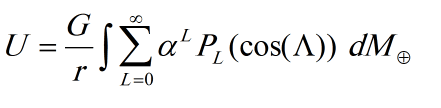
i was reading a book on astrodynamics and was trying to understand the mathematical treatment of the Earth gravitational potential . i kinda understand the main idea , after reaching the following equation of the potential in terms of the Legendre polynomials :
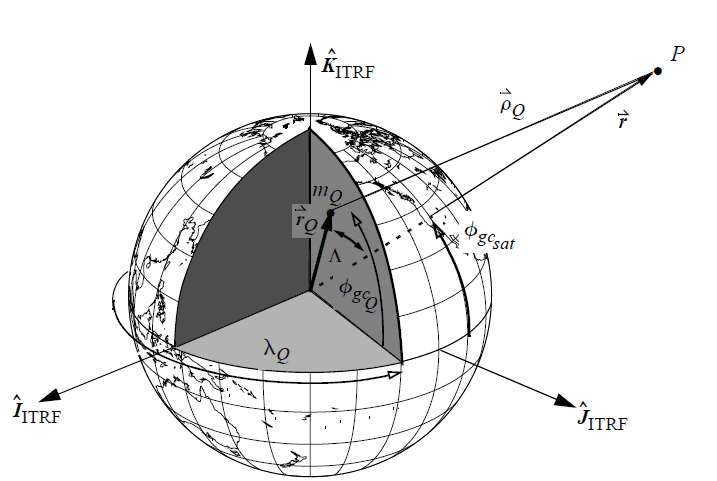
earht.png

potential.png

##\alpha = r_{Q}/r##

i am really interested in the geometrical interpretation of this equation which is known as MacCullagh’s method , the 1st , 2nd and the third expansion terms was some how understandable in which they some how determine the moment of inertia and different mass distribution contribution to the non sphereicity , but i am curious abut the 4th term :

potential2.png

it some how seems like we start the series with the regular spherical potential and each successive term held some kind a contribution to the non sphericity so every term should have a physical meaning , right! , what this term mean is it also some kind of a fancy combination of moment of inertial around some point or something ?!
 
  • Like
Likes   Reactions: etotheipi and Delta2
Physics news on Phys.org
Every term in the harmonic expansion reflects more "fine structure" regarding the shape of the Earth, but also the density distribution of the Earth as well. For example, Mt Everest alone is pretty local, as far as the whole Earth is concerned, but Mt Everest alone would contribute to higher degree harmonics. I think the number of harmonics in some Earth models is up to order 2190, with over 4 million coefficients, with higher order models to come. These coefficients for these harmonics are obtained by fitting local gravity observations throughout the entre world. Geodesists realize it is not fruitful to characterize the harmonics based on "what would be expected physically", based on the order. There are just too many coefficients.

For more detail Heiskanen and Moritz is sort of the bible among geodesists.
 
  • Informative
  • Like
Likes   Reactions: etotheipi, vanhees71 and patric44
If I may add a more satisfactory answer to your question. The zero-th degree is the spherical monopole expansion in the gravitational potential. The first degree term is the dipole expansion. The second degree term is the quadrupole term and related to the moments of inertia which are integral r squared dm's, the third degree term is (spherical) octopole moments, etc
 
  • Like
Likes   Reactions: patric44
thanks so much for the explanation , i have a little question : how the expansion terms mathematically knows that there is something on the Earth that might cause that harmonic?! , or am i missing something , i am sorry i don't really get what you mean by "octopole moment" can you explain it a little bit 😅
 
It might be worth considering multipole moments in electrostatics.
A point charge q has a potential that falls off as 1/r.

Take two point charges q and -q, separated by a distance d, but still centered at the origin... an electric dipole.
How does the potential behave far away, at large r?
Since the net charge is zero, there is no monopole term...
This follows by superposition...
far away, the opposite sign potentials from these slightly displaced charges almost cancel.

Now take two identical dipoles and flip one and displace them slightly...
so it looks like a square centered at the origin, with alternating charges as one walks around the square.
How does the potential behave far away, at large r?
Since the net charge is zero, there is no monopole term.
The dipole term is also zero.

Keep going.

Here's a figure from Griffiths Introduction to Electrodynamics.
1608415812411.png
 
  • Like
Likes   Reactions: etotheipi, patric44 and Delta2
robophy covered it quite well. The real Earth does not look like one isolated charge. One charge with a dipole is a better approximation. A charge with a dipole and a quadrupole would be better still. A charge with a dipole and a quadrupole and an octopole would be even better. Ad infinitum.

In practice in Astrodynamics, it looks like you may be using Vallado, or Bate Mueller White, you do not use all 2190 terms in the latest Earth gravity model. I think (I do not know for sure) GPS uses only around 15 -20 order (perhaps 400 total coefficients) for their ephemeris. Other applications in astrodynamics do not even extend to this order.
 
patric44 said:
thanks so much for the explanation , i have a little question : how the expansion terms mathematically knows that there is something on the Earth that might cause that harmonic?! , or am i missing something , i am sorry i don't really get what you mean by "octopole moment" can you explain it a little bit 😅
In textbooks you usually find this in electrodynamics texts. The good thing is you only need electrostatics. The reason is that Newtonian gravity is just a field theory with the graivtational potential ##\Phi(\vec{x})## fulfilling the Poisson equation,
$$-\Delta \Phi=-4 \pi \gamma \rho,$$
where ##\gamma## is Newton's gravitational constant and ##\rho## the mass density.

In the following we assume that there's a sphere of radius ##R## within the entire mass distribution (in this case the Earth) is located, i.e., ##\rho(\vec{x})=0## for ##r=|\vec{x}|>R##.

The general solution is as for the electrostatic Coulomb field
$$\Phi(\vec{x})=-\gamma \int_{\mathbb{R}} \mathrm{d}^3 x' \frac{\rho(\vec{x}')}{|\vec{x}-\vec{x}'|}.$$
Now the idea of the multipole expansion is to expand the corresponding Green's function of the (negative) Laplace operator in terms of spherical harmonics
$$G(\vec{x}-\vec{x}')=\frac{1}{4 \pi |\vec{x}-\vec{x}'|}=\sum_{\ell=0}^{\infty} \frac{r_{<}^{\ell}}{(2 \ell+1)r_{>}^{\ell+1}} \sum_{m=-\ell}^{\ell} \text{Y}_{\ell m}^*(\vartheta',\varphi') \text{Y}_{\ell m}(\vartheta,\varphi),$$
Here ##(r,\vartheta,\varphi)## and ##(r',\vartheta',\varphi')## are the spherical coordinates of ##\vec{x}## and ##\vec{x}'##, respectively and ##r_{>}=\text{max}(r,r')## and ##r_{<}=\text{min}(r,r')##.

Plugging this into the solution you get
$$\Phi(\vec{x})=-\gamma \sum_{\ell=0}^{\infty} \sum_{m=-\ell}^{\ell} \frac{P_{\ell m}}{r^{\ell}} \text{Y}_{\ell m}(\vartheta,\varphi)$$
with the multipole moments
$$P_{\ell m}=\int_{0}^{R} \mathrm{d} r' \int_0^{\pi} \mathrm{d} \vartheta \int_0^{2 \pi} \frac{4 \pi}{2 \ell+1} r^{\prime \ell+2} \text{Y}_{\ell m}^{*}(\vartheta,\varphi) \rho(\vec{r}').$$
 
  • Informative
Likes   Reactions: etotheipi

Similar threads

  • · Replies 9 ·
Replies
9
Views
2K
  • · Replies 4 ·
Replies
4
Views
1K
  • · Replies 2 ·
Replies
2
Views
2K
  • · Replies 2 ·
Replies
2
Views
3K
  • · Replies 7 ·
Replies
7
Views
3K
Replies
8
Views
15K
  • · Replies 1 ·
Replies
1
Views
1K
  • · Replies 1 ·
Replies
1
Views
2K
  • · Replies 1 ·
Replies
1
Views
2K
  • · Replies 3 ·
Replies
3
Views
1K