Homework Help Overview
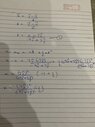
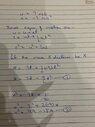
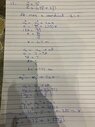
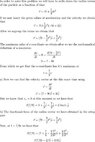
The discussion revolves around a particle motion problem in the x-y plane with constant acceleration. The original poster describes a scenario where a particle starts from the origin with an initial velocity and experiences a constant acceleration, leading to questions about its maximum x-coordinate, velocity, and position vector at that point.
Discussion Character
- Exploratory, Conceptual clarification, Mathematical reasoning, Problem interpretation, Assumption checking
Approaches and Questions Raised
- Participants explore the relationship between initial velocity, acceleration, and the maximum x-coordinate. They raise questions about the velocity at the maximum position and the time taken to reach that position. Some participants suggest focusing on the x-direction first before considering the y-motion.
Discussion Status
The discussion is ongoing, with participants providing hints and guidance on how to approach the problem. There are multiple interpretations of the velocity at the maximum x-coordinate, and some participants are working through the equations while others are questioning their assumptions about the motion.
Contextual Notes
Participants note potential confusion regarding the orientation of the motion in the xy-plane and the implications of using rounded versus unrounded values in calculations. There is also mention of the need to clarify the definitions and properties of maximum values in the context of the problem.