A particle motion problem in the x-y plane with constant acceleration

Click For Summary
The discussion focuses on solving a particle motion problem in the x-y plane with constant acceleration. The initial conditions include an x-velocity of 7 m/s and an x-acceleration of -9 m/s². Participants clarify how to determine the x-velocity at the maximum x-coordinate, the time to reach that coordinate, and the maximum x-coordinate itself, emphasizing the importance of using correct equations and avoiding rounding errors. The conversation also touches on the independence of x and y motion, with the particle's trajectory being analyzed in two dimensions. Overall, the problem-solving approach involves understanding the relationship between velocity, acceleration, and position in the context of kinematics.
  • #31
rudransh verma said:
@haruspex what path does the particle take in xy plane? Can you draw?
The acceleration is constant. What familiar path results from constant acceleration?
 
Physics news on Phys.org
  • #32
haruspex said:
The acceleration is constant. What familiar path results from constant acceleration?
Since the position vector is quadratic so it will be a parabolic path.
Idk about constant acceleration path.
 
  • #33
rudransh verma said:
Idk about constant acceleration path.
What planet are you on?
 
  • Haha
  • Like
Likes SammyS, Steve4Physics and rudransh verma
  • #34
haruspex said:
What planet are you on?
Not linear
 
  • #35
rudransh verma said:
Since the position vector is quadratic so it will be a parabolic path.
Idk about constant acceleration path.
In this case: is the position vector quadratic?
In this case: is acceleration constant?
In the general case: if acceleration is constant, will the position vector be quadratic?

If a ball is thrown in vacuum with constant gravity, its trajectory is parabolic, yes?
If you rotate the coordinate system, is its trajectory still parabolic?
 
  • #36
haruspex said:
Sure.
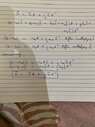
To get the scalar eqns from the vector, take the dot product with, respectively, ##\hat x, \hat y##.
Conversely, multiply the scalar equns by respectively, ##\hat x, \hat y##, and add them to produce the vector equn.
Still working on latex
 

Attachments

  • image.jpg
    image.jpg
    47 KB · Views: 135
  • #37
rudransh verma said:
Still working on latex
Yes.
 

Similar threads

Replies
5
Views
2K
Replies
30
Views
1K
  • · Replies 9 ·
Replies
9
Views
1K
  • · Replies 35 ·
2
Replies
35
Views
5K
Replies
1
Views
780
Replies
9
Views
2K
  • · Replies 2 ·
Replies
2
Views
974
  • · Replies 8 ·
Replies
8
Views
2K
  • · Replies 40 ·
2
Replies
40
Views
2K
Replies
25
Views
1K