A problem involving Riemann Integrals

  • Thread starter Thread starter fylth
  • Start date Start date
  • Tags Tags
    Integrals Riemann
Click For Summary

Homework Help Overview

The discussion revolves around problems involving Riemann integrals, with participants expressing confusion regarding the material taught in their course compared to the questions posed. The original poster seeks hints or guidance to navigate the discrepancies between their understanding and the requirements of the problems.

Discussion Character

  • Exploratory, Assumption checking, Problem interpretation

Approaches and Questions Raised

  • Participants discuss the non-negativity of a specific function related to Riemann integrals and explore the implications of expanding it as a polynomial. There are inquiries about the meaning of certain integral symbols that have not been covered in their coursework. Some participants express a desire for clarification on concepts like Hölder's inequalities.

Discussion Status

There is ongoing exploration of the problems, with some participants providing partial expansions and reasoning. Guidance has been offered regarding the interpretation of integral symbols, and there is a recognition of the disconnect between taught material and the problems presented.

Contextual Notes

Participants note that they have not been taught certain concepts or symbols relevant to the problems, leading to requests for hints or nudges in the right direction. The discussion reflects a broader concern about the alignment of coursework with problem expectations.

fylth
Messages
4
Reaction score
0
I've been having some trouble with a maths problem and I hoped someone might be able to help.

We don't seem to have been taught most of what we need to do this, I understand Riemann integrals but what we've been taught and what they're asking for is just different.
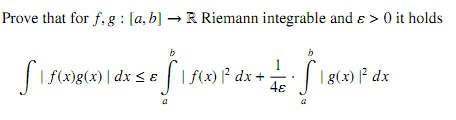
2iuazgx.png


I could do with a couple of hints or steps to get me in the right direction, it seems we've been taught different stuff to this, or stuff completely unrelated

Any help at all would be greatly appreciated
 
Physics news on Phys.org
The function:
[tex] \Psi(x, \epsilon) \equiv \left( \epsilon \, \vert f(x) \vert - \vert g(x) \vert \right)^2 \ge 0[/tex]
is non-negative for all values of [itex]x[/itex] and [itex]\epsilon[/itex]. But, if you expand it as a polynomial in [itex]\epsilon[/itex], you will get a quadratic function:
[tex] \psi(x, \epsilon) = \epsilon^2 \vert f(x) \vert^2 - 2 \epsilon \, \vert f(x) \vert \, \vert g(x) \vert + \vert g(x) \vert^2 \ge 0[/tex]
But, for [itex]\epsilon > 0[/itex], we have the inequality
[tex] \frac{\epsilon}{2} \, \vert f(x) \vert^2 + \frac{1}{2 \epsilon} \, \vert g(x) \vert^2 \ge \vert f(x) g(x) \vert, \; \forall x \in \mathbb{R}[/tex]
Taking [itex]\epsilon \rightarrow 2\epsilon[/itex] would lead you to an inequality that is very useful for you
 
Thank you so much, that actually looks like maths I can understand, not the unrelated gibberish our lecturers seem to enjoy telling us

It's now almost 1 in the morning and I've been doing maths for the last 6 hours pretty much, I may be back tomorrow with a question about Holders Inequalities (same situation, my lecture notes don't match the questions in the slightest), but i'll have a better look when I've had some sleep

Thanks again!
 
Hey, I have another problem using Riemann Integrals:

2k1sti.png


In the case of part (ii), we haven't actually been taught what the symbol of the integral with the line through means or used it in any way

Again, any help or just a nudge in the right direction would be much appreciated, this module has been great for giving us questions unrelated to what we've been taught
 
Let's focus on the first problem. Did you solve it? If yes, post the solution here.
 
Thats a good idea, here's what I've got (I'm no good with Latex so ill write it out longhand, say if anything is unclear)

Given
a
∫ (ε|f(x)| - |g(x)||2dx≥0 for all x, ε,
b

We can expand this to:
a
∫ε2|f(x)|2-ε|f(x)||g(x)|-ε|f(x)||g(x)|+|g(x)|2dx
b

=
a
∫ε2|f(x)|2-2ε|f(x)||g(x)|+|g(x)|2dx
b

So we know:
a
∫ε2|f(x)|2-2ε|f(x)||g(x)|+|g(x)|2dx ≥ 0
b

then
a
∫ε2|f(x)|2+|g(x)|2dx ≥
b


a
∫2ε|f(x)||g(x)|dx
b

Then dividing by 2ε:
a
∫(ε/2)|f(x)|2+(1/2ε)|g(x)|2dx
b

a
∫|f(x)||g(x)|dx
b

We now need to substitute ε by 2ε:
a
∫ε|f(x)|2+(1/4ε)|g(x)|2dx
b

=
a
∫ε|f(x)|2dx +
b

a
∫(1/4ε)|g(x)|2dx ≥
b

a
∫|f(x)||g(x)|dx
b

=a
ε∫|f(x)|2dx +
_b

_____a
(1/4ε)∫|g(x)|2dx ≥
_____b

a
∫|f(x)g(x)|dx
b

or
a
∫|f(x)g(x)|dx ≤
b

=a
ε∫|f(x)|2dx +
_b

_____a
(1/4ε)∫|g(x)|2dx
_____b

as required.

Sorry that's such a mess, must teach myself how to represent the symbols using latex :P
 
Last edited:
fylth said:
Hey, I have another problem using Riemann Integrals:

2k1sti.png


In the case of part (ii), we haven't actually been taught what the symbol of the integral with the line through means or used it in any way
That's because it is not a standard symbol. It is defined in this problem: it means "the integral of f from a to b divided by b- a" just as you are told.

Again, any help or just a nudge in the right direction would be much appreciated, this module has been great for giving us questions unrelated to what we've been taught
 

Similar threads

  • · Replies 2 ·
Replies
2
Views
1K
  • · Replies 14 ·
Replies
14
Views
5K
  • · Replies 4 ·
Replies
4
Views
3K
  • · Replies 2 ·
Replies
2
Views
2K
  • · Replies 6 ·
Replies
6
Views
2K
  • · Replies 6 ·
Replies
6
Views
4K
  • · Replies 2 ·
Replies
2
Views
2K
  • · Replies 11 ·
Replies
11
Views
4K
  • · Replies 1 ·
Replies
1
Views
3K
Replies
26
Views
5K