A problem involving Riemann Integrals

6 replies · 3K views · last reply
fylth
Messages
4
Reaction score
0
I've been having some trouble with a maths problem and I hoped someone might be able to help.

We don't seem to have been taught most of what we need to do this, I understand Riemann integrals but what we've been taught and what they're asking for is just different.
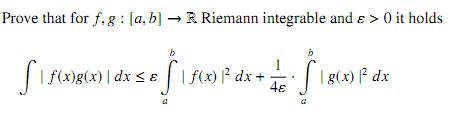
Printed inequality: for Riemann integrable f, g on [a, b] and epsilon > 0, the integral of |f(x)g(x)| from a to b is at most epsilon times the integral of |f(x)|^2 dx plus 1/(4 epsilon) times the integral of |g(x)|^2 dx.


I could do with a couple of hints or steps to get me in the right direction, it seems we've been taught different stuff to this, or stuff completely unrelated

Any help at all would be greatly appreciated
 
The function:
[tex] \Psi(x, \epsilon) \equiv \left( \epsilon \, \vert f(x) \vert - \vert g(x) \vert \right)^2 \ge 0[/tex]
is non-negative for all values of [itex]x[/itex] and [itex]\epsilon[/itex]. But, if you expand it as a polynomial in [itex]\epsilon[/itex], you will get a quadratic function:
[tex] \psi(x, \epsilon) = \epsilon^2 \vert f(x) \vert^2 - 2 \epsilon \, \vert f(x) \vert \, \vert g(x) \vert + \vert g(x) \vert^2 \ge 0[/tex]
But, for [itex]\epsilon > 0[/itex], we have the inequality
[tex] \frac{\epsilon}{2} \, \vert f(x) \vert^2 + \frac{1}{2 \epsilon} \, \vert g(x) \vert^2 \ge \vert f(x) g(x) \vert, \; \forall x \in \mathbb{R}[/tex]
Taking [itex]\epsilon \rightarrow 2\epsilon[/itex] would lead you to an inequality that is very useful for you
 
Thank you so much, that actually looks like maths I can understand, not the unrelated gibberish our lecturers seem to enjoy telling us

It's now almost 1 in the morning and I've been doing maths for the last 6 hours pretty much, I may be back tomorrow with a question about Holders Inequalities (same situation, my lecture notes don't match the questions in the slightest), but i'll have a better look when I've had some sleep

Thanks again!
 
Hey, I have another problem using Riemann Integrals:

Printed homework problem 6 on Riemann integrals: part (i) defines a partition sequence and Riemann sums S_n(f) and asks to prove their limit equals the integral of f; part (ii) defines the mean value of f and asks to prove a limit formula for it.


In the case of part (ii), we haven't actually been taught what the symbol of the integral with the line through means or used it in any way

Again, any help or just a nudge in the right direction would be much appreciated, this module has been great for giving us questions unrelated to what we've been taught
 
Let's focus on the first problem. Did you solve it? If yes, post the solution here.
 
Thats a good idea, here's what I've got (I'm no good with Latex so ill write it out longhand, say if anything is unclear)

Given
a
∫ (ε|f(x)| - |g(x)||2dx≥0 for all x, ε,
b

We can expand this to:
a
∫ε2|f(x)|2-ε|f(x)||g(x)|-ε|f(x)||g(x)|+|g(x)|2dx
b

=
a
∫ε2|f(x)|2-2ε|f(x)||g(x)|+|g(x)|2dx
b

So we know:
a
∫ε2|f(x)|2-2ε|f(x)||g(x)|+|g(x)|2dx ≥ 0
b

then
a
∫ε2|f(x)|2+|g(x)|2dx ≥
b


a
∫2ε|f(x)||g(x)|dx
b

Then dividing by 2ε:
a
∫(ε/2)|f(x)|2+(1/2ε)|g(x)|2dx
b

a
∫|f(x)||g(x)|dx
b

We now need to substitute ε by 2ε:
a
∫ε|f(x)|2+(1/4ε)|g(x)|2dx
b

=
a
∫ε|f(x)|2dx +
b

a
∫(1/4ε)|g(x)|2dx ≥
b

a
∫|f(x)||g(x)|dx
b

=a
ε∫|f(x)|2dx +
_b

_____a
(1/4ε)∫|g(x)|2dx ≥
_____b

a
∫|f(x)g(x)|dx
b

or
a
∫|f(x)g(x)|dx ≤
b

=a
ε∫|f(x)|2dx +
_b

_____a
(1/4ε)∫|g(x)|2dx
_____b

as required.

Sorry that's such a mess, must teach myself how to represent the symbols using latex :P
 
Last edited:
fylth said:
Hey, I have another problem using Riemann Integrals:

Text of a calculus homework problem 6 on Riemann integrable functions: parts (i) and (ii) about partitions, Riemann sums S_n(f), the mean value of f, and the hint to use part a.


In the case of part (ii), we haven't actually been taught what the symbol of the integral with the line through means or used it in any way
That's because it is not a standard symbol. It is defined in this problem: it means "the integral of f from a to b divided by b- a" just as you are told.

Again, any help or just a nudge in the right direction would be much appreciated, this module has been great for giving us questions unrelated to what we've been taught