A problem with non evident first integral

  • Context: Undergrad 
  • Thread starter Thread starter wrobel
  • Start date Start date
  • Tags Tags
    Integral
Click For Summary
SUMMARY

The discussion revolves around the dynamics of a homogeneous rod with two sliding particles connected by springs, analyzed using Lagrangian and Hamiltonian mechanics. The system exhibits three degrees of freedom, with energy and angular momentum as obvious integrals, alongside a third integral derived from the effective potential. Participants compute the Lagrangian, Hamiltonian, and equations of motion, exploring the implications of Noether's theorem and the search for additional first integrals. The conversation highlights the complexity of the system and the potential for discovering non-trivial integrals, akin to the Laplace-Runge-Lenz vector in the Kepler problem.

PREREQUISITES
  • Understanding of Lagrangian mechanics and Hamiltonian mechanics
  • Familiarity with concepts of degrees of freedom in mechanical systems
  • Knowledge of Noether's theorem and its application to conservation laws
  • Ability to compute canonical momenta and analyze equations of motion
NEXT STEPS
  • Study the derivation and implications of Noether's theorem in classical mechanics
  • Learn about effective potentials and their role in reducing degrees of freedom
  • Explore the Laplace-Runge-Lenz vector and its significance in celestial mechanics
  • Investigate the dynamics of systems with multiple degrees of freedom and their integrals
USEFUL FOR

Students and researchers in physics, particularly those focusing on classical mechanics, dynamical systems, and integrable systems. This discussion is beneficial for anyone interested in advanced mechanics and the mathematical foundations of physical systems.

wrobel
Science Advisor
Insights Author
Messages
1,255
Reaction score
1,056
The following problem we considered with the students. Perhaps it would also be interesting for PF

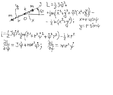
A homogeneous rod can rotate freely in a plane about its (fixed) center of mass O . The corresponding moment of inertia is equal to J. Two identical particles of mass m can slide along the rod freely. Each particle is connected with the point O by a spring of stiffness k. The relaxed length of both springs is equal to zero.
This system has 3 degrees of freedom: the angle of rod's rotation ##\varphi## and the distances ##x,y## from the particles to the origin O. Two integrals are obvious: the energy and the angular momentum. But there is a third less banal integral: see the attachment.
This observation allows to reduce the system to one degree of freedom and then study it by means of the effective potential.
 

Attachments

  • rod and springs.png
    rod and springs.png
    14.7 KB · Views: 173
Physics news on Phys.org
If I see it right, the coordinates ##\psi## and ##\varphi## are cyclic. Then ##L## is not explicitly time dependent, so that ##H## (energy) is conserved either. So you've three first integrals and an integrable system, right?
 
  • Like
Likes   Reactions: wrobel
exactly
 
  • Like
Likes   Reactions: vanhees71
OK, this looks like an interesting exercise to dust off what's left of my brain... :oldbiggrin:

I'll start by tidying it up a bit. The Lagrangian is
$$L ~:=~ \frac12 J \dot\phi^2 ~+~ \frac12 m \left(\dot r^2 + r^2 \dot\psi^2 + r^2 \dot\phi^2\right) ~-~ \frac12 k r^2 ~.$$ I compute the canonical momenta to be $$p_r =
m \dot r ~,~~~~ p_\phi = (J + m r^2) \dot\phi ~,~~~~ p_\psi = m r^2 \dot\psi ~.$$ and I compute the Hamiltonian as $$H ~=~
\frac{p_r^2}{2m} ~+~ \frac{p_\phi^2}{2(J+mr^2)}
~+~ \frac{p_\psi^2}{2mr^2}
~+~ \frac12 k r^2 ~.$$ From the Hamiltonian form of the EoM one quickly finds that ##p_\phi## and ##p_\psi## are constants.

I compute the Lagrangian (E-L) equations of motion to be $$
\ddot r ~=~ r(\dot\phi^2 + \dot\psi^2) + \frac{kr}{m} ~~=:~ w_r ~,$$$$
\ddot\phi ~=~ -\, \frac{2mr \dot r \dot\phi}{J+mr^2} ~~=:~ w_\phi ~,$$$$
\ddot\psi ~=~ -\, \frac{2\dot r \dot\psi}{r} ~~=:~ w_\psi ~.$$To find nontrivial first integrals (a.k.a constants of the motion) systematically we need the canonical on-shell total time derivative operator: $$A ~:=~
\frac{\partial}{\partial t} ~+~ \dot q^a \frac{\partial}{\partial q^a}
~+~ w^a \frac{\partial}{\partial \dot q^a} ~,$$where the ##q_a## are ##r,\phi,\psi##, etc. First integrals are functions ##f(t,r,\phi,\psi,\dot r, \dot\phi, \dot\psi)## of the phase space variables satisfying $$A \, f ~=~ 0 ~.$$[I'll continue tomorrow. Have I made any mistakes so far?]
 
Last edited:
  • Like
Likes   Reactions: Hamiltonian and vanhees71
That looks good, but why are you looking for more "first integrals". You already have 3 independent ones, i.e., ##p_{\phi}##, ##p_{\psi}##, and ##H##. From this you can find an effective 1D equation of motion for ##r##.
 
  • Like
Likes   Reactions: wrobel
vanhees71 said:
That looks good, but why are you looking for more "first integrals". You already have 3 independent ones, i.e., ##p_{\phi}##, ##p_{\psi}##, and ##H##. From this you can find an effective 1D equation of motion for ##r##.
I thought that was the point of the exercise -- to find all the (functionally independent) 1st integrals, not just the obvious ones. I presumed this is like in the Kepler problem where one has the additional 1st integral known as the Laplace-Runge-Lenz vector, which is not all obvious from the Kepler Lagrangian.

Moreover, I'd intended to (try and) find all the dynamical symmetries of the problem, even though that was not explicitly asked for in the problem statement. Again, this is like in the Kepler problem where one finds a dilation-like symmetry, responsible for Kepler's 3rd law, yet does not correspond to any conserved quantity.
@wrobel: if I've misunderstood your intent in this problem, please let me know.
 
  • Like
Likes   Reactions: vanhees71
That's of course an interesting exercise too!
 
  • Like
Likes   Reactions: sysprog
strangerep said:
if I've misunderstood your intent in this problem, please let me know.
I just wanted to draw your attention that this system has two trivial first integrals: energy and momentum; but it has another integral that does not follow from general theorems of dynamics. It happens sometimes but as for me every such a case is a little miracle
 
  • Like
Likes   Reactions: vanhees71
wrobel said:
I just wanted to draw your attention that this system has two trivial first integrals: energy and momentum; but it has another integral that does not follow from general theorems of dynamics.
Which theorem(s)? Noether? Other? Do you include the LRL vector of the Kepler problem in this category?

Probably I must finish working it out before I'll see your meaning properly.
 
  • Like
Likes   Reactions: vanhees71
  • #10
I'll post a continuation of my detailed computations tomorrow (it's too late here now). But the result I got for the unexpected 1st integral is $$\frac{(J+mr^2)^{J+mr^2}}{(mr^2)^{mr^2}}$$which looks too utterly weird to let me think it could possibly be correct.

Has anyone else besides @wrobel tried to solve this yet?
 
  • #11
strangerep said:
Which theorem(s)? Noether? Other? Do you include the LRL vector of the Kepler problem in this category?

Probably I must finish working it out before I'll see your meaning properly.
Noether's theorem works in "both directions": If you have a one-parameter symmetry group there's a conservation law, and the conserved quantity is the generator of the symmetry and if there's a conserved quantity it defines a one-parameter symmetry group being its generator.

The Runge-Lenz vector in the (non-relativistic) Kepler problem is an example. Depending on the three cases ##E<0## (bound, elliptic orbits) the symmetry group it generates together with angular momentum (which generates the rotation group of course) is and SO(4), for ##E=0## (unbound parabolic orbits) it creates a Galilei group, and for ##E>0## (unbound hyperbolic orbits) it generates the Lorentz group ##\mathrm{SO}(1,3)^{\uparrow}##. The latter two have of course nothing to do with the spacetime symmetries of Newtonian or special relativistic physics but are the "dynamical symmetries" of the non-relativistic Kepler problem.
 
  • #12
strangerep said:
I'll post a continuation of my detailed computations tomorrow (it's too late here now). But the result I got for the unexpected 1st integral is $$\frac{(J+mr^2)^{J+mr^2}}{(mr^2)^{mr^2}}$$which looks too utterly weird to let me think it could possibly be correct.

Has anyone else besides @wrobel tried to solve this yet?
I've not tried it yet...
 
  • #13
strangerep said:
unexpected 1st integral is (J+mr2)J+mr2(mr2)mr2which looks too utterly weird to let me think it could possibly be correct.
So you claim that r is a first integral. Noway!
 
  • #14
wrobel said:
So you claim that r is a first integral.
No, I don't "claim" that. I merely wrote down what I had at the end of yesterday, realizing I must surely have cocked it up somewhere.
wrobel said:
Noway!
Indeed. A few minutes after I arose this morning and looked at it again, I saw my mistake...:doh:

I'll keep going today... :headbang:
 
  • #15
I get the following 1st integrals: $$ p_\phi ~=~ (J + m r^2) \dot\phi ~,$$$$ p_\psi ~=~ m r^2 \dot\psi ~,$$$$E ~=~ \frac12 m\dot r^2 ~+~ \frac{p_\phi^2}{2(J+mr^2)} ~+~ \frac{p_\psi^2}{2m r^2} ~+~ \frac{k r^2}{2} ~.$$But I can't find any more.

Is there really another one?
 
Last edited:
  • Like
Likes   Reactions: vanhees71
  • #16
Good question. It may be, but you don't need it, because with the 3 standard first integrals, you've already found you have reduced the EoM. to an effective 1D equation of motion in an effective potential, and that can be solved up to a quadrature.
 
  • #17
vanhees71 said:
Good question. It may be, but you don't need it, because with the 3 standard first integrals, you've already found you have reduced the EoM. to an effective 1D equation of motion in an effective potential, and that can be solved up to a quadrature.
But knowing all the dynamical symmetries of a problem might allow features of the solution to be revealed more easily than solving the EoM. E.g., in the Kepler problem, one gets a very inconvenient transcendental equation for the orbit. But besides the symmetries associated with conservation of energy, angular momentum, and the LRL vector, one also finds a (non-conserved) dilation-like symmetry that is responsible for Kepler's 3rd law. One finds this without exhaustively solving the EoM.

I don't know if that sort of thing is applicable to the current double spring-loaded beads on a rotating rod problem. I suspect not, but I'd like to know for sure.
 
  • Like
Likes   Reactions: vanhees71
  • #18
For the orbit you get a simple equation of a shifted harmonic oscillator, leading to the ellipse, parabola, or hyperbola, dependening on the initial conditions. The additional symmetry explains why you have closed orbits, which is a very special case, since usually for central-potential problems not all bound orbits are closed. Only the symmetric harmonic oscillator and the ##1/r## potential have the feature that all bound orbits are closed.
 
  • Like
Likes   Reactions: wrobel

Similar threads

  • · Replies 12 ·
Replies
12
Views
1K
  • · Replies 3 ·
Replies
3
Views
1K
  • · Replies 6 ·
Replies
6
Views
2K
  • · Replies 6 ·
Replies
6
Views
3K
  • · Replies 2 ·
Replies
2
Views
333
  • · Replies 4 ·
Replies
4
Views
3K
  • · Replies 8 ·
Replies
8
Views
2K
  • · Replies 138 ·
5
Replies
138
Views
8K
  • · Replies 13 ·
Replies
13
Views
3K
  • · Replies 11 ·
Replies
11
Views
793