A question about a wheel rolling without slipping while tied to a cube

Click For Summary
SUMMARY

The forum discussion centers on the mechanics of a wheel rolling without slipping while tied to a cube, specifically addressing torque calculations and the direction of friction. Users identify errors in the original solution, particularly the mislabeling of variables (R vs. r) and the need for clarity in the torque equation. The conversation emphasizes the importance of analyzing torques about the point of contact and understanding the implications of static friction in motion. Participants seek clarification on these concepts to better grasp the underlying physics.

PREREQUISITES
  • Understanding of basic physics concepts, particularly torque and friction.
  • Familiarity with rotational dynamics and the equations of motion.
  • Knowledge of inertial and non-inertial reference frames.
  • Ability to interpret diagrams related to mechanical systems.
NEXT STEPS
  • Study the principles of torque and its calculation in rotational systems.
  • Learn about static friction and its role in rolling motion.
  • Explore the concept of inertial frames and their significance in mechanics.
  • Review examples of similar mechanical systems to reinforce understanding of these principles.
USEFUL FOR

Physics students, mechanical engineers, and educators seeking to deepen their understanding of rotational dynamics and friction in mechanical systems.

glen21082000
Messages
3
Reaction score
0
Homework Statement
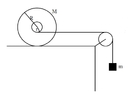
In what direction can the wheel start rolling if it is rolling without slipping
Relevant Equations
Vcm = ωR
Screenshot_20250607-210756_Drive.webp
 

Attachments

  • Screenshot_20250607-210601_Drive.webp
    Screenshot_20250607-210601_Drive.webp
    18.2 KB · Views: 51
Physics news on Phys.org
I forgot to write my question, oops. Honestly I simply don't understand the given answer to the question. There is a mistake in the question and the solution - the R in the moment of the tension should be "r" instead of "R" since the string is pulled from the inner ring (look at the figure). Other than that I don't really understand what is going on in the solution and I really want to understand it so I would appreciate any form of help! TIA
 
This YouTube video may help:

 
My first problem with the question is relating the description to the diagram. “The other end of the string” - two ends are already mentioned. How many ends does it have? - “is attached frictionlessly to the table” - how do you attach something frictionlessly? To a table?

Ignoring that, and correcting TR to Tr, which way is positive in the given torque equation? If f acts to the left and T to the right then the torque expression is written with clockwise positive, so a positive result means the pulley moves to the right.

Simpler, here, is to take torques about the point of contact. That way we don’t have to worry about the direction or magnitude of the friction. There is only one torque to consider, T(R-r), and it acts clockwise, so the pulley moves to the right.

Where is this question from?
 
Gordianus said:
This YouTube video may help:


Thank you very much! I have a question about the video you sent, in the video why is the friction left? Shouldn't the friction be dependent on whether the yoyo rolls to the right or to the left? If the yoyo rolls to the right then shouldn't the yoyo try to slip left at the contact point with the ground which will cause the static friction to be to the right?

Another question is about the torque calculation, is it okay using the center of the yoyo when calculating the torque or do we need to fix another point outside of the yoyo since the yoyo is non inertial.

Thanks a lot of the help!
 
glen21082000 said:
Thank you very much! I have a question about the video you sent, in the video why is the friction left?
Drawing it to the left merely says that we are taking left as positive for that force. All the equations derived from the diagram work perfectly well if f turns out negative, i.e. if friction turns out to act to the right.

Note that the question in this thread is for the case ##\beta=0##, and in this case Prof Miller's solution is that the yoyo moves to the right (and, of course, friction is to the right).
glen21082000 said:
Another question is about the torque calculation, is it okay using the center of the yoyo when calculating the torque or do we need to fix another point outside of the yoyo since the yoyo is non inertial.
In general, it is safe to use any point if its line of acceleration passes through the mass centre of the body. That's a bit complicated, so stick to either of two special cases:
  • the mass centre of the body
  • any point fixed in an inertial frame
With rolling contact it can be a little confusing: taking the instantaneous point of contact is ok if by that you mean a point fixed on the ground, not the locus of the point of contact, which could be accelerating.

Did you read post #4? Using torques about point of contact shows why ##r_1\cos(\beta)-r_2## is critical. If positive, the torque from T is clockwise about the point of contact, so the pulley rolls to the right.
 
To @glen21082000:
Trike.webp
Here is a question to test your understanding of how to analyze what's going on. On the right is shown a tricycle on a flat surface where it can roll without sliding. The handlebar is locked and prevented from turning away from the forward position.

You stand in front of the tricycle and perform two tasks separately and independently of each other as indicated below.
  1. Tie a string on the pedal above the axle of the front wheel and pull forward and parallel to the ground as indicated by the yellow arrow.
  2. Tie a string on the pedal below the axle of the front wheel and pull forward and parallel to the ground as indicated by the red arrow.
In which direction, forward or backward, will the tricycle move in each case and why?

Hint
One might argue thus: I know that if I ride the tricycle and push forward with my foot against the top pedal, I will move forward and if I push forward against the bottom pedal, I will move in reverse. A force is a force. Therefore in (1) the tricycle will move forward and in (2) the tricycle will move in reverse.

This argument is specious.
 
kuruman said:
To @glen21082000:
View attachment 361984Here is a question to test your understanding of how to analyze what's going on. On the right is shown a tricycle on a flat surface where it can roll without sliding. The handlebar is locked and prevented from turning away from the forward position.

You stand in front of the tricycle and perform two tasks separately and independently of each other as indicated below.
  1. Tie a string on the pedal above the axle of the front wheel and pull forward and parallel to the ground as indicated by the yellow arrow.
  2. Tie a string on the pedal below the axle of the front wheel and pull forward and parallel to the ground as indicated by the red arrow.
In which direction, forward or backward, will the tricycle move in each case and why?

Hint
One might argue thus: I know that if I ride the tricycle and push forward with my foot against the top pedal, I will move forward and if I push forward against the bottom pedal, I will move in reverse. A force is a force. Therefore in (1) the tricycle will move forward and in (2) the tricycle will move in reverse.

This argument is specious.
I see no evidence in post #2 that @glen21082000 does not already understand. He correctly identifies several errors in the given solution, not least that it arrives at the wrong answer.
 
haruspex said:
I see no evidence in post #2 that @glen21082000 does not already understand. He correctly identifies several errors in the given solution, not least that it arrives at the wrong answer.
I agree. However, by OP's own admission
glen21082000 said:
Other than that I don't really understand what is going on in the solution and I really want to understand it so I would appreciate any form of help! TIA
OP wants to understand how the solution was crafted. My explanation is that the solution's author seems to be under the impression that the way to figure out which way the pulley will roll is to first imagine which way it would rotate about a fixed axle (clockwise or counterclockwise) when the string is pulled and then conclude that the center will move to the right if clockwise and to the left if counterclockwise. The tricycle question is a more subtle variation of this and I wanted to ensure that @glen21082000 really "got it."
 
  • Like
Likes   Reactions: SammyS
  • #10
kuruman said:
I agree. However, by OP's own admission

OP wants to understand how the solution was crafted. My explanation is that the solution's author seems to be under the impression that the way to figure out which way the pulley will roll is to first imagine which way it would rotate about a fixed axle (clockwise or counterclockwise) when the string is pulled and then conclude that the center will move to the right if clockwise and to the left if counterclockwise. The tricycle question is a more subtle variation of this and I wanted to ensure that @glen21082000 really "got it."
Ok, but that’s not how I read the logic of the given solution. Rather, I read it (correcting the R/r typo) as:
  1. Suppose it moves left.
  2. [missing statement: so we'll define f as positive left and T as positive right]
  3. It follows from F=ma that f>T.
  4. Since R>r, f>T implies fR>Tr.
  5. fR>Tr implies a rotation consistent with the pulley moving left
  6. The consistency implies our assumption (1) is correct.
Trouble is, 5 is false. Had that step been performed correctly we would have got the right answer.
Also, step 6 is a bit hokey. Merely observing that no contradiction arises from the tests we happened to apply is hardly rigorous.
Besides, it is a poor approach because had we happened to start with supposing it moves right, so f<T, we would not have been able to draw any inference on the comparison between fR and Tr.
 
  • #11
haruspex said:
Trouble is, 5 is false. Had that step been performed correctly we would have got the right answer.
I would say, "Had the correct conclusion been drawn from step 4, we would have found a direct contradiction to the assumption in step 1." In other words, provide a reductio ad absurdum proof.
 
  • #12
kuruman said:
I would say, "Had the correct conclusion been drawn from step 4, we would have found a direct contradiction to the assumption in step 1." In other words, provide a reductio ad absurdum proof.
I believe that is the same as I wrote, except that it is a RAD disproof of what the author claims.
 

Similar threads

Replies
4
Views
3K
Replies
6
Views
1K
  • · Replies 42 ·
2
Replies
42
Views
3K
  • · Replies 60 ·
3
Replies
60
Views
4K
  • · Replies 21 ·
Replies
21
Views
5K
  • · Replies 30 ·
2
Replies
30
Views
1K
  • · Replies 5 ·
Replies
5
Views
2K
  • · Replies 35 ·
2
Replies
35
Views
5K
  • · Replies 17 ·
Replies
17
Views
3K
  • · Replies 7 ·
Replies
7
Views
4K