A question about angular momentum and torques....

Click For Summary

Discussion Overview

The discussion centers on the law of conservation of angular momentum, particularly in scenarios where a person's moment of inertia changes while rotating about an axis. Participants explore the implications of changing rotational inertia on angular speed and the conditions under which torque is or is not present.

Discussion Character

  • Exploratory
  • Technical explanation
  • Debate/contested
  • Mathematical reasoning

Main Points Raised

  • One participant questions how angular acceleration can occur without torque when a person lowers their arms, thus changing their moment of inertia.
  • Another participant explains the relationship between torque, moment of inertia, and angular acceleration, noting that if moment of inertia is variable, the equation for torque must account for this change.
  • Some participants draw parallels between angular momentum and linear momentum, suggesting that changes in moment of inertia can lead to changes in angular velocity while keeping angular momentum constant.
  • There is a discussion about how internal forces and torques relate to changes in angular velocity, with some participants expressing difficulty in visualizing this relationship.
  • A later reply points out a potential sign error in a previous statement regarding the relationship between angular velocity and moment of inertia, leading to a clarification about the conditions under which angular momentum remains constant.

Areas of Agreement / Disagreement

Participants express differing views on the relationship between torque and angular momentum, with some asserting that no torque is present when angular momentum is conserved, while others seek clarification on the conditions that lead to this conclusion. The discussion remains unresolved regarding the conceptual understanding of internal torques and their effects.

Contextual Notes

Participants reference the need to consider variable moment of inertia in their equations, and there are unresolved questions about the implications of internal forces on angular momentum. The discussion highlights the complexity of relating angular and linear momentum concepts.

NoahCygnus
Messages
96
Reaction score
2
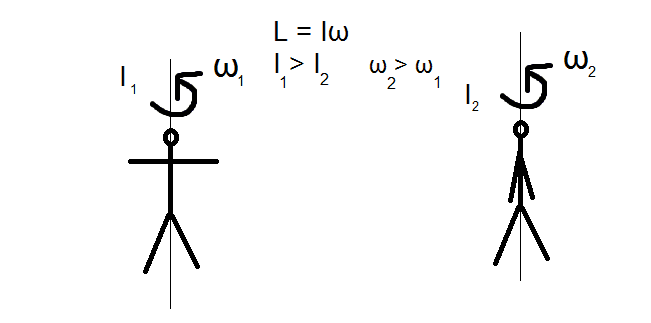
There is something I don't quite understand about the law of conservation of angular momentum.
AgXgxQC.png

Let's say a person is rotating about an axis passing through his/her centre of mass, with an angular speed speed ω1, and has a rotational inertia I1 about about the centre of mass. No torque is acting on the person. The person lowers his arms bringing them closer to his body, lowering the rotational inertia to I2. As no torque acts on him, the angular momentum shouldn't change, so the angular speed goes up and he starts rotating faster, with an angular speed of ω2. But there is a change in angular velocity, that means there is an angular acceleration, and we know τ = Iα , so a torque should act on the person. I don't quite understand this, I would appreciate if you explain to me why there will be no torque if there is an angular acceleration on the person.
 
Physics news on Phys.org
NoahCygnus said:
we know τ = Iα
If moment of inertia is fixed, then ##\tau = \frac{dL}{dt} = \frac {d(I \omega)}{dt} = I \frac{d \omega}{dt} = I\alpha##.

But if moment of inertia is not fixed then ##\tau = \frac{dL}{dt} = \frac{d(I \omega)}{dt} = I \frac{d \omega}{dt} + \omega \frac{dI}{dt} = I\alpha + \omega \frac{dI}{dt}##.
 
As already in translational motion an acceleration doesn't necessarily imply the action of a force but only a change in momentum. If mass changes also the speed changes such that the momentum stays constant. Here it's the same: A torque is only necessary to change angular momentum, but here ##L## stays unchanged, i.e., ##I_1 \omega_1=I_2 \omega_2##.
 
vanhees71 said:
As already in translational motion an acceleration doesn't necessarily imply the action of a force but only a change in momentum. If mass changes also the speed changes such that the momentum stays constant. Here it's the same: A torque is only necessary to change angular momentum, but here ##L## stays unchanged, i.e., ##I_1 \omega_1=I_2 \omega_2##.
In case of linear momentum, if a body's mass changes, there is a change in velocity due to internal forces, which we cancel out when we consider the entire system, that is the remaining mass and mass ejected. I can't relate that to angular momentum, I can't seem to imagine how internal torques can cause a change in angular velocity.
 
jbriggs444 said:
If moment of inertia is fixed, then ##\tau = \frac{dL}{dt} = \frac {d(I \omega)}{dt} = I \frac{d \omega}{dt} = I\alpha##.

But if moment of inertia is not fixed then ##\tau = \frac{dL}{dt} = \frac{d(I \omega)}{dt} = I \frac{d \omega}{dt} + \omega \frac{dI}{dt} = I\alpha + \omega \frac{dI}{dt}##.
I get it, inertial mass is also variable so we have to use the second equation. But how does that explain why there is no torque? Unless ω dI/dt = Iα , I don't understand how there will be no torque.
 
NoahCygnus said:
In case of linear momentum, if a body's mass changes, there is a change in velocity due to internal forces, which we cancel out when we consider the entire system, that is the remaining mass and mass ejected. I can't relate that to angular momentum, I can't seem to imagine how internal torques can cause a change in angular velocity.
Again: A torque changes angular momentum, not necessarily angular velocity. In your example there is no torque, and thus angular momentum stays constant. Since the moment of inertia around the rotation axis changes, angular velocity must change such as to keep angular momentum constant.

For a simple example with translational motion, think about a wagon filled with water, running on a horizontal track along the ##x##-direction with the water flowing out (perpendicular to the plane). Then momentum is constant, which means (since the water doesn't transfer any momentum in ##x## direction)
$$\dot{m} v + m \dot{v}=0.$$
Now assume, for simplicty ##\dot{m}=\mu=\text{const}##, and you get
$$\dot{v}=-\frac{\mu}{m} v.$$
So what happens (note that in the exampe ##\mu<0##)?
 
  • Like
Likes   Reactions: jbriggs444
NoahCygnus said:
I get it, inertial mass is also variable so we have to use the second equation. But how does that explain why there is no torque? Unless ω dI/dt = Iα , I don't understand how there will be no torque.
You have a sign error there. ##\omega \frac{dI}{dt} = - I \alpha##

Edit: This makes sense. If you increase angular rotation rate while holding angular momentum constant, you must be decreasing the moment of inertia.
 
Last edited:
  • Like
Likes   Reactions: vanhees71

Similar threads

  • · Replies 10 ·
Replies
10
Views
2K
  • · Replies 6 ·
Replies
6
Views
1K
  • · Replies 3 ·
Replies
3
Views
2K
  • · Replies 16 ·
Replies
16
Views
1K
  • · Replies 1 ·
Replies
1
Views
1K
  • · Replies 5 ·
Replies
5
Views
3K
  • · Replies 30 ·
2
Replies
30
Views
5K
  • · Replies 2 ·
Replies
2
Views
3K
  • · Replies 6 ·
Replies
6
Views
1K
Replies
4
Views
2K