A simple pendulum is suspended from the ceiling of an accelerating car

Click For Summary
SUMMARY

The discussion focuses on deriving the motion equation for a simple pendulum suspended in an accelerating car using Lagrangian and Hamiltonian mechanics. The equilibrium angle is established as ##\theta_{e} = \tan^{-1}(\frac{-a}{g})##, where ##a## is the acceleration of the car and ##g## is the acceleration due to gravity. Participants emphasize the importance of using small angle approximations and working with the variable ##\theta' = \theta - \theta_e## for accurate results. The conversation also highlights the need for clarity in mathematical notation to avoid confusion.

PREREQUISITES
  • Understanding of Lagrangian mechanics
  • Familiarity with Hamiltonian equations
  • Knowledge of small angle approximations in physics
  • Proficiency in mathematical notation for trigonometric functions
NEXT STEPS
  • Study Lagrangian mechanics in detail, focusing on pendulum systems
  • Explore Hamiltonian mechanics and its applications in dynamic systems
  • Research small angle approximation techniques and their implications
  • Review mathematical notation conventions for clarity in physics problems
USEFUL FOR

Physics students, mechanical engineers, and anyone interested in the dynamics of pendulum systems in non-inertial reference frames.

badluckmath
Messages
9
Reaction score
3
Homework Statement
Show that ## \omega = \frac{\sqrt{a^{2}+g^{2} }}{l} ## for small angles
Relevant Equations
After solving the Hamilton equations, we find that ## \frac{d^{2}\theta}{dt^{2}} = -gsin(\theta)/l- acos(\theta)/l ##
Here is an image of the problem:
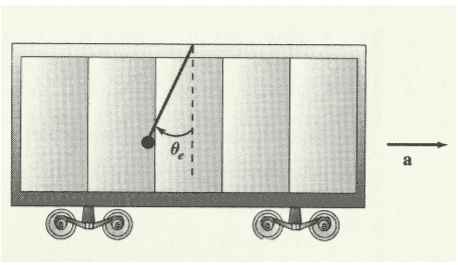
Sem título (2).png
The problem consist in finding the moviment equation for the pendulum using Lagrangian and Hamiltonian equations.
I managed to get the equations , which are shown insed the blue box:
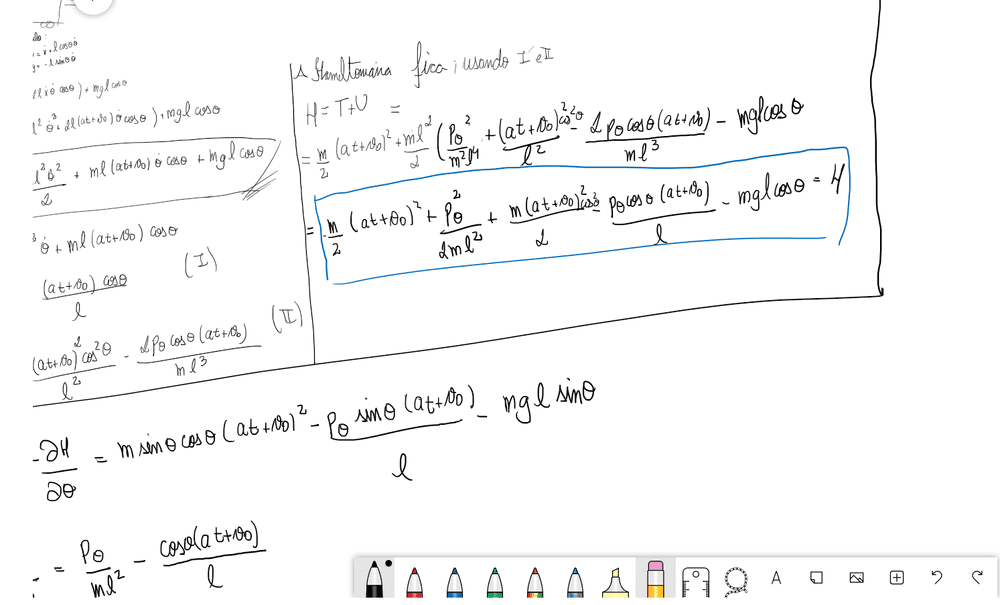
Sem título (1).png

Using the hamilton equations, i finally got that the equilibrium angle ##\theta_{e}## : $$\theta_{e} = \tan^{-1}(\frac{-a}{g})$$m which is the angle where ## \frac{d^{2}\theta}{dt^{2}} =0 ##.

Now, i got stuck. I tried to solve an EDO using the small angles aproximation, but it doesn't seems to lead me anywhere, because i don't really have information for the initial values.
 

Attachments

  • Sem título.png
    Sem título.png
    27.2 KB · Views: 210
  • Like
Likes   Reactions: kent davidge
Physics news on Phys.org
You want small angles wrt ##\theta_e##, so work the equation around to ##\theta' = \theta -\theta_e## in first order of ##\theta'##.
 
Did you understand my post at all ? You want to work with ##\theta'##, not with ##y## .
 
BvU said:
Did you understand my post at all ? You want to work with θ′, not with y .
This was another question. About your answer, i used ## \mu = \theta + \theta_{e}## and i got the right answer. Which is the same as you said.
 
badluckmath said:
This was another question.
And do we have a problem statement for that one ?

Side note: use \cos and \sin, just like \tan.
That way there is no confusion about e.g.
## acos(\theta)/l## read as ## \operatorname {acos}(\theta)/l## instead of ## a\cos(\theta)/l##
 
BvU said:
And do we have a problem statement for that one ?

Side note: use \cos and \sin, just like \tan.
That way there is no confusion about e.g.
## acos(\theta)/l## read as ## \operatorname {acos}(\theta)/l## instead of ## a\cos(\theta)/l##
It's the same as before, but now, the acceleration is upwards .
 
Thread now looks garbled: there was a post #3 from you that has disappeared :oldconfused:
(not so bad, it was barely legible :nb) )
 

Similar threads

Replies
9
Views
3K
  • · Replies 4 ·
Replies
4
Views
5K
  • · Replies 19 ·
Replies
19
Views
3K
  • · Replies 9 ·
Replies
9
Views
3K
  • · Replies 7 ·
Replies
7
Views
2K
  • · Replies 3 ·
Replies
3
Views
3K
  • · Replies 11 ·
Replies
11
Views
2K
Replies
4
Views
2K
  • · Replies 2 ·
Replies
2
Views
2K
  • · Replies 1 ·
Replies
1
Views
3K