Tangeton
- 62
- 0
A speck of dust has a mass of 1 x 10-18 kg and carries a charge equal to that of one electron. Near to the Earth's surface it experiences a uniform downward electric field od strength 100NC-1 and a uniform gravitational field of strength 9.8Nkg-1.
Draw a diagram which shows the electric field pattern and the sign of the charge on the surface.
I find my college's homeworks very confusing in wording and just generally to understand. I can do more stuff with exam Q's most of the time, but these homework bring me out of the safe zone because I can never actually understand what they are trying to say.
First of all, It says the speck of dust itself has a charge, does that mean that I can treat it as a point charge?
Secondly, if it's equal to one electron's charge, does it automatically make the charge negative? The homework sheet says "Electronic Charge = 1.6 x10⁻¹⁹", while the formula booklet says there is a minus before all that so I don't know whether it is a positive charge or a negative charged dust speck.
Thirdly, if it is a point charge, does it mean that it will have its own radial field that, depending on whether it is positive or negative, goes outwards or towards the charge? And that there is going to be a background electric field that is going downwards from most positive to least positive at the same time?
Fourthly, what does it mean by ''the sign of the charge on the surface''? Does it mean that I label the particle negative or positively?
Since this forum requires an attempt at answer:
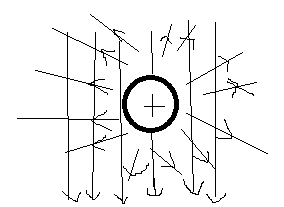
Draw a diagram which shows the electric field pattern and the sign of the charge on the surface.
I find my college's homeworks very confusing in wording and just generally to understand. I can do more stuff with exam Q's most of the time, but these homework bring me out of the safe zone because I can never actually understand what they are trying to say.
First of all, It says the speck of dust itself has a charge, does that mean that I can treat it as a point charge?
Secondly, if it's equal to one electron's charge, does it automatically make the charge negative? The homework sheet says "Electronic Charge = 1.6 x10⁻¹⁹", while the formula booklet says there is a minus before all that so I don't know whether it is a positive charge or a negative charged dust speck.
Thirdly, if it is a point charge, does it mean that it will have its own radial field that, depending on whether it is positive or negative, goes outwards or towards the charge? And that there is going to be a background electric field that is going downwards from most positive to least positive at the same time?
Fourthly, what does it mean by ''the sign of the charge on the surface''? Does it mean that I label the particle negative or positively?
Since this forum requires an attempt at answer:
Last edited: