Anticitizen
- 152
- 0
About a decade or so ago, I came across a website that featured a reactionless drive some guy built in his garage. My google-fu is weak, and I can't seem to find any info on it on the net anymore, and was hoping someone knew something about it. It worked as follows:
There are two rings, set parallel to each other, but skewed slightly. There is a ball (or series of balls) that spin around inside the ring.
Here is my crappy paintbrush representation:
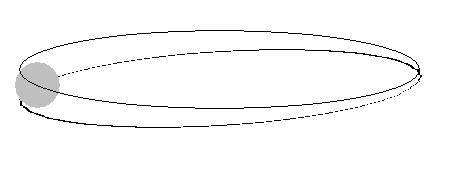
The rig he built had pool balls, I believe, propelled by a motor with a spinning disc located in the center that hit each ball and sent it spinning around the rings at high speed.
(It had another 'retainer ring' to keep the balls from falling out as well.)
He had the whole rig set up on wheels.
There were videos on the site showing the thing scooting across the floor when powered on, dragging an extension cord behind it.
To the best of my memory, this is how it worked:
The ball, when approaching the narrow end of the rings, would spin faster than it would at the other end. Due to some quirk of conservation of momentum, it would carry momentum in that direction (the narrow end) causing the whole rig to move in that direction. Or maybe it moved in the opposite direction, I can't recall.
Does anybody know what I'm talking about, or otherwise can help me address the physics involved here?
There are two rings, set parallel to each other, but skewed slightly. There is a ball (or series of balls) that spin around inside the ring.
Here is my crappy paintbrush representation:
The rig he built had pool balls, I believe, propelled by a motor with a spinning disc located in the center that hit each ball and sent it spinning around the rings at high speed.
(It had another 'retainer ring' to keep the balls from falling out as well.)
He had the whole rig set up on wheels.
There were videos on the site showing the thing scooting across the floor when powered on, dragging an extension cord behind it.
To the best of my memory, this is how it worked:
The ball, when approaching the narrow end of the rings, would spin faster than it would at the other end. Due to some quirk of conservation of momentum, it would carry momentum in that direction (the narrow end) causing the whole rig to move in that direction. Or maybe it moved in the opposite direction, I can't recall.
Does anybody know what I'm talking about, or otherwise can help me address the physics involved here?