About KE and PE of a stone falling down a tube filled with oil

Click For Summary

Homework Help Overview

The discussion revolves around the concepts of kinetic energy (KE) and gravitational potential energy (GPE) in the context of a stone falling through a tube filled with oil. Participants explore the relationship between these forms of energy and the effects of friction and drag in a viscous medium.

Discussion Character

  • Exploratory, Conceptual clarification, Assumption checking

Approaches and Questions Raised

  • Participants express confusion about the relationship between KE and GPE, questioning why the sum is not constant in this scenario. They explore the implications of constant velocity and terminal velocity in a viscous fluid, raising questions about real-life examples and the nature of forces acting on falling objects.

Discussion Status

The discussion is active, with participants seeking clarification on key concepts and sharing insights about terminal velocity and the effects of drag. Some participants have acknowledged misunderstandings and are re-evaluating their interpretations of the problem.

Contextual Notes

Participants mention challenges related to the lack of numerical values in the problem and the potential for confusion due to language barriers. The specific context of the stone falling through oil is noted as significant for understanding the dynamics involved.

Iwanttolearnphysics
Messages
44
Reaction score
9
Homework Statement
A stone is falling at a constant velocity down a tube filled with oil. Which of the following statements about the energy changes of the stone during its motion are correct?

I. The gain in kinetic energy is less than the loss in gravitational potential energy.
II. The sum of kinetic and gravitational potential energy of the stone is constant.
III. The work done by the force of gravity has the same magnitude as the work done by Friction.
Relevant Equations
PE = mgh
KE = 1/2mv^2
This question does not have numbers, so I'm stumped. Here's my thinking.
  • (I), the gain in KE is less than the loss in GPE is correct according to the key, but I think I don't understand this conceptually. Can you ask me questions to make me think about this a bit more? I can't even form questions to ask myself. I don't get this one at all.
  • (II), According to the key, this is wrong the sum of KE and GPE is not constant. But why is that? Isn't there a formula that goes, ME = KE + PE. If that's true, then when KE changes, PE will also change, but they will still both add up to ME. Then shouldn't be ME constant?
  • (III), the work done by the force of gravity has the same magnitude as the work done by friction. This is correct because they're opposing forces in this case and they'll be equal in magnitude but in opposite directions.
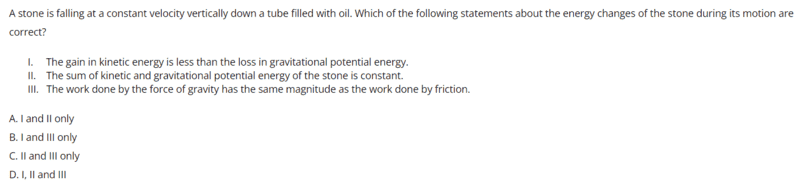
Here's a picture of the question:
1637716081037.png
Thank you!
 
Physics news on Phys.org
What is the gain in kinetic energy when a mass is moving at constant velocity? As the mass falls, does it gain or lose potential energy? Start from there.
 
  • Like
Likes   Reactions: Iwanttolearnphysics
kuruman said:
What is the gain in kinetic energy when a mass is moving at constant velocity? As the mass falls, does it gain or lose potential energy? Start from there.
Oh. I misunderstood the question. Okay, if its velocity is constant, that means that KE will always be the same. As the mass falls, the potential energy will decrease because of h decreasing.

Hmm. Is this something that happens in real life? Can things fall down with constant velocity?

Thank you!
 
Last edited:
Iwanttolearnphysics said:
Hmm. Is this something that happens in real life? Can things fall down with constant velocity?
Parachutes? Snowflakes? (no wind)
 
  • Like
Likes   Reactions: Iwanttolearnphysics and PeroK
I've even seen things fall upwards, like balloons or leaves on a windy day.
 
  • Like
Likes   Reactions: Iwanttolearnphysics
kuruman said:
Parachutes? Snowflakes? (no wind)
Thank you! :D
 
PeroK said:
I've even seen things fall upwards, like balloons or leaves on a windy day.
Thank you! I hope you don't mind if I ask another question. Is it possible for the stone in this question to fall at a constant velocity? I mean it's affected by gravity so it should be different each time right?
 
Iwanttolearnphysics said:
Thank you! I hope you don't mind if I ask another question. Is it possible for the stone in this question to fall at a constant velocity? I mean it's affected by gravity so it should be different each time right?
Yes, it is possible for the stone to fall at constant velocity just like a parachute. Air is a viscous fluid except that its viscosity is lower than oil. A mass falling through a viscous fluid will eventually reach terminal velocity. Read about drag here. When terminal velocity is reached, the drag force (which is velocity-dependent) is equal to the force of gravity and the net force on the mass is zero. This means that, after that point, the mass will keep on moving at terminal velocity until another force stops it.

What is "it" that "should be different at each time"? A given mass falling through a given fluid will reach the same terminal velocity at all times.
 
  • Like
Likes   Reactions: Iwanttolearnphysics
Iwanttolearnphysics said:
Thank you! I hope you don't mind if I ask another question. Is it possible for the stone in this question to fall at a constant velocity? I mean it's affected by gravity so it should be different each time right?
Why not? Newton's laws allow forces to be balanced. An object floating on the surface of water is moving at constant velocity, with buoyancy balancing gravity. Albeit that velocity is zero. In fact, the same applies to you sitting in a chair. In that case, gravity is also balanced by the normal force.

Moreover, have you ever heard the term "terminal velocity"? A falling object will reach a maximum speed where air resistance balances gravity. For a parachutist this speed is less than for a falling person. But, nevertheless, even without a parachute you reach a maximum speed, where you are effectively no longer accelerating.
 
  • Like
Likes   Reactions: Iwanttolearnphysics
  • #10
kuruman said:
Yes, it is possible for the stone to fall at constant velocity just like a parachute. Air is a viscous fluid except that its viscosity is lower than oil. A mass falling through a viscous fluid will eventually reach terminal velocity. Read about drag here. When terminal velocity is reached, the drag force (which is velocity-dependent) is equal to the force of gravity and the net force on the mass is zero. This means that, after that point, the mass will keep on moving at terminal velocity until another force stops it.

What is "it" that "should be different at each time"? A given mass falling through a given fluid will reach the same terminal velocity at all times.
Sorry for the late reply. I was really busy. Anyway, I think I misunderstood this question. For some reason, even though it says "filled with oil", I imagined something completely different! I should read the question again when I don't understand it. But it makes complete sense to me now. Thanks for the clarification!
 
  • Like
Likes   Reactions: kuruman
  • #11
PeroK said:
Why not? Newton's laws allow forces to be balanced. An object floating on the surface of water is moving at constant velocity, with buoyancy balancing gravity. Albeit that velocity is zero. In fact, the same applies to you sitting in a chair. In that case, gravity is also balanced by the normal force.

Moreover, have you ever heard the term "terminal velocity"? A falling object will reach a maximum speed where air resistance balances gravity. For a parachutist this speed is less than for a falling person. But, nevertheless, even without a parachute you reach a maximum speed, where you are effectively no longer accelerating.

I missed the "filled with oil" part. I was trying to solve this question during my lunch break and I'm not sure anymore if it was a good idea studying during my break, so I didn't understand what this was even asking. English is not my native language, so there are times I get a bit confused. I'm trying not to do that anymore (not the "not getting confused" part, that's completely out of my control. I mean I'm trying not to ask without reading the question over and over first), which is why I haven't been posting. I try to read the question more than 3x and if it still doesn't make sense, then that's the time I think I need a bit of help. But yeah, the question makes perfect sense now. And yes, I have heard of terminal velocity. Thank you!
 

Similar threads

Replies
14
Views
1K
Replies
3
Views
2K
  • · Replies 20 ·
Replies
20
Views
4K
  • · Replies 3 ·
Replies
3
Views
1K
  • · Replies 2 ·
Replies
2
Views
7K
Replies
23
Views
5K
  • · Replies 1 ·
Replies
1
Views
2K
Replies
21
Views
3K
Replies
5
Views
9K
  • · Replies 6 ·
Replies
6
Views
5K