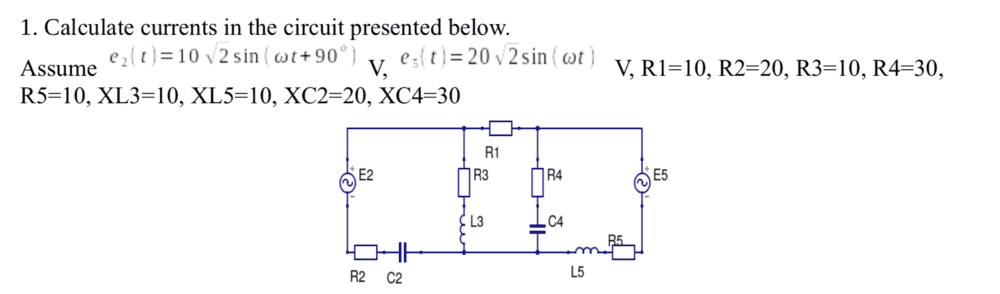
SUMMARY
The discussion focuses on converting time-domain signals to the phasor domain in AC circuits, specifically addressing the conversion of e2 and e5 to their phasor forms, e2 = j10 and e5 = 20. The "j" in e2 signifies the imaginary unit, essential for representing sinusoidal signals in phasor notation. Participants emphasize the importance of understanding the peak and RMS values, noting that the RMS voltage for a sine wave is calculated as Vpeak / √2. This conversion is crucial for analyzing AC circuit behavior using Kirchhoff's laws.
PREREQUISITES
- Understanding of AC circuit theory
- Familiarity with phasor representation of sinusoidal signals
- Knowledge of Kirchhoff's Current Law (KCL) and Kirchhoff's Voltage Law (KVL)
- Basic concepts of RMS and peak voltage calculations
NEXT STEPS
- Study the phasor representation of sinusoidal signals in depth
- Learn about Kirchhoff's Current Law (KCL) and Kirchhoff's Voltage Law (KVL) applications in AC circuits
- Explore the calculation of RMS voltage from peak voltage in AC systems
- Review the relationship between time-domain and phasor-domain representations in electrical engineering
USEFUL FOR
Electrical engineering students, circuit designers, and professionals working with AC circuit analysis and phasor transformations.