Investigating Why a Century AC Motor's Label Shows 1625 RPM

  • Thread starter Thread starter souky101
  • Start date Start date
  • Tags Tags
    Ac Rpm
Click For Summary
SUMMARY

The Century AC motor in question is a ¼ HP, 115 V, 60 Hz Permanent Split Capacitor (PSC) motor with 4 poles, leading to a theoretical synchronous speed of 1800 RPM. However, the motor label indicates an actual running speed of 1625 RPM due to slip, which is typical for induction motors. This motor is designed for applications requiring a 10% slip at full load, indicating lower efficiency compared to more efficient motors that exhibit only 5% slip. The discrepancy between synchronous and actual speed is a result of rotor resistance and the need for slip in induction motors to function effectively.

PREREQUISITES
  • Understanding of AC induction motor principles
  • Familiarity with synchronous speed calculations
  • Knowledge of rotor resistance and slip in motors
  • Basic electrical concepts related to voltage and frequency
NEXT STEPS
  • Research "Induction motor slip and efficiency" to understand performance metrics
  • Learn about "Torque-slip curves in AC motors" for deeper insights into motor behavior
  • Explore "Permanent Split Capacitor (PSC) motor applications" for practical uses
  • Investigate "Motor nameplate specifications" to interpret performance ratings
USEFUL FOR

Electrical engineers, motor technicians, and anyone involved in the design or maintenance of AC induction motors will benefit from this discussion.

souky101
Messages
21
Reaction score
1
TL;DR
AC motor RPM
Hi great folk

I have a Century AC motor which is ¼ HP, 115 V, 60 HZ

This is a Permanent Split Capacitor (PSC) motor

It has 4 poles, so the running speed according to the motor equation should be:

.

Speed = 120x60 / p …………….. Where P = number of poles

Therefore RPM = 120 X 60 / 4 = 1800

.

My question now is why the motor label shows 1625 RPM and no 1800

.

Thanks for your investigation in advance
 
Engineering news on Phys.org
souky101 said:
Summary: AC motor RPM

Hi great folk

I have a Century AC motor which is ¼ HP, 115 V, 60 HZ

This is a Permanent Split Capacitor (PSC) motor

It has 4 poles, so the running speed according to the motor equation should be:

.

Speed = 120x60 / p …………….. Where P = number of poles

Therefore RPM = 120 X 60 / 4 = 1800

.

My question now is why the motor label shows 1625 RPM and no 1800

.

Thanks for your investigation in advance
You used 120 V, whereas the motor's running speed was calculated from 115 V.
 
  • Like
Likes   Reactions: dlgoff
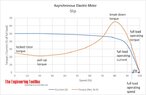
Your motor is an AC induction motor. The synchronous speed is the 1800 RPM that you correctly calculated. Induction motors run slower than synchronous speed. The difference between the synchronous speed and the actual speed induces currents in the rotor. Those currents create a rotor magnetic field that works with the stator magnetic field to make the rotor turn. The magnitude of the rotor currents, and thus the strength of the rotor magnetic field, is proportional to the speed difference between the rotor and stator, and also to the rotor resistance.

The motor nameplate RPM is the RPM at which the motor develops full rated power. That same motor, with nothing attached to the shaft, will turn about 1798 RPM. Your motor has a high resistance rotor, so is designed for applications where it needs to run at less than rated speed. Such applications include high inertia loads and certain adjustable speed applications such as furnace blowers. It is a low efficiency motor. Most 1800 RPM induction motor have a full load speed near 1725 to 1750 RPM, and have higher efficiency.
 
  • Like
Likes   Reactions: Babadag and Tom.G
souky101 said:
My question now is why the motor label shows 1625 RPM and no 1800.
jrmichler is correct.
Your motor is a low-power induction motor. It is designed to have 10% slip at full load, which suggests it is inefficient, light-weight, and low-cost.
A more efficient small motor would have only about 5% slip at full load. Bigger industrial motors will slip between 1% and 2%.
 
  • Like
Likes   Reactions: Babadag, russ_watters and Tom.G
Mark44 said:
You used 120 V, whereas the motor's running speed was calculated from 115 V.
Voltage has nothing to do with it, within reason. The OP's math came up with a synchronous speed that is correct but only by accident. But the math should be: (frequency * 60) / number of pole pairs.
-
Of course as others have pointed out, slip is required for an induction motor to work so the actual speed will be less.
 
  • Like
Likes   Reactions: Baluncore
Averagesupernova said:
Voltage has nothing to do with it, within reason.
Correct, but to state it better: changing voltage changes the torque-slip curve. However, nameplate values are not variable; rated voltage; rated frequency; max power and speed at max power.
 
anorlunda said:
However, nameplate values are not variable...
I've never seen a three phase motor that lists a range of voltages other than 208-240 and of course the high volt connection of 460. But, those voltages are moved around all the time with variable frequency drives.
 
The 1800 rpm it is what is called synchronous speed and that is-approximate- the no-load speed-but if it is loaded 1/4 hp a slip will occur then s=(1800-1625)/1800=9.7% [it is very large in my opinion but still possible]
For instance a manufacturer presents in his catalogue for General purpose aluminum motors 460 V 60 Hz and 0.2 hp 1660 rated rpm. (1800-1660)/1800=7.78%
 

Attachments

  • INDUCTION MOTOR SLIP.jpg
    INDUCTION MOTOR SLIP.jpg
    31 KB · Views: 147

Similar threads

Replies
4
Views
2K
Replies
1
Views
7K
  • · Replies 4 ·
Replies
4
Views
17K
  • · Replies 7 ·
Replies
7
Views
3K
  • · Replies 10 ·
Replies
10
Views
5K
Replies
3
Views
7K
  • · Replies 5 ·
Replies
5
Views
4K
  • · Replies 2 ·
Replies
2
Views
3K
  • · Replies 18 ·
Replies
18
Views
35K
  • · Replies 20 ·
Replies
20
Views
41K