Achieving Rotational Symmetry with Tetrahedral Universal Joints

  • Context: High School 
  • Thread starter Thread starter DaveC426913
  • Start date Start date
  • Tags Tags
    Symmetry
Click For Summary
SUMMARY

The forum discussion centers on the challenges of achieving rotational symmetry in a widget utilizing tetrahedral universal joints. The user aims for a configuration where the arrangement remains identical regardless of the tetrahedron's orientation, but acknowledges that true symmetry is unattainable due to the inherent biases introduced by the bars attached at each vertex. The conversation delves into the mathematical principles of tetrahedral symmetry, highlighting the limitations of achieving both rotational and mirror symmetry. Suggestions include exploring alternative joint configurations and utilizing 3D printing for prototyping components.

PREREQUISITES
  • Understanding of tetrahedral geometry and symmetry
  • Familiarity with universal joints and their mechanical properties
  • Basic knowledge of rotational transformations and permutations
  • Experience with 3D printing technologies and prototyping
NEXT STEPS
  • Research the mathematical principles of tetrahedral symmetry and permutations
  • Explore alternative joint designs, such as ball joints, for improved flexibility
  • Investigate 3D printing techniques for creating complex joint structures
  • Learn about control systems for remotely manipulating joint configurations
USEFUL FOR

Engineers, designers, and hobbyists involved in robotics, mechanical design, or any project requiring advanced joint configurations and symmetry in three-dimensional structures.

DaveC426913
Gold Member
2025 Award
Messages
24,258
Reaction score
8,382
I'm building a widget that requires tetrahedral arrangement of universal joints.
Currently, I'm only concerning myself with half of the u-joint - the half attached at the tetrahedron. (essentially just the one bar)

I want the arrangement of the U-joints to be as symmetrical as possible around the tetrahedron. i.e. you should be able to rotate the 'tet' about any of its axes and end up with the exact same configuration, or if you rolled it like a die, you could not tell which of the four faces were up, since they're identical.

This is not actually possible.

Here is a tetrahedron with four bars attached:
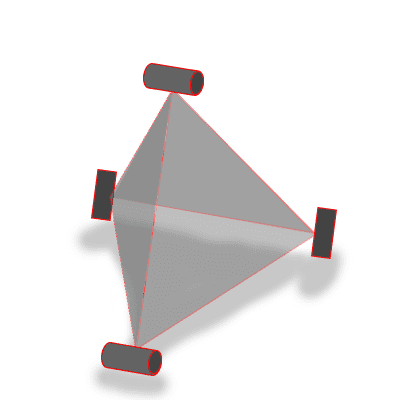
tetroid.png


I can rotate the 'tet' but I will not always get the same orientation of bars. It is sitting on one horizontal bar at the front and two vertical bars at the rear. If I were to rotate the tet 120 degrees, it would have a vertical bar at the front, thus I would be able to tell which face is toward me. It has a bias.

While I can't have true symmetry, I wonder if it is possible to least attain some rotational symmetry. That would give the tet a chiral bias, (clockwise would not be the same as CCW) but at least it would have some symmetry.

I'm not sure how to work this out, or, if it can't be done, why not. What am I encountering here that a highly symmetric object (a tetrahedron, or simply four point on a sphere) is broken by the addition of a bar at each vertex?
 
Last edited:
Physics news on Phys.org
You can have symmetry under mirroring the object, it should be clear how. You can also get a symmetry under some but not all orientations, and your object shows one of the only two possible arrangements already.

Tetrahedral symmetry is equivalent to permutation of 4 objects (e. g. the 4 vertices), with 24 elements. 12 of them have positive parity, 12 of them negative parity, and mirroring translates between the groups while rotations are transformations within the groups.

Starting from one orientation: Draw an axis through one vertex and the boxy center, rotate by 120 or 240 degrees with respect to this. 4 choices for the axis and 2 angles means you can reach 8 other states that way. As you rotate the bar at the rotation axis, none of these rotations will keep the orientation of all bars correct. This corresponds to permutations where one number is mapped onto itself while the other three form a cycle.

Draw an axis going through the center of an edge and the body center (and another center of an edge), rotate by 180 degrees. There are three choices for the axis. This can be a symmetry.

Pick one one of the axes and look at the two selected edges: you can let both "tet" point along this axis, or orthogonal to it (your picture shows the orthogonal case). Both cases lead to an 8-fold symmetry, using the second rotation process and mirroring. This is the maximal symmetry you can get. Any other orientation can keep the rotational symmetry but will break the mirror symmetry.
 
  • Like
Likes   Reactions: QuantumQuest
Can you explain more about the "scope of work" of this widget?

Is it that there is a real tet involved or just a geometric tet orientation?

Why not mount the shafts radially?

Maybe draw or describe the shaft rotations required... I'm not seeing why the shafts you show are attached in those locations and orientations... as "driven" shafts they appear to be able to rotate about their longitudinal axis but since they are just half of the u-joint they don't themselves have any degrees of freedom except rotation (they are fixed shafts). In that case, why mount on the points rather than the faces? In the former case, I can see why the mountings would be on the points, the tet shafts (bars) fixed radially so that the distal shafts of the u-joints could bend further than 90 degrees from their radial axes (not constrained to about 90 degrees if face mounted). But your point mount shafts are half u-joints without couplers... are they attached firmly or loosely (are you allowing them to yaw and pitch and spin in any direction already)?

The tet structure prevents rotation unless some non-driven joints themselves are allowed to make orbital translation motions about the tet or the coupling for the joints allow disengagement... translation would have the distal connecting parts to the rest of the system swinging around wildly and decoupling would make them stop functioning as u-joints.
 
Schlegel_wireframe_8-cell.png
bahamagreen said:
Is it that there is a real tet involved or just a geometric tet orientation?
No. Ideally, I want a magical zero-dimensional point from which four posts emanate that can tilt in any direction by a large angle (see below).

bahamagreen said:
Why not mount the shafts radially?
They're not shafts; they're bars about which a universal joint will rotate. The post is on the other end of the u-joint. So it can be tilted in any direction.

Here is a structure that accomplishes the same thing, but using ball joints instead of universal joints.
capture 12.PNG

This would be ideal but it does not work. The degree of freedom is insufficient. (If you look carefully at the posts, you can see they intersect the ball, meaning this is an impossible configuration to achieve physically)

The angle of freedom must be such that three posts can all be 90 degrees from each other (i.e. the corner of a cube) while the fourth post points inward (not outward).

As some members are already aware, I'm building a tesseract. You will find other posts of mine scattered about PF over the years.

Schlegel_wireframe_8-cell.png
 
mfb said:
Starting from one orientation: Draw an axis through one vertex and the boxy center, rotate by 120 or 240 degrees with respect to this. 4 choices for the axis and 2 angles means you can reach 8 other states that way. As you rotate the bar at the rotation axis, none of these rotations will keep the orientation of all bars correct. This corresponds to permutations where one number is mapped onto itself while the other three form a cycle.

Draw an axis going through the center of an edge and the body center (and another center of an edge), rotate by 180 degrees. There are three choices for the axis. This can be a symmetry.

Pick one one of the axes and look at the two selected edges: you can let both "tet" point along this axis, or orthogonal to it (your picture shows the orthogonal case). Both cases lead to an 8-fold symmetry, using the second rotation process and mirroring. This is the maximal symmetry you can get. Any other orientation can keep the rotational symmetry but will break the mirror symmetry.
Thanks. I will try this ... and soon as I can ... decipher it with a sketchpad. :eek:
 
Not sure if this helps, but just thinking outside the box, if I was going to do this:

- the edges would be elastic strings inside rigid telescopic tubes
- the tubes would grasp the elastic at the end of each tube
- some way that the four-way elastic knots (vertices) would have sufficient degrees of freedom
- the tubes would have worm gears to manipulate their lengths (stretching the internal elastic)
- the individual worm gear stepping motors would be controlled by radio telemetry
- 32 channels (one for each edge length) would control edge lengths
- there is program code already that simulates the geometry of rotations of tesseracts that might be utilized for configuration control
- a computer application that controls the 32 channels of radio control hobby gear

The soft spot in all this does seem to be the four-way vertices... have you considered something like spherical magnets as vertices, with the intersecting edges (thin rods) presenting concave ends?
 
bahamagreen said:
Not sure if this helps, but just thinking outside the box, if I was going to do this:

- the edges would be elastic strings inside rigid telescopic tubes
- the tubes would grasp the elastic at the end of each tube
Like this guy does:
100_1345.jpg


bahamagreen said:
- some way that the four-way elastic knots (vertices) would have sufficient degrees of freedom
Indeed. A central problem.

bahamagreen said:
- the tubes would have worm gears to manipulate their lengths (stretching the internal elastic)
- the individual worm gear stepping motors would be controlled by radio telemetry
My current version is manually-manipulated. Future versions will use stepper motors...

bahamagreen said:
- 32 channels (one for each edge length) would control edge lengths
- there is program code already that simulates the geometry of rotations of tesseracts that might be utilized for configuration control
- a computer application that controls the 32 channels of radio control hobby gear
... and remote control.

bahamagreen said:
The soft spot in all this does seem to be the four-way vertices... have you considered something like spherical magnets as vertices, with the intersecting edges (thin rods) presenting concave ends?
Indeed I have.
I have a set of neodymium mags and a large ball bearing for that purpose.
If my ball joints don't pan out, I may have to fall back to the magnetic joints.
The only problem so far is that, when the jounts are flexed, the neodyms tend to like to stick together along their edges.
 
Is there another thread where folks are following status on your progress?
 
  • #10
Just whipped up a sketch of a joint as 4 universal-joints.
u-joint.png
 
  • #11
The ball looks like the placement of the receiving holes for the post pin pairs might be in a tetrahedral orientation (if there are four holes) or might be in a mutually orthogonal antipodal orientation (if there are six holes)... hard to tell which, but I think both are incorrect. Doesn't each ball only need four holes to mate the joint frame to an individual post and don't those four holes need to comprise two antipodal pairs orthogonal in one plane through the center of the ball? The ball is the only object in the diagram that is shaded, so I'm guessing it was brought in from a subsequent work and the holes indicated are an incorrect artifact?

3D printing in your plans?
 
  • #12
bahamagreen said:
The ball looks like the placement of the receiving holes for the post pin pairs might be in a tetrahedral orientation (if there are four holes) or might be in a mutually orthogonal antipodal orientation (if there are six holes)... hard to tell which, but I think both are incorrect.
Doesn't each ball only need four holes to mate the joint frame to an individual post and don't those four holes need to comprise two antipodal pairs orthogonal in one plane through the center of the ball?
Yes. The ball only needs 4 holes. 2 pairs of antipodals. No harm in making all 6 though.

bahamagreen said:
The ball is the only object in the diagram that is shaded, so I'm guessing it was brought in from a subsequent work and the holes indicated are an incorrect artifact?
Actually, the whole thing was whipped up on Photoshop in less than an hour. So all measurement and placements are by eye. It's just a sketch, not a blueprint.

bahamagreen said:
3D printing in your plans?
As a matter of fact, I just got my first prototypes back from shapeways.com a few days ago.

This project was started before the advent of cost-effective 3D printing services. My prototype telescoping posts were all painstakingly built out of brass hobby tubing - either soldered or epoxied.

But I never had a satisfactory solution for the ball joints - certainly not one that could be feasibly constructed by hand. That was what finally drove me to 3D printing. It's opened up a world of possibilities for me.
 

Similar threads

  • · Replies 1 ·
Replies
1
Views
3K
  • · Replies 2 ·
Replies
2
Views
2K
Replies
1
Views
2K
  • · Replies 7 ·
Replies
7
Views
2K
  • · Replies 2 ·
Replies
2
Views
2K
Replies
2
Views
2K
  • · Replies 3 ·
Replies
3
Views
2K
  • · Replies 13 ·
Replies
13
Views
2K
Replies
22
Views
2K
  • · Replies 8 ·
Replies
8
Views
10K