Addressing Load Performance in Sensored BLDC Motors

Click For Summary
Sensored BLDC motors are experiencing issues with load performance during downward movement, as they fail to maintain the desired velocity and allow the load to descend freely. When the motors rotate downward, they act as generators, which can lead to a lack of braking torque proportional to the load. To address this, a 4-quadrant drive for regenerative braking or a dynamic brake circuit may be necessary to manage the load effectively. Short-circuiting the terminals can provide braking torque but lacks control. Implementing these solutions can enhance the motor's ability to handle high loads during downward motion.
tirupoti
Messages
1
Reaction score
0
Hi,
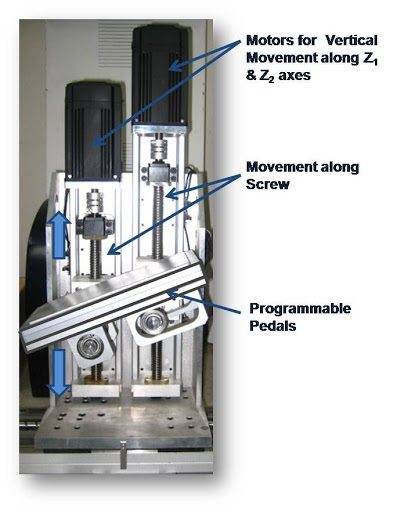
I am using Sensored BLDC motors for some robotic movements. I am driving my motors using motor drivers. I am using ball screw mechanism for lifting a pedal up and down. On the pedal, there will be always a very high load, placed on it.

Now, my motor can lift up the pedal with my desired speed accurately but while going downward, the pedal just goes down freely overcoming the output speed of the motor.
Picture1.jpg


In summery I would like to say, when the motors are on downward rotation, they can’t hold the weight of the load and fail to conform to the desired downward velocity; instead they just let the pedal goes down freely until it reaches the lower threshold.


If you have any questions please let me know

thanks in advance
 
Engineering news on Phys.org
If the motors were standard brushed dc motors, there are two ways they can be connected; series connected (stator in series with armature), and shunt connected (stator in parallel with armature). I believe connecting them in shunt mode, with a voltage applied to the stator and a load (or short) connected to armature, the motor will act as a brake.

If the motor is a brushless dc motor (BLDC) with a permanent magnet rotor, then shorting the stator MAY cause the motor to act like a brake, depending on details of driver circuit. The cogging in BLDC motors may hold depending on load, but it may creep. The stator WILL act as a brake if the stator windings can be excited at a dc voltage, without commutation.
 
Going down, your machine is acting as a generator. It will have retarding toque in proportion to the load seen at the electrical terminals. This means you need either a 4-quadrant drive for regenerative braking, or a dynamic brake circuit which essentially puts a resistor across the terminals, and the heating is the load. Short-circuiting the terminals makes braking torque during rotation, but it is not controllable.
 
Had my central air system checked when it sortta wasn't working. I guess I hadn't replaced the filter. Guy suggested I might want to get a UV filter accessory. He said it would "kill bugs and particulates". I know UV can kill the former, not sure how he thinks it's gonna murder the latter. Now I'm finding out there's more than one type of UV filter: one for the air flow and one for the coil. He was suggesting we might get one for the air flow, but now we'll have to change the bulb...

Similar threads

Replies
6
Views
4K
  • · Replies 2 ·
Replies
2
Views
5K
Replies
11
Views
2K
Replies
21
Views
8K
  • · Replies 4 ·
Replies
4
Views
2K
Replies
1
Views
2K
  • · Replies 7 ·
Replies
7
Views
5K
Replies
6
Views
4K
Replies
5
Views
2K
  • · Replies 4 ·
Replies
4
Views
3K