msdavid
- 1
- 0
[The subject should say "adjusting center of mass"]
Hello, I am trying to make a machine that "pairs" two object's center of mass and weight. I was trying to figure this out myself but with barely primary school completed, I obviously could not figure it out. Any help is very much appreciated.
Please feel free to redirect me if this is not the appropriate forum for such question.
Consider this figure:
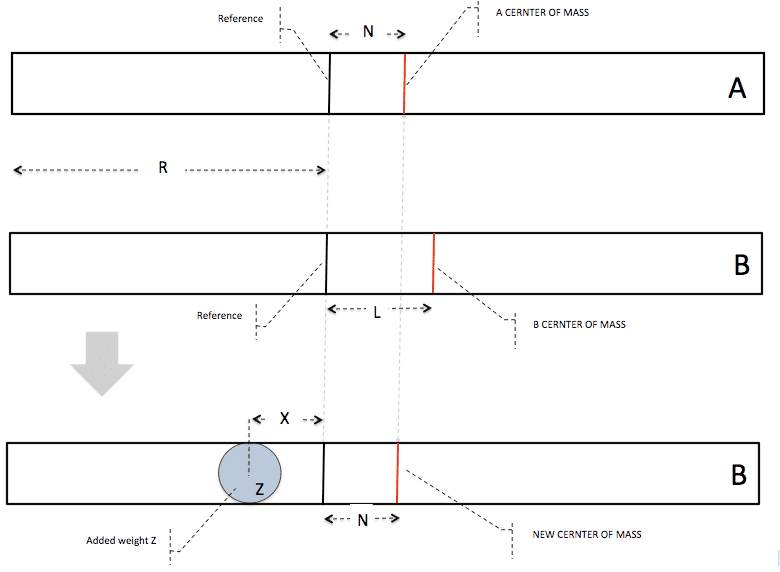 Both objects A and B are exactly same length but unknown. (same dimensions)
R is a reference unknown distance but matches the position in both objects
The red lines represent the center of mass of each object
N is known
L is know
The weight of each object is also known.
I want to find out how much wight should be added and at what distance from the reference should be placed to make both objects match their weight and center of mass.
Example:
A and B = equal dimensions (unknown)
R = set at exactly same distance in both objects
Weight of A = 90 grams
Weight of B = 80 grams
N distance = 10 millimeters
L distance = 20 millimeters
I would like to find out a formula to calculate X ( distance from the reference) and Z( weight of the added mass) to end up with both objects having the same weight and center of mass.
Any help would be great.
Thank you in advance.
Hello, I am trying to make a machine that "pairs" two object's center of mass and weight. I was trying to figure this out myself but with barely primary school completed, I obviously could not figure it out. Any help is very much appreciated.
Please feel free to redirect me if this is not the appropriate forum for such question.
Consider this figure:
R is a reference unknown distance but matches the position in both objects
The red lines represent the center of mass of each object
N is known
L is know
The weight of each object is also known.
I want to find out how much wight should be added and at what distance from the reference should be placed to make both objects match their weight and center of mass.
Example:
A and B = equal dimensions (unknown)
R = set at exactly same distance in both objects
Weight of A = 90 grams
Weight of B = 80 grams
N distance = 10 millimeters
L distance = 20 millimeters
I would like to find out a formula to calculate X ( distance from the reference) and Z( weight of the added mass) to end up with both objects having the same weight and center of mass.
Any help would be great.
Thank you in advance.
Attachments

Last edited: