hob63
- 1
- 0
For a symmetrical wing (NACA 0012 - due to wide data avaialble) at 0 deg inclination the following Cp to x/c relationship exists:

The upper and lower surfaces produce the same Cp and hence a symmetric wing with no inclination doesn't produce a result force (i'm happy with this).
Now at an inclination angle (10 deg) the following happens:
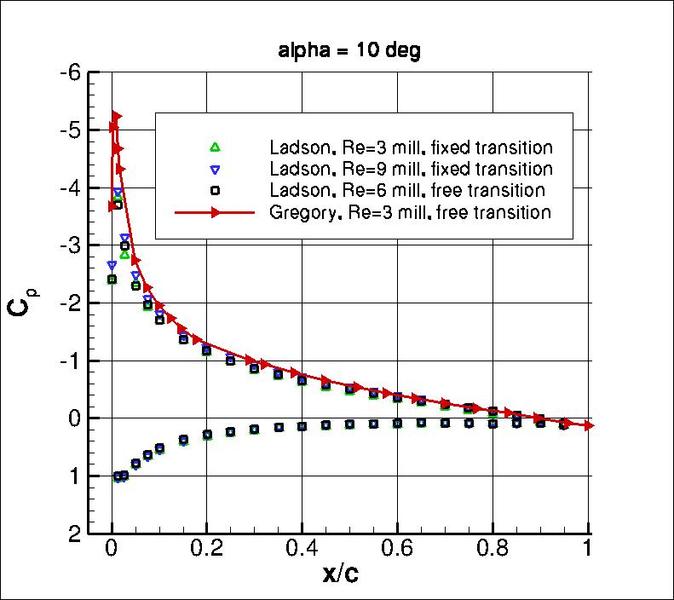
My question is for the lower surface we have Cp = 1.0 (stagnation point, this is ok), however, this decays to freestream (Cp = 0) close to trailing edge.
Is the lower surface actually an unfavourable pressure gradient? it is a symmetric wing and so I have a hard time seeing the lower as unfavourable (in terms of geometry). Why is it that curving upwards = favourable pressure gradient and curving downwards = unfavourable pressure gradient? there is a small contribution (ρg(Δh)) in terms of pressure due to the actual height, is it simply due to this? Or is it that the stagnation points dominates the lower flow resulting in a high->low gradient and thus an unfavourable gradient (not resulting from the actual geometry but due to the location of the stagnation point).
Cheers for any help :)
The upper and lower surfaces produce the same Cp and hence a symmetric wing with no inclination doesn't produce a result force (i'm happy with this).
Now at an inclination angle (10 deg) the following happens:
My question is for the lower surface we have Cp = 1.0 (stagnation point, this is ok), however, this decays to freestream (Cp = 0) close to trailing edge.
Is the lower surface actually an unfavourable pressure gradient? it is a symmetric wing and so I have a hard time seeing the lower as unfavourable (in terms of geometry). Why is it that curving upwards = favourable pressure gradient and curving downwards = unfavourable pressure gradient? there is a small contribution (ρg(Δh)) in terms of pressure due to the actual height, is it simply due to this? Or is it that the stagnation points dominates the lower flow resulting in a high->low gradient and thus an unfavourable gradient (not resulting from the actual geometry but due to the location of the stagnation point).
Cheers for any help :)