Aerodynamics vs pressure Gradient

Click For Summary

Discussion Overview

The discussion revolves around the behavior of fluid flow over a wing, particularly focusing on the pressure gradients and streamline patterns observed at the trailing edge of the wing. Participants explore concepts related to static pressure (SP), total pressure (TP), and dynamic pressure (DP), as well as the implications of flow separation and stagnation in aerodynamics.

Discussion Character

  • Exploratory
  • Technical explanation
  • Debate/contested

Main Points Raised

  • One participant questions the behavior of flow rejoining at the trailing edge, suggesting that static pressure above the flow should equal total pressure due to stagnation, while below the wing, the dynamic pressure is high due to fast-moving fluid.
  • Another participant seeks clarification on the definitions of static pressure, total pressure, and dynamic pressure used in the discussion.
  • A participant draws an analogy with a fire hose, proposing that the static pressure should increase as the fluid exits into atmospheric pressure, expecting lower pressure streamlines to converge past the trailing edge instead of spreading into higher pressure zones.
  • Another participant counters that the flow above the control surface is not stagnated and may contain significant vorticity, suggesting that the flow could be moving in unexpected ways, including potentially upstream in some areas.
  • This participant also challenges the analogy with the fire hose, stating that there is no inherent reason for the stream to narrow and emphasizes that the pressure dynamics below the wing should not lead to negative lift unless the wing is stalled.
  • They propose that the observed flow characteristics may indicate that the airfoil is stalled, leading to altered streamline behavior at the trailing edge.

Areas of Agreement / Disagreement

Participants express differing views on the behavior of the flow and pressure dynamics around the wing, with no consensus reached on the implications of the observed flow patterns or the validity of the analogies used.

Contextual Notes

The discussion includes assumptions about flow behavior, pressure definitions, and the effects of flow separation that remain unresolved. The complexity of the flow dynamics, particularly within the separation bubble, is acknowledged but not fully explored.

Tom79Tom
Messages
45
Reaction score
3
Could someone explain the image we see below of a fully separated and stagnated flow over a wing
if we were to focus on where the flows rejoin on the trailing edge we see above a fully stagnated flow DP=0
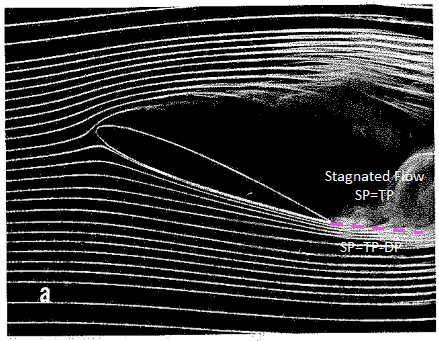
upload_2016-4-13_11-27-30.png

The static pressure here in the boundary layer above where the flows rejoin should be equal to the total pressure as there is no flow
SP=TP-0
Below we have a fast moving fluid with high DP as evidenced by tight streamlines
SP=TP-DP
If we were to draw a control surface line (pink line) parallel to the streamlines we have a Static Pressure gradient towards the higher speed lower pressure bottom flow
The image however shows the streamlines crossing the control surface into the higher pressure zone
How is this so
Is this the Kutta condition where SP at the trailing edge (where the flow rejoins) is stagnated therefore equal
If so we are seeing the diffusion (of the bottom flows) higher momentum towards the lower momentum area
If so shouldn't this be only at the stagnation point and further afield the pressure gradient would dominate ? We do see this as the lower streamlines actually become tighter past the trailing edge ?
 
Physics news on Phys.org
What exactly are you defining as SP, TP and DP? I am just trying to make sure I am clear on your terminology.
 
Hi Thanks for the reply SP= static pressure TP=Total Pressure DP= Total Pressure
To explain further I am trying to understand this in comparison to what we see in a fire hose
When the velocity of the fluid in the nozzle accelerates its static pressure drops as the rigid vessel pushes back equally to the force of the fluid it when it enters the atmospheric pressure the parcel actually experiences a increase in the static pressure pushing upon it and is squeezed narrower- further speeding up the fluid parcel
upload_2016-4-13_13-35-20.png

Applying this example I would expect to see the lower pressure/higher velocity streamlines below the wing converge past the trailing edge (being squeezed by the region of higher pressure stagnated flow above ) not spread out into the higher pressure zone as the original picture seems to indicate ?

What am I missing ?
 

Attachments

  • upload_2016-4-13_13-32-0.png
    upload_2016-4-13_13-32-0.png
    51.1 KB · Views: 573
Well, the flow above your control surface isn't stagnated, for one. That flow is absolutely moving. Inside that separation bubble, there is a large amount of vorticity, so it actually likely to be moving quite a bit and very well may have a very low pressure, which would explain why the flow starts to bend up at the trailing edge like that. We can't really see what is occurring inside that separation bubble, so it is difficult to make any real conclusions, but it is even possible that the flow is locally moving upstream (relative to the free stream) in some locations, which would create a whole lot of shear and could also help bend the streamlines upward.

Also, in a fire hose there is no reason for the stream to narrow like that. Generally speaking, with an incompressible jet, the outlet pressure is equal to the ambient pressure (atmospheric in this case).

Also also, if the pressure below a wing is lower than on top, the plane would fall from the sky. It would have negative lift. Now, they could be lower in pressure in the image you linked because of the huge separation region, so the wing is quite likely to be stalled at that point, but in general you shouldn't see faster, lower-pressure flow underneath. In fact, based on the streamlines, I would guess this particular airfoil is stalled and generating negative lift right now.

In this case, I would say it is simply most likely that the pressure below is still higher than in the separated region but that the overall effective change in shape of the airfoil (which now incorporates effects of the separation bubble) has caused it to enter stall, so the streamlines don't angle downward anymore like they normally would leaving the trailing edge.
 
  • Like
Likes   Reactions: Tom79Tom

Similar threads

  • · Replies 48 ·
2
Replies
48
Views
6K
  • · Replies 1 ·
Replies
1
Views
2K
  • · Replies 35 ·
2
Replies
35
Views
5K
  • · Replies 8 ·
Replies
8
Views
3K
  • · Replies 1 ·
Replies
1
Views
2K
  • · Replies 20 ·
Replies
20
Views
3K
  • · Replies 3 ·
Replies
3
Views
2K
  • · Replies 1 ·
Replies
1
Views
3K
  • · Replies 3 ·
Replies
3
Views
2K
  • · Replies 15 ·
Replies
15
Views
4K