Algebraically Closed Fields

  • Context: Undergrad 
  • Thread starter Thread starter Math Amateur
  • Start date Start date
  • Tags Tags
    Closed Fields
Click For Summary

Discussion Overview

The discussion revolves around the concept of algebraically closed fields, specifically whether the definition applies to multivariate polynomial rings such as ##K[x_1, x_2, \ldots, x_n]##, in addition to univariate polynomial rings like ##K[x]##. Participants explore the implications of algebraic closure in relation to roots of polynomials in these contexts.

Discussion Character

  • Exploratory
  • Technical explanation
  • Debate/contested

Main Points Raised

  • Peter questions whether the definition of an algebraically closed field applies to multivariate polynomials, seeking clarification on how this generalizes from univariate cases.
  • Some participants suggest that if every univariate polynomial over ##K## has a root, then any multivariate polynomial ##P(x_1, \ldots, x_m)## must also have a root, based on setting other variables to zero.
  • Others argue that algebraic closure is a property of the field ##K## itself, not of the polynomial rings, and thus the question about multivariate polynomial rings may not be meaningful.
  • It is noted that ##K[x_1, x_2]## can be expressed as ##K[x_1][x_2]##, leading to the conclusion that this structure does not satisfy the conditions of algebraic closure.
  • Participants discuss the necessity of considering the quotient field of polynomial rings to address the question of algebraic closure, with examples illustrating that certain polynomials may not have roots in the field even if the field is algebraically closed.
  • There is a mention of the distinction between polynomial rings and fields, emphasizing that the algebraic closure of rings is not straightforward and requires careful consideration of their properties.

Areas of Agreement / Disagreement

Participants express differing views on whether the concept of algebraically closed fields extends to multivariate polynomials. While some find a logical connection between univariate and multivariate cases, others assert that the definition does not apply in the same way, leading to an unresolved debate on the topic.

Contextual Notes

Limitations include the dependence on definitions of algebraic closure and the nature of polynomial rings versus fields. The discussion highlights the complexity of extending properties from univariate to multivariate contexts without reaching a consensus.

Math Amateur
Gold Member
MHB
Messages
3,920
Reaction score
48
Dummit and Foote in their book Abstract Algebra give the following definition of an algebraically closed field ... ...
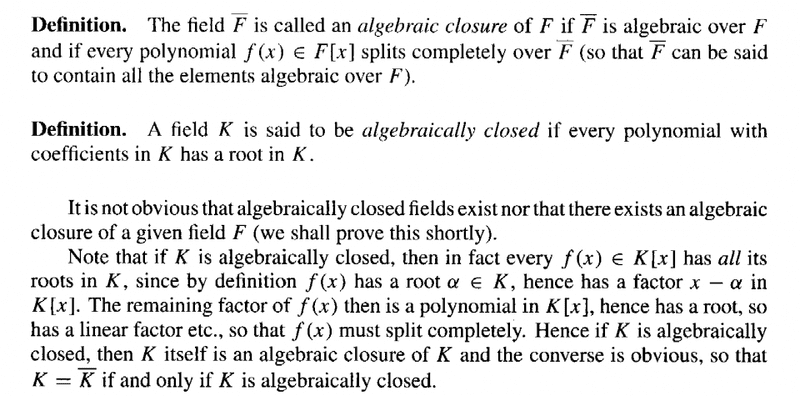
?temp_hash=ccdc0f54172a4c9db6126e8ec6b690e1.png

From the remarks following the definition it appears that the definition only applies to ##K[x]## ...

Does it also apply to ##K[x_1, x_2], K[x_1, x_2, x_3], \ ... \ ... \ , K[x_1, x_2, \ ... \ ... \ , x_n] , \ ... \ ... \ ...## ?

That is ... when we say K is an algebraically closed field does it imply that every polynomial in ##K[x_1, x_2, \ ... \ ... \ , x_n]## has a root in ##K## ... ... ?

... ... or maybe it is better if I say ... how does the definition of algebraically closed generalise to ##K[x_1, x_2, \ ... \ ... \ , x_n]## ... ... ?

Hope someone can clarify this issue ... ...

Peter
 

Attachments

  • D&F - Definition of an algebraicly closed field  ....png
    D&F - Definition of an algebraicly closed field ....png
    52.7 KB · Views: 990
Last edited:
Physics news on Phys.org
take a polynomial in x and y and set x equal to anything. then what do you have?
 
It seems to me that extending the notion to multivariate polynomials makes no difference to the field.

If every univariate polynomial over ##K## has a root, so must any multivariate polynomial ##P(x_1,...,x_m)##, since the univariate polynomial in ##x_1## that is obtained by setting all other ##x_j## to 0 will have a root ##a##, whence ##(a,0,...,0)## will be a root of ##P##.

Conversely, if every multivariate polynomial has a root then univariate polynomials must all have roots, since they are just the case where ##m=1##.

Edit: Oh, ah, er Jinx! I suppose.
 
mathwonk said:
take a polynomial in x and y and set x equal to anything. then what do you have?

Thanks for the help ... I see that if you put x equal to something, then you have a polynomial in y, which, since K is algebraically closed has a root in K ...

So we have a point ##(x, y) \in K^2## for which the polynomial is zero ...

Is that what you are getting at? ...

Peter
 
andrewkirk said:
It seems to me that extending the notion to multivariate polynomials makes no difference to the field.

If every univariate polynomial over ##K## has a root, so must any multivariate polynomial ##P(x_1,...,x_m)##, since the univariate polynomial in ##x_1## that is obtained by setting all other ##x_j## to 0 will have a root ##a##, whence ##(a,0,...,0)## will be a root of ##P##.

Conversely, if every multivariate polynomial has a root then univariate polynomials must all have roots, since they are just the case where ##m=1##.

Edit: Oh, ah, er Jinx! I suppose.
Thanks for the help, Andrew ... that appears to clarify my problem/issue ...!

Peter
 
Math Amateur said:
From the remarks following the definition it appears that the definition only applies to ##K[x]## ...
Algebraic closure is a property of the field ##K##. It means that all polynomial roots, which are per definition zeros, i.e. "numbers", are already in the field. E.g. ##\mathbb{C}## in which the additional element ##i## provides all possible polynomial zeros over the real numbers. It is not a property of the polynomial ring, so the question about multivariate polynomial rings doesn't make sense.
Does it also apply to ##K[x_1, x_2], K[x_1, x_2, x_3], \ ... \ ... \ , K[x_1, x_2, \ ... \ ... \ , x_n] , \ ... \ ... \ ...## ?
No. ##K[x_1, x_2] = K[x_1][x_2]=(K[X_1])[X_2]##. But ##(K[X_1])## is a ring and thus fails the condition of the definition.
One would have to consider its quotient field ##K(X_1)## instead, which isn't an algebraic extension over ##K## and thus again fails the definition. So to make sense at all, one has to consider ##K(X_1)## as the "starting field". But this reduces the entire question to a situation ##K' \, [X_2]## as described anyway.
So the only question which might be left is, whether the quotient field of a polynomial ring over an algebraic closed field is algebraic closed again, which is a different issue. However, ##p(y) = y^2 -x \in \mathbb{C}(x)[y]## has a root ##y=\sqrt{x}## which is not an element of ##\mathbb{C}(x)##. Hence ##\mathbb{C}(x)## is not algebraic closed although ##\mathbb{C}## is.
That is ... when we say K is an algebraically closed field does it imply that every polynomial in ##K[x_1, x_2, \ ... \ ... \ , x_n]## has a root in ##K## ... ... ?
No. ##X_1 - X_2 = 0## as polynomial in ##X_2## over ##\mathbb{C}[X_1]## has no root in ##\mathbb{C}##.
Only if you consider all variables as being replaced by elements of ##K## then you have a chance to end up in ##K##.
But this situation is not distinguishable from ##K[a_1,...,a_{n-1}][X_n] = K[X_n] ##, which is exactly the situation in the definition.

Edit : The reason for it doesn't make sense to speak of an algebraic closure of rings ##R## in general - such as polynomial rings ##R = K[X_1]## - is: Even the division, i.e. the zeros of ##a \cdot X_1 - 1 = 0## for an element ##a \in R - \{0\}## isn't a priori guaranteed. Therefore one would have to assume the existence of and pass to a quotient field of ##R## and ending up with a field again.
 
Last edited:
  • Like
Likes   Reactions: Math Amateur
fresh_42 said:
Algebraic closure is a property of the field ##K##. It means that all polynomial roots, which are per definition zeros, i.e. "numbers", are already in the field. E.g. ##\mathbb{C}## in which the additional element ##i## provides all possible polynomial zeros over the real numbers. It is not a property of the polynomial ring, so the question about multivariate polynomial rings doesn't make sense.

No. ##K[x_1, x_2] = K[x_1][x_2]=(K[X_1])[X_2]##. But ##(K[X_1])## is a ring and thus fails the condition of the definition.
One would have to consider its quotient field ##K(X_1)## instead, which isn't an algebraic extension over ##K## and thus again fails the definition. So to make sense at all, one has to consider ##K(X_1)## as the "starting field". But this reduces the entire question to a situation ##K' \, [X_2]## as described anyway.
So the only question which might be left is, whether the quotient field of a polynomial ring over an algebraic closed field is algebraic closed again, which is a different issue. However, ##p(y) = y^2 -x \in \mathbb{C}(x)[y]## has a root ##y=\sqrt{x}## which is not an element of ##\mathbb{C}(x)##. Hence ##\mathbb{C}(x)## is not algebraic closed although ##\mathbb{C}## is.

No. ##X_1 - X_2 = 0## as polynomial in ##X_2## over ##\mathbb{C}[X_1]## has no root in ##\mathbb{C}##.
Only if you consider all variables as being replaced by elements of ##K## then you have a chance to end up in ##K##.
But this situation is not distinguishable from ##K[a_1,...,a_{n-1}][X_n] = K[X_n] ##, which is exactly the situation in the definition.

Edit : The reason for it doesn't make sense to speak of an algebraic closure of rings ##R## in general - such as polynomial rings ##R = K[X_1]## - is: Even the division, i.e. the zeros of ##a \cdot X_1 - 1 = 0## for an element ##a \in R - \{0\}## isn't a priori guaranteed. Therefore one would have to assume the existence of and pass to a quotient field of ##R## and ending up with a field again.
Thanks for the extensive help fresh_42 ... really appreciate your assistance in clarifying this matter ...

Still reflecting on what you have written ... ...

Thanks again,

Peter
 

Similar threads

  • · Replies 2 ·
Replies
2
Views
2K
  • · Replies 25 ·
Replies
25
Views
4K
  • · Replies 21 ·
Replies
21
Views
2K
  • · Replies 40 ·
2
Replies
40
Views
4K
  • · Replies 5 ·
Replies
5
Views
1K
  • · Replies 1 ·
Replies
1
Views
1K
  • · Replies 28 ·
Replies
28
Views
3K
  • · Replies 2 ·
Replies
2
Views
2K
  • · Replies 1 ·
Replies
1
Views
2K
  • · Replies 4 ·
Replies
4
Views
3K