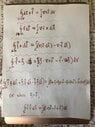
If these results are correct then they can be established by dotting one side with an arbitrary constant vector field. The aim in case of a volume integral is then to write the integrand as a divergence, and for a surface integral to write the integrand as a curl and apply the divergence theorem or Stokes' Theorem respectively. Now manipulate the result to obtain a dot product of the arbitrary constant field with an integral. You can then 'cancel' the dot product. Setting [itex]d\mathbf{S} = \mathbf{n}\,dS[/itex] where [itex]\mathbf{n}[/itex] is the outward unit normal and [itex]d\mathbf{l} = \mathbf{t}\,d\ell[/itex] where [itex]\mathbf{t}[/itex] is the unit tangent and taking advantage of the cyclic nature of the scalar triple product is also useful.
For example, to prove the first identity: Let [itex]\mathbf{c}[/itex] be an arbitrary constant vector. Then [tex]
\nabla \cdot (\mathbf{f} \times \mathbf{c}) = \mathbf{c} \cdot (\nabla \times \mathbf{f}).[/tex] Now apply the divergence theorem: [tex]
\mathbf{c} \cdot \int_V \nabla \times \mathbf{f}\,dV = \int_{\partial V} (\mathbf{f} \times \mathbf{c}) \cdot \mathbf{n}\,dS = \mathbf{c} \cdot \int_{\partial V} \mathbf{n} \times \mathbf{f}\,dS.[/tex] Hence [tex]
\mathbf{c} \cdot \left(\int_V \nabla \times \mathbf{f}\,dV - \int_{\partial V} \mathbf{n} \times \mathbf{f}\,dS\right) = 0[/tex] and since this holds for all [itex]\mathbf{c}[/itex] it holds in particular for each of the cartesian standard basis vectors, and we must have [tex]\int_V \nabla \times \mathbf{f}\,dV = \int_{\partial V} \mathbf{n} \times \mathbf{f}\,dS.[/tex]