Alternating current circuit with transformer

Click For Summary

Discussion Overview

The discussion revolves around solving a problem related to an alternating current circuit that includes a transformer. Participants explore various methods for analyzing the circuit, including the use of impedance transformation and simulations, while addressing issues with calculations and unit conversions.

Discussion Character

  • Technical explanation
  • Mathematical reasoning
  • Debate/contested

Main Points Raised

  • One participant expresses confusion about transforming the circuit to a direct current problem using the jw method and questions the approach taken with the transformer.
  • Another participant suggests using Kirchhoff's Current Law (KCL) to derive an expression for V1, but raises concerns about potential computational errors.
  • Some participants affirm that the method appears correct, but they have not verified the final substitutions.
  • Discrepancies in simulation results and calculations are noted, with one participant indicating a significant difference in the calculated and simulated values of current I1.
  • Participants discuss the importance of correctly accounting for the inner impedance in simulations and the implications of using incorrect values for Zi.
  • One participant acknowledges overcomplicating the problem and expresses gratitude for clarifications regarding the use of impedance values.
  • Concerns are raised about the educational value of simulations, with one participant arguing that they do not adequately teach the underlying principles of circuit behavior.
  • There is a discussion about the relationship between V1 and V2, with one participant confirming the correct expression for V2 and noting issues with sign errors in calculations.

Areas of Agreement / Disagreement

Participants generally agree on the methods being used, but there are multiple competing views regarding the accuracy of calculations and the implications of simulation results. The discussion remains unresolved regarding the exact values and relationships in the circuit.

Contextual Notes

Limitations include potential errors in unit conversions, assumptions about the ideal transformer, and discrepancies between simulation parameters and theoretical calculations. Some participants express uncertainty about specific values used in their calculations.

David331
Messages
31
Reaction score
1
Homework Statement
Find the voltage u(t) in the circuit.
Relevant Equations
?
Hi, I don't understand how to solve the problem below for (a).
First I transform the cirucuit to direct current problem using jw method. Now i see that U=-I2Z. Z=R2+Zc3=R2+1/jwC3=4,5+1/[j(1000)(10^-3*0,25)]. Then I use impedance transformation to get rid of the transformator(using Z0), but then I don't really know what to do. None of my lectures have shown how to actually solve such a problem with tranformators. Is the current through Z0 I1 or have I even approached the problem in a right way?
Basically what it says in swedish is that the source inner impedance is Zi and that for the Transformator N1/N2=10.
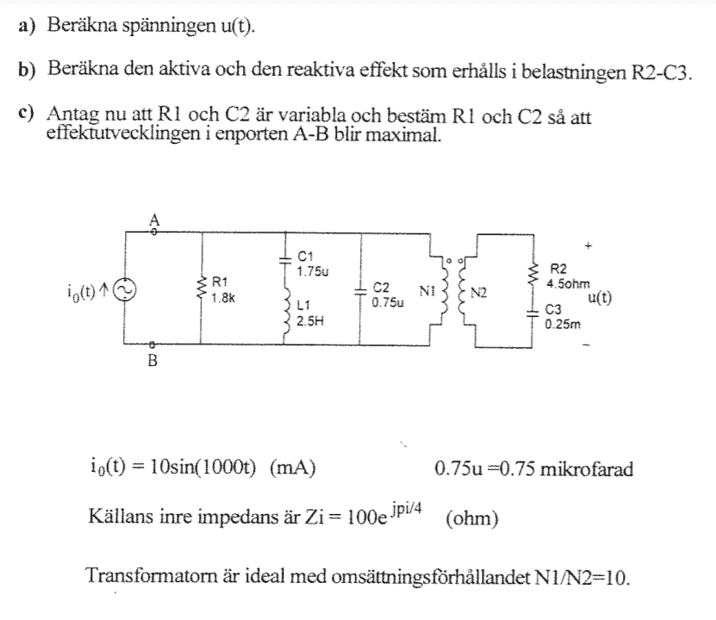
inlm 2.png
försök 1.jpg
 
Last edited:
Physics news on Phys.org
Now, continuing with this I firstly use KCL to get an expression for V1:
ny1.jpg

ny2.jpg

Is it correct or?? There are many numbers involved that can easily be computed wrong, but if the idea is correct then these wrongly made computations should not be a problem to find.
 
Your method looks good to me. The equations are OK, but I haven't checked the last page where you substituted the values.
 
Oh okay, thanks for the answer! Then it should be some errors when i substitute and compute. Because when I run it in simulator I get:
fig 2.png

Meaning that the topvalue of for example I1 is 7.4 A which is not what I get when i take the absolute value of the expression I got for I1.
 
Now I have cleaned the expressions a bit. I also noticed I forgot the inner impedance in my simulation. Now I for example get the topvalue of I1 in my simulation to 1.400... but in my calculation I get 1.5726... I have checked the computations many times, but see nothing wrong. Can anyone notice some fault?

fig 3.png

ny3.jpg
 
The problem statement shows that io(t) is in milliamperes, but you seem to used units of amperes. Where you calculated v1 you have 10 in the numerator, but it seems to me that it should be .01
Your simulation doesn't show anything labeled Zi, but it does have R3 which is not in the original circuit. Is R3 the stand-in for Zi in the simulation? If so, there are some numbers in the vicinity of R3 in the simulation schematic that I can't make out; do you have the correct value for Zi in the simulation?

My calculations get the same result as yours if I use 10 for the value of io rather than .01

Here's what I get if io = .01
ParTran.png
 
Last edited:
Yes, so here is the updated figure, with 10mA. R3 resembles Zi and I use 100 ohm, which I guess is right? And yes now I also get I2's topvalue to be 0,00157261A, but this is not the same as the simulation, maybe it is the figure that is wrong?
Skärmbild 2021-09-29 095232.png
 
You can't use a value of 100 ohms for Zi (R3) in your simulation and expect to get the same result as your calculation which uses a value for Zi of 70.7 + j 70.7.

In your calculation temporarily change Zi to 100 and see what results you get. Do the results nearly match the simulation results? In the simulation you must replace R3 with a series combination of a resistor and an inductor with values chosen so that the impedance of that combination is 70.7 + j 70.7 (at the frequency of the current source) if you want to get the same result as your calculation.
 
Now I understand, of course can I not replace 100 ohms for Zi. I guess I tried to simulate something I yet do not have enough knowledge of and overcomplicate the problem. And yes when I replace 100 ohms for 70.7+j70.7 in my expression I get almost the identical current I1. Thanks for explaining and using your time to help me! And now it is pretty straightforward to calculate u(t), if I am doing it correct:
ing (A).jpg

Does it seem right?
 
  • #10
David331 said:
I guess I tried to simulate something I yet do not have enough knowledge of and overcomplicate the problem.
This! This is exactly what I dislike about simulations. They really aren't great for teaching about how things work. They just tell you what will happen, not why.

When I have used simulators, sometimes extensively, most of the work isn't in getting the answers. The real work is in properly defining things, setting up the simulator, verifying the models are good enough, running test cases where you know the answers, etc. Then you know you can trust the answer.

This is roughly the equivalent of teaching arithmetic to an 8 year old versus giving them a calculator.
 
  • #11
David331 said:
Now I understand, of course can I not replace 100 ohms for Zi. I guess I tried to simulate something I yet do not have enough knowledge of and overcomplicate the problem. And yes when I replace 100 ohms for 70.7+j70.7 in my expression I get almost the identical current I1. Thanks for explaining and using your time to help me! And now it is pretty straightforward to calculate u(t), if I am doing it correct:
View attachment 289911
Does it seem right?
I think you have made some arithmetic mistakes, but I don't have the desire to track them down. Let's go back to post #2 where you have an expression for V1. If I replace the mistaken numerator of 10 with the correct value of .01, you get:

ParTran2.png


This is the same value I get. Since the transformer is ideal, V2 =V1/10 with appropriate sign. You can redo your calculations for the phase angle.
 
Last edited:
  • #12
I see, so V2 is the voltage on the secondary side of the transfomer. But is V2=U? Because I actually just got (when doublechecking on another calculator website) U=-0.07950...-0.005142...j which is the same as V2 for you. But with wrong signs, so there is just some wrong minus somewhere, I will check for it :)
 
  • #13
Nevermind, found the wrong sign...
 

Similar threads

  • · Replies 12 ·
Replies
12
Views
2K
  • · Replies 26 ·
Replies
26
Views
3K
  • · Replies 5 ·
Replies
5
Views
2K
  • · Replies 1 ·
Replies
1
Views
2K
  • · Replies 4 ·
Replies
4
Views
2K
  • · Replies 4 ·
Replies
4
Views
2K
  • · Replies 7 ·
Replies
7
Views
3K
  • · Replies 4 ·
Replies
4
Views
2K
Replies
1
Views
2K
  • · Replies 5 ·
Replies
5
Views
2K