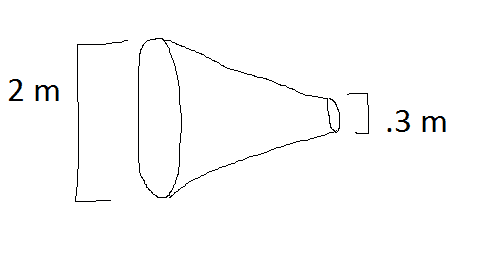
The math in the original post is wrong. If the cross section of the tube is circular, then I get about 185 m/s outlet velocity using the incompressible assumption, which is into the compressible regime. I believe the OP calculated the inlet area from the radius but forgot to half the 0.3 m to convert to radius when getting the outlet velocity. Doing that seems to reproduce the 46.2 m/s, which would fall well within the range of incompressible approximation. Using this number,, the outlet Mach number is about 0.13, so that would be fine if it was correct. However, 185 m/s equates to Mach 0.53 if you assume it to be incompressible, which is not valid.
In other words, while doing ##u_1 A_1 = u_2 A_2## is fine for incompressible flow, it won't work here because the area contracts too much. So, the analysis has to be done using the compressible equations. I did some quick calculations and if you include compressibility, the outlet velocity comes out to be about 236 m/s instead of the 185 m/s you get form an incompressible analysis, which equates to about Mach 0.71 (assuming the flow started out at 300 K). The increase in Mach number is due not only to the increase in speed, but also the decrease in ambient temperature that comes along with compressible acceleration.