Amount of energy in wind blowing through a tube

Click For Summary

Discussion Overview

The discussion revolves around calculating the velocity of air flowing through a tapered tube, starting from a wider opening. Participants explore the appropriate equations to use for both incompressible and compressible flow scenarios, considering the implications of flow speed and area changes.

Discussion Character

  • Technical explanation
  • Mathematical reasoning
  • Debate/contested

Main Points Raised

  • Some participants propose using the equation Q = v * A to calculate flow, questioning its applicability to the scenario presented.
  • Others argue that the equation is valid only for incompressible flow and may not yield accurate results for compressible fluids.
  • A participant mentions that gases can be assumed incompressible at flow speeds below a certain threshold, specifically under 100-120 m/s for air.
  • One participant suggests that compressible flow might result in higher speeds under certain idealized conditions, while acknowledging real-world factors like friction that could affect flow rates.
  • Another participant points out that once flow speed reaches the speed of sound, further increases in speed are constrained, and any mass flow rate increase would involve changes in pressure and density.
  • A participant identifies a potential error in the original calculations regarding the outlet velocity, suggesting that the correct approach involves compressible flow equations, leading to a different outlet velocity than initially calculated.
  • There is a discussion about the complexity of equations for compressible flow and the challenges of conveying this information effectively to those unfamiliar with the topic.

Areas of Agreement / Disagreement

Participants express differing views on the applicability of the incompressible flow equation and the implications of compressibility on flow speed. There is no consensus on a single correct approach, and the discussion remains unresolved regarding the best method to calculate the outlet velocity.

Contextual Notes

Participants note that the analysis may depend on specific assumptions about flow conditions, such as speed and compressibility, and that the original calculations may have overlooked certain factors like the correct conversion of dimensions.

samsterC
Messages
17
Reaction score
0
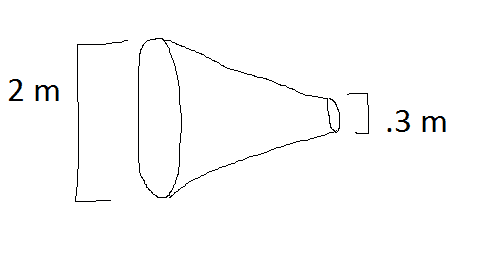
If wind was blowing through a tube at 15 kilometers an hour from an open end 2 meters wide to a tapered end only .3 meters wide how fast would the air be moving when it exits the pipe?
I'm using the equation Q = v * A (Q is flow, v is velocity and A is area of the tube opening) but is that the proper way to do it? Or should I be using a different equation?
Untitled.png
 
Physics news on Phys.org
samsterC said:
If wind was blowing through a tube at 15 kilometers an hour from an open end 2 meters wide to a tapered end only .3 meters wide how fast would the air be moving when it exits the pipe?
I'm using the equation Q = v * A (Q is flow, v is velocity and A is area of the tube opening) but is that the proper way to do it? Or should I be using a different equation?View attachment 98756
Welcome to the PF.

Is this for schoolwork?
 
Thank you, nice to be here ^-^ And no, I'm just doing this on my own and wondering if I did it right. I got that the flow of air is 13.06 meters cubed a second to solve for the first part and that because the flow remains the same the velocity of the air when it leaves the tube would have increased to 46.2 meters a second
 
But I'm not even 100% sure I'm using the correct equation
 
samsterC said:
If wind was blowing through a tube at 15 kilometers an hour from an open end 2 meters wide to a tapered end only .3 meters wide how fast would the air be moving when it exits the pipe?
I'm using the equation Q = v * A (Q is flow, v is velocity and A is area of the tube opening) but is that the proper way to do it? Or should I be using a different equation?
Hi samsterC.
aerobanner.gif


That equation is applicable to incompressible flow. If the fluid can be compressed then at the constriction it will have a lower speed than that formula gives.

I'll have to leave it to others to point you in the right direction, though.
 
NascentOxygen said:
Hi samsterC.
aerobanner.gif


That equation is applicable to incompressible flow. If the fluid can be compressed then at the constriction it will have a lower speed than that formula gives.

I'll have to leave it to others to point you in the right direction, though.

As it turns out though, gases can be assumed to be incompressible if the flow speeds involved are less than about a third of the speed of sound in the gas. For air, the speed of sound is about 340m/s, so any flow involving air moving slower than about 100-120m/s can be reasonably analyzed as an incompressible flow without much error.
 
Ok! Thanks :)
 
NascentOxygen said:
If the fluid can be compressed then at the constriction it will have a lower speed than that formula gives.
Assuming the pressure is decreased as the speed increases, then shouldn't compressible flow be faster in an idealized case? In a real world case, friction with the walls of the tube will reduce pressure further still, converting the lost energy into heat, but since mass flow is maintained, then the speed should be faster still. All of this is assuming a power source that can maintain a fixed flow rate into the tube, despite any resistance to that flow due to friction or constriction.
 
That depends on the details of the flow - to a point, you are correct, but once the speed of the flow at the constriction reaches the speed of sound, the speed cannot increase any more (and any further mass flow rate increase will be due to increasing pressure and density).
 
  • #10
The math in the original post is wrong. If the cross section of the tube is circular, then I get about 185 m/s outlet velocity using the incompressible assumption, which is into the compressible regime. I believe the OP calculated the inlet area from the radius but forgot to half the 0.3 m to convert to radius when getting the outlet velocity. Doing that seems to reproduce the 46.2 m/s, which would fall well within the range of incompressible approximation. Using this number,, the outlet Mach number is about 0.13, so that would be fine if it was correct. However, 185 m/s equates to Mach 0.53 if you assume it to be incompressible, which is not valid.

In other words, while doing ##u_1 A_1 = u_2 A_2## is fine for incompressible flow, it won't work here because the area contracts too much. So, the analysis has to be done using the compressible equations. I did some quick calculations and if you include compressibility, the outlet velocity comes out to be about 236 m/s instead of the 185 m/s you get form an incompressible analysis, which equates to about Mach 0.71 (assuming the flow started out at 300 K). The increase in Mach number is due not only to the increase in speed, but also the decrease in ambient temperature that comes along with compressible acceleration.
 
  • Like
Likes   Reactions: cjl
  • #11
Thank you for solving that for me, what is the equation you used to solve it with compressible flow so I can use it for future problems?
 
  • #12
How deep do you want to go down this rabbit hole? There isn't just one simple equation for compressible flows, and I don't generally like dumping stacks of equations on people who don't know what their background is. On the other hand, building all of that up would take a fair bit of time. I am just not really sure how to do this in a way that you actually learn this that is also time-efficient.
 

Similar threads

  • · Replies 9 ·
Replies
9
Views
4K
  • · Replies 4 ·
Replies
4
Views
2K
  • · Replies 17 ·
Replies
17
Views
10K
  • · Replies 2 ·
Replies
2
Views
1K
  • · Replies 9 ·
Replies
9
Views
2K
  • · Replies 2 ·
Replies
2
Views
2K
Replies
1
Views
2K
  • · Replies 6 ·
Replies
6
Views
2K
  • · Replies 2 ·
Replies
2
Views
3K
  • · Replies 3 ·
Replies
3
Views
2K