Amplifying Current in Monostable Circuit for Brighter LED Strip: A Solution

  • Thread starter Thread starter wavy
  • Start date Start date
  • Tags Tags
    Circuit
Click For Summary
SUMMARY

The forum discussion centers on amplifying current in a monostable circuit using a 555 timer to drive a 12V LED strip. The user initially faced dim lighting due to the 555 timer's 200mA output limitation. A solution involving the TIP31C NPN transistor was proposed to amplify the current, but the user encountered issues with the circuit configuration. Key advice included ensuring proper connections and adding a resistor in series with the transistor's base to limit current.

PREREQUISITES
  • Understanding of 555 timer operation in monostable mode
  • Basic knowledge of NPN transistor functionality, specifically TIP31C
  • Familiarity with LED strip circuitry and resistor applications
  • Ability to read and interpret circuit diagrams
NEXT STEPS
  • Research proper circuit configurations for using TIP31C with a 555 timer
  • Learn about current limiting resistors and their calculations in transistor circuits
  • Explore troubleshooting techniques for LED strip circuits
  • Study the impact of capacitor values in timing circuits with 555 timers
USEFUL FOR

Electronics enthusiasts, hobbyists building LED projects, and anyone looking to enhance their understanding of monostable circuits and transistor applications.

wavy
Messages
3
Reaction score
0
Hi,

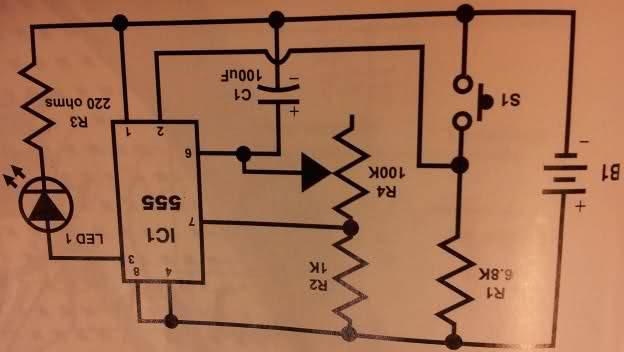
I am trying to make a Monostable circuit with my 12V LED strip. When I push the switch once, the LED strip will light up for 10 seconds and go off by itself. I have built the circuit using this schematic, the only difference is I am using a 1000uf capacitor.
309pzl2.jpg


Everything works, but the only problem I have is the 555 timer can only output 200mA, so the LED strip is very dim. I understand that I could use a TIP31C NPN transitor to amplify the current? What I did was wire the base to pin 3, the collector to the negative pin of my LED strip and the emitter to pin 1(ground). THe LED doesn't light up at all.

I am not really an expert in electronics, I hope someone can help me. Thank you.
 
Engineering news on Phys.org
Do you have the LED anode connected to the battery positive?

Also, you should place a resistor in series with the base to limit the current. The transistor BE junction is approximately a short circuit on the 555 timer output.
 
Hi uart,

Thanks for your reply. The positive is connected to the 220 resistor and to pin3. I have attached a 3D view of the circuit. The LED strips appears to have resistors on them.I'm currently blurred trying to get this to work, I will have to look at the resistor part when I solve this. Been looking for a solution for days..
 
Last edited:
wavy said:
Hi uart,

Thanks for your reply. The positive is connected to the 220 resistor and to pin3. I have attached a 3D view of the circuit. The LED strips appears to have resistors on them.

I'm currently blurred trying to get this to work, I will have to look at the resistor part when I solve this. Been looking for a solution for days..

You need to post a circuit diagram of how you actually have it connected. Otherwise this is futile.
 
Issue solved.
 
Last edited:
Most likely this can only be answered by an "old timer". I am making measurements on an uA709 op amp (metal can). I would like to calculate the frequency rolloff curves (I can measure them). I assume the compensation is via the miller effect. To do the calculations I would need to know the gain of the transistors and the effective resistance seen at the compensation terminals, not including the values I put there. Anyone know those values?

Similar threads

  • · Replies 14 ·
Replies
14
Views
2K
  • · Replies 3 ·
Replies
3
Views
2K
  • · Replies 9 ·
Replies
9
Views
2K
  • · Replies 4 ·
Replies
4
Views
2K
  • · Replies 7 ·
Replies
7
Views
19K
  • · Replies 2 ·
Replies
2
Views
2K
  • · Replies 23 ·
Replies
23
Views
4K
Replies
5
Views
2K
Replies
16
Views
3K
  • · Replies 3 ·
Replies
3
Views
3K