An infinite network (XKCD) - is it not clear?

  • Thread starter Thread starter OJFord
  • Start date Start date
  • Tags Tags
    Infinite Network
Click For Summary
SUMMARY

The discussion centers around the concept of infinite networks as depicted in the XKCD comic. Participants agree that the equivalent resistance in such a network cannot be infinite, with a maximum resistance of 1.5 Ohms due to the presence of two independent paths of three resistors. The intuitive understanding is that parallel circuits yield lower equivalent resistance than any individual branch. The complexity of visualizing infinite networks is acknowledged, yet mathematical representations exist to model them accurately.

PREREQUISITES
  • Understanding of electrical resistance and Ohm's Law
  • Familiarity with parallel and series circuits
  • Basic knowledge of mathematical concepts related to infinity
  • Ability to interpret mathematical models and equations
NEXT STEPS
  • Research the mathematical modeling of infinite networks
  • Study the principles of equivalent resistance in parallel circuits
  • Explore advanced topics in electrical engineering related to infinite resistive networks
  • Review the derivation of equivalent resistance in complex circuits
USEFUL FOR

Electrical engineers, physics students, and anyone interested in the mathematical modeling of complex networks and electrical resistance concepts.

OJFord
Messages
29
Reaction score
0
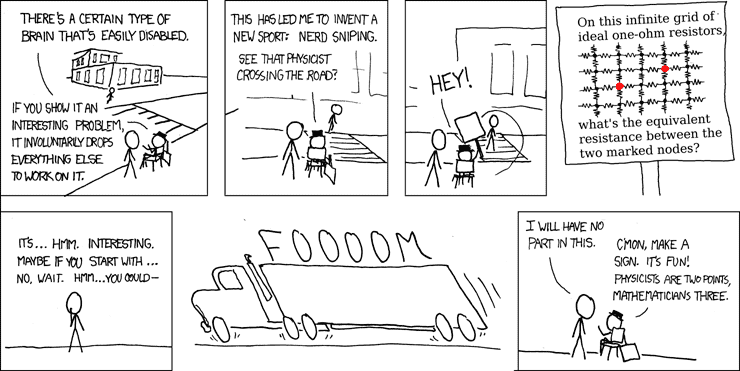
Hi, unless I'm missing something here, it seems to me that the answer is that it is infinite, and that that is pretty intuitive.

Is that not the case?
nerd_sniping.png


I would think it could be simplified to view as two parallel and infinite resistances, giving ∞2/2∞, which simplifies to half infinity, which is of course really (in as much as it is) still infinite.
 
Engineering news on Phys.org
I have no solution, but the resistance cannot be larger than 1.5 Ohm, since there are two independent paths of 3 resistors between the points. The other parallel paths can only lower the resistance. So it's definitely finite.

The forum page of this comic will no doubt contain the correct answer.
 
Last edited:
I think it is intuitive that the resistance can not be infinite.

With some hand-waving: whenever you have a parallel circuit the equivalent resistance is lower than any of the branch resistance, so the resistance between any to adjacent nodes must be less than 1 Ohm. This means you have a path between the two marked nodes as a series of three networks that can be replaced with a resistor less than 1 Ohm, totaling less than 3 Ohm.

The exact solution, I seem to remember from years back, is a bit harder to obtain. Found a derivation [1] that may be of some use (haven't read it thoroughly enough to say if it is correct or not).

[1] http://mathpages.com/home/kmath668/kmath668.htm
 
ZVdP said:
I have no solution, but the resistance cannot be larger than 1.5 Ohm, since there are two independent paths of 3 resistors between the points. The other parallel paths can only lower the resistance. So it's definitely finite.

Filip Larsen said:
I think it is intuitive that the resistance can not be infinite.

With some hand-waving: whenever you have a parallel circuit the equivalent resistance is lower than any of the branch resistance, so the resistance between any to adjacent nodes must be less than 1 Ohm.
[1] http://mathpages.com/home/kmath668/kmath668.htm


Right, that was stupid of me. Thank you both - and for the link.

I see why it was comic-worthy now, the answer is certainly not trivial!


I would say that the concept of infinity is a complex and abstract one that can be difficult to fully comprehend. In the context of a network, an infinite network would mean that the number of nodes or connections is infinite, which is not something that we can easily visualize or understand. However, mathematically, it is possible to represent an infinite network using equations and models. In the example given, the approach of simplifying it to two parallel and infinite resistances is a valid way to conceptualize it, but it is important to note that this is just one way of looking at it and there may be other ways to model an infinite network. Ultimately, the answer to whether an infinite network is clear or not depends on the perspective and understanding of the individual.
 
Most likely this can only be answered by an "old timer". I am making measurements on an uA709 op amp (metal can). I would like to calculate the frequency rolloff curves (I can measure them). I assume the compensation is via the miller effect. To do the calculations I would need to know the gain of the transistors and the effective resistance seen at the compensation terminals, not including the values I put there. Anyone know those values?

Similar threads

Replies
10
Views
3K
Replies
14
Views
2K
Replies
20
Views
4K
Replies
26
Views
1K
  • · Replies 14 ·
Replies
14
Views
3K
  • · Replies 5 ·
Replies
5
Views
2K
  • · Replies 8 ·
Replies
8
Views
2K
  • · Replies 130 ·
5
Replies
130
Views
14K
Replies
2
Views
2K
  • · Replies 15 ·
Replies
15
Views
2K