Analogue Circuits Question -- AC and DC currents through a coil

Join the discussion
Ask a follow-up here, or get your own question answered by working scientists, mathematicians and engineers — people, not an autocomplete.
Real named experts · corrections over time · the nuance an AI answer skips
7 replies · 1K views
IronaSona
Messages
38
Reaction score
7
Summary:: .

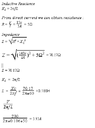
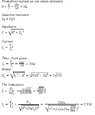
Hi ,so am currently doing homework , and was wondering if anyone could tell me if i have done my calculations correctly ,because am not 100% sure that i have answer to those 2 questions correctly .If i have went somewhere wrong if you could tell me where and how i could fix it ,that would be great. Thank you.
 

Attachments
  • 2.PNG
    2.PNG
    3.3 KB · Views: 251
  • 1.PNG
    1.PNG
    3 KB · Views: 238
Physics news on Phys.org
Your capacitive reactance answer looks good.
 
  • Like
Likes   Reactions: IronaSona
You are a bit more consistent than the examiner.
The questioner wrongly specifies lower case units, without a space; 100v, 250w, 50hz.

For units named after a person, such as Volta, Watt or Hertz;
the initial should be spaced and upper case; 100 V, 250 W, 50 Hz;
while the spelled out unit should be all lower case; 100 volt, 250 watt, 50 hertz.
 
  • Informative
  • Like
Likes   Reactions: berkeman and IronaSona
Both answers contain typos.
The answer for the capacitor case looks ok, though I haven't check the arithmetic operations.

The answer for the coil contains too many typos and inconsistencies, for example you write that ##Z=\sqrt{R^2+X_L^2}## and then later you seem to imply that ##Z=X_L##.

Please rewrite the answer for the coil.
 
Delta2 said:
Both answers contain typos.
The answer for the capacitor case looks ok, though I haven't check the arithmetic operations.

The answer for the coil contains too many typos and inconsistencies, for example you write that ##Z=\sqrt{R^2+X_L^2}## and then later you seem to imply that ##Z=X_L##.

Please rewrite the answer for the coil.
is this better ?
 

Attachments

  • 4.PNG
    4.PNG
    2.5 KB · Views: 245
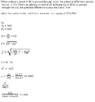
Nope you basically do the same mistake. The correct way to go is as follows:
The coil's impedance at 60hz is ##Z=\frac{140}{2}##. Use this and the equation ##Z=\sqrt{R^2+X_L^2}## to correctly determine the reactance ##X_L## at 60 hz and from that the value of L.
Then you should NOT forget the ohmic resistance of the coil when you calculate the new reactance and new impedance at 50hz
 
Delta2 said:
Nope you basically do the same mistake. The correct way to go is as follows:
The coil's impedance at 60hz is ##Z=\frac{140}{2}##. Use this and the equation ##Z=\sqrt{R^2+X_L^2}## to correctly determine the reactance ##X_L## at 60 hz and from that the value of L.
Then you should NOT forget the ohmic resistance of the coil when you calculate the new reactance and new impedance at 50hz
 

Attachments

  • 42.PNG
    42.PNG
    3.4 KB · Views: 224