Inductor Circuit Simulation: Understanding Current Rise and Voltage Output

Click For Summary
The discussion focuses on simulating an inductor circuit where the expected current rises from 0A to 500mA, with a voltage output of 5V. Participants clarify that the current should increase slowly, governed by the time constant of the circuit, calculated as L1/R1 = 10 microseconds. An equation for the inductor current is provided, confirming that the simulation results match the theoretical expectations. To observe the current rise accurately, it's suggested to zoom into the transient waveform and adjust simulation parameters, including pulse settings and stop time. Properly configuring the simulation will reveal the gradual current increase over approximately 50 microseconds.
PhysicsTest
Messages
256
Reaction score
27
TL;DR
To understand the inductor circuit.
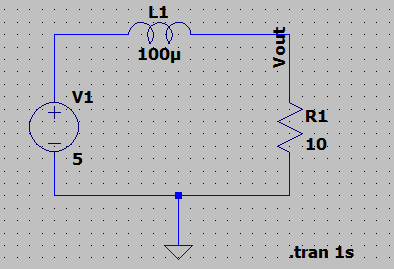
I am trying to understanding the inductor circuit. I have drawn the below circuit and try to simulate
1635602554158.png

The Inductor current comes to 500mA and Vout is 5V as per simulation. The current in inductor should slowly increase from 0A to 500mA but i cannot see that in the waveform. Is my understanding correct?
 
Engineering news on Phys.org
PhysicsTest said:
but i cannot see that in the waveform
Neither can we. What waveform ?
Do you have some equations to describe the behaviour of your circuit ?

##\ ##
 
  • Like
Likes PhysicsTest
I'm not sure about "slowly".
The time constant for this circuit is L1/R1 = 10uSec.
 
1635604571909.png

This is the output waveform i can get. Ok now i started writing the equation for the circuit.
##i(t) = \frac{V} {R} (1 - e^{\frac{-Rt} L})##
Substituting the values
##i(1) = 5/10*(1 - e^{-10^5}) ##
##i = 0.5A##. The answer is matching.
 
So zoom into the first few us of the transient waveform to see the LR time constant...
 
The DC analysis sets up 500 mA before the run.
You must use; V1 pulse; initial=0V; Von=5V; Tdelay=5usec;
and .TRAN stop time = 100 usec.
Then see the current rise over about 50 usec.
Inductor.png
 
Last edited:
  • Like
  • Informative
Likes BvU, PhysicsTest and berkeman
I am trying to understand how transferring electric from the powerplant to my house is more effective using high voltage. The suggested explanation that the current is equal to the power supply divided by the voltage, and hence higher voltage leads to lower current and as a result to a lower power loss on the conductives is very confusing me. I know that the current is determined by the voltage and the resistance, and not by a power capability - which defines a limit to the allowable...

Similar threads

  • · Replies 4 ·
Replies
4
Views
2K
  • · Replies 26 ·
Replies
26
Views
4K
  • · Replies 4 ·
Replies
4
Views
2K
  • · Replies 19 ·
Replies
19
Views
2K
  • · Replies 4 ·
Replies
4
Views
2K
  • · Replies 13 ·
Replies
13
Views
3K
  • · Replies 37 ·
2
Replies
37
Views
4K
  • · Replies 14 ·
Replies
14
Views
2K
Replies
1
Views
2K
  • · Replies 2 ·
Replies
2
Views
2K